
TL;DR: A May 2026 SAS and IDC global study of more than 1,600 SMB leaders across 28 countries found that nearly 70% of small and midsize businesses remain in the experimental or opportunistic stages of AI maturity, despite 89% of SMBs reporting AI use per Intuit's 2026 ICIC survey. The disconnect is strategic: SMBs are running tools without a data foundation, governance, or measured business outcomes. For NC small businesses, the right next move is not more pilots; it is a 90-day plan to move one or two high-value use cases out of the experimental stage and into integrated, measured production with the right data and governance underneath.
Key takeaway: Using AI is no longer a moat. Operationalizing AI with data, governance, and measured outcomes is. The NC SMBs winning in 2026 are running fewer, deeper, integrated use cases, not more pilots.
Want a 90-day AI roadmap that moves your top two use cases to production? Preferred Data Corporation runs AI transformation discovery sprints for NC small businesses. Call (336) 886-3282 or request an AI readiness review.
What does the SAS and IDC SMB AI readiness study actually say?
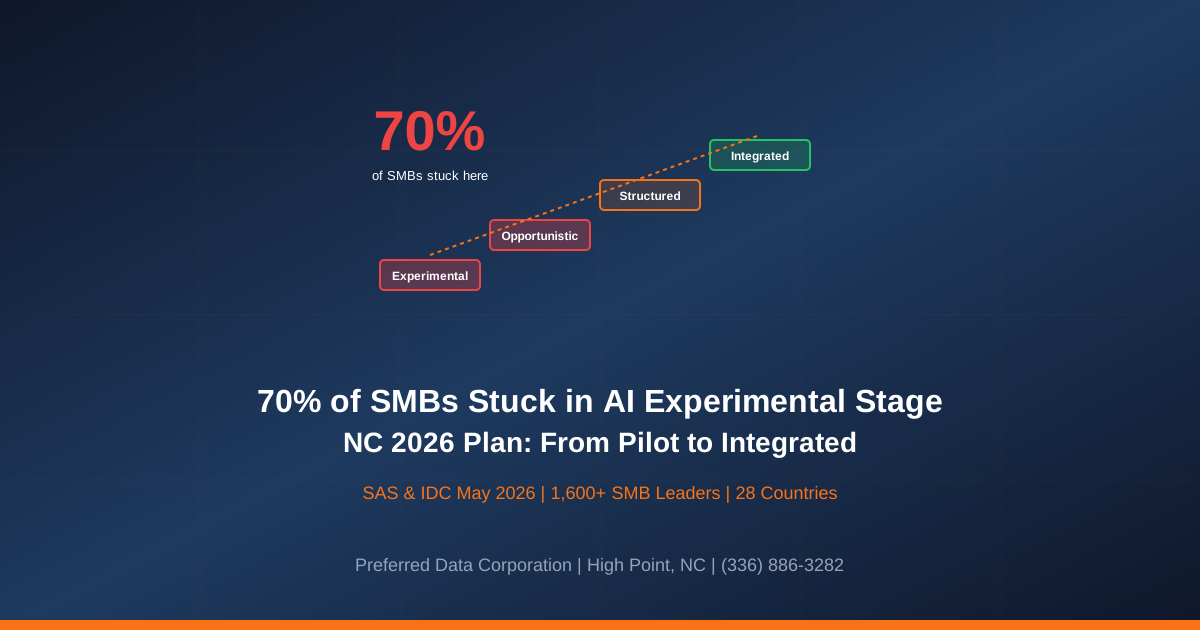
The May 2026 study, published by SAS Voices and summarized by BenefitsPRO, introduces an AI Readiness Index with four maturity stages: Experimental, Opportunistic, Structured, and Integrated. The headline finding is that 70% of SMBs surveyed remain in the first two stages, where AI is used as a tool by individuals or small teams without an enterprise data foundation, governance model, or measured business outcome tied to it.
Three specific findings frame the gap:
- Investment is rising faster than maturity. Most SMBs surveyed report increased AI spend year-over-year, but the spend is largely on per-seat tool licenses (ChatGPT Team, Microsoft 365 Copilot, Google Gemini for Workspace) rather than data infrastructure, governance, or process redesign.
- The data foundation is weak. SMBs at the Experimental and Opportunistic stages typically lack centralized data warehouses, consistent data quality, and governed access controls. AI built on top of fragmented data produces fragmented outcomes.
- Skills and governance are the binding constraint. SMBs in the Structured and Integrated stages have at least one named owner for AI strategy, a documented governance policy, and measured KPIs tied to AI outcomes. SMBs in the lower two stages typically have none of those.
The Intuit 2026 ICIC report adds a complementary data point: business owners save a median of 5 hours per week with AI, and employees save 11.5 hours per week, but the savings concentrate sharply in SMBs that have integrated AI into named workflows rather than scattered individual use.
Why are NC small businesses stuck in the experimental stage?
Because the path from a copilot license to integrated, measured outcome runs through data, governance, and process work that is unfamiliar to most NC SMB leadership teams. Four practical blockers show up over and over in NC SMB AI engagements:
- No clear use case prioritization. Leadership knows AI matters but has 15 candidate use cases and no scoring framework. The team runs three pilots in parallel, finishes none.
- Data is in line-of-business silos. ERP, MES, CRM, accounting, and email each hold a piece of the picture. Building an AI workflow that needs data from two systems requires integration work the team has not budgeted.
- No governance for sensitive data in AI tools. Employees paste customer data, contracts, and supplier prices into public chat tools. Leadership knows it is a problem and has not closed it because the alternative requires investment.
- No KPI tied to the use case. A pilot that "saves time" with no measurement cannot defend itself in next year's budget cycle, so it quietly sunsets.
The result is a portfolio of half-implemented pilots, no measurable outcome, and AI spend that grows year over year without proportionate business value.
What separates AI Integrated SMBs from AI Experimental SMBs?
Five characteristics show up consistently in the AI Integrated tier of the SAS/IDC framework and in adjacent industry research, including the US Chamber of Commerce's 2026 AI for SMBs report and Business.com's 2026 Small Business AI Outlook Report.
| Dimension | Experimental SMB | Integrated SMB |
|---|---|---|
| Named owner for AI strategy | None | At least one named owner with budget |
| Use case selection | Bottom-up, no scoring | Top-down prioritization, scored on impact and feasibility |
| Data foundation | Per-system silos | Centralized data with documented quality |
| Governance | None or implicit | Written policy on data sharing, model use, retention |
| Outcome measurement | "Feels faster" | Named KPI per use case, reviewed quarterly |
The 90-day roadmap below is built to move one or two use cases across that table.
What is a realistic 90-day AI plan for an NC small business?
Four phases, each measurable, each completable inside one quarter.
- Discovery and prioritization (weeks 1-3). Run a structured discovery across leadership and front-line teams. Inventory candidate use cases. Score each on revenue impact, cost reduction, customer-experience impact, feasibility, and data readiness. Pick two: one quick win (4-6 weeks to production) and one foundational (8-12 weeks to production).
- Data and governance foundation (weeks 4-6). Stand up the minimum data pipeline required for the two chosen use cases. Document data classification (public, internal, customer-confidential, regulated) and write a one-page AI usage policy that names which tools may receive which classes of data. Train the team on it.
- Build and integrate (weeks 7-10). Build the two use cases into the actual workflow, not as a side experiment. For a manufacturer, that might be AI-assisted production scheduling integrated with the ERP. For a distributor, it might be AI-assisted demand forecasting integrated with inventory. For a professional services firm, it might be AI-assisted proposal generation integrated with the CRM.
- Measure and decide (weeks 11-12). Pull the KPI numbers. Compare to baseline. Decide whether to scale, iterate, or sunset. Document the decision and the data behind it. This is what moves the use case from Opportunistic to Structured.
Quotable definition: AI maturity is the degree to which AI is integrated into a business's data, processes, governance, and decision-making, not the number of AI tools the business has licensed.
Where do NC SMBs see the highest AI ROI in 2026?
Per the Intuit 2026 ICIC report and the SBE Council's 2026 SMB AI tools survey, four use case categories return the most consistent measurable value for NC SMBs:
- Marketing and customer outreach. AI-assisted copywriting, segmentation, and personalization. Highest reported revenue impact for SMBs in growth mode.
- Operations and scheduling. AI-assisted production scheduling, route optimization, and inventory forecasting. Highest reported cost-reduction impact for manufacturers and distributors.
- Document processing. AI extraction from POs, invoices, contracts, and inspection reports. Highest reported time savings.
- Customer service and support. AI-assisted triage, response drafting, and knowledge base search. Highest reported customer-satisfaction impact.
For NC manufacturers specifically, AI-assisted production scheduling and AI-assisted document processing have the strongest ROI signal because they connect directly to throughput and quote turnaround, the two metrics that most directly drive growth.
Want help picking the right two use cases for your business? Call (336) 886-3282 or request an AI use case prioritization workshop.
How does Preferred Data Corporation help?
PDC supports NC small businesses with three things that move AI from experimental to integrated:
- AI transformation services for use case discovery, prioritization, data readiness assessment, and 90-day production roadmaps tied to measurable KPIs.
- Custom software development for the integration work between AI workflows and your existing ERP, MES, CRM, and accounting systems. AI value is unlocked at the integration boundary.
- PDC Software Suite for NC manufacturers and distributors who run on our proprietary ERP, with AI-assisted features already integrated into production scheduling, inventory, and document workflows.
PDC has supported NC small businesses, manufacturers, and distributors for over 39 years with on-site coverage within 200 miles of High Point. The combination of deep industry context, proprietary software, and AI integration expertise is what gets a use case to production with measured business value, not just another pilot.
Frequently Asked Questions
Is the SAS/IDC AI Readiness Index methodology credible?
Yes. The study surveyed more than 1,600 SMB leaders across 28 countries, used a structured four-stage maturity model, and was published in May 2026 alongside a full report available from SAS. The findings align with adjacent studies from Intuit, US Chamber of Commerce, and Business.com.
How much should an NC SMB budget to move from Experimental to Integrated?
Typical 90-day engagements for one or two production use cases run $25,000-$75,000 in services, plus per-seat tooling that scales with the team. The defensible business case is built on measurable outcome (revenue uplift, cost reduction, or hours saved) tied to a named KPI, not on the cost of the engagement.
What if our leadership team is divided on AI strategy?
That alignment work is part of the discovery phase. A structured AI use case scoring framework, run as a leadership workshop, surfaces the disagreement on which problems matter most and forces a prioritization decision. Most leadership teams find that the disagreement is about priority, not about whether AI matters.
Do we need a data warehouse before we can build integrated AI use cases?
Not always. For a single focused use case (e.g., AI-assisted production scheduling), you typically need a clean data pipeline from one or two source systems, not a full enterprise data warehouse. The right approach is to build the minimum data foundation required for the chosen use case, then expand as the next use case demands it.
How do we measure AI ROI without overinvesting in measurement?
Pick one KPI per use case. Capture a baseline before launch. Measure the same KPI at 30, 60, and 90 days post-launch. For marketing, that might be qualified leads per week. For operations, it might be on-time order completion. For document processing, it might be hours per week spent on a specific document workflow. The trap to avoid is measuring everything; the discipline to keep is measuring the one number that matters per use case.
Related Resources
- AI Transformation Services for NC Businesses - Use case discovery, roadmaps, KPI design
- Custom Software Development for NC Businesses - AI workflow integration with ERP, MES, CRM
- PDC Software Suite for NC Manufacturers - Industry-specific ERP with integrated AI features
- Intuit ICIC: 89% of SMBs Use AI, 11.5 Hours Saved - The adoption side of the picture
- AI Agent ROI Reality Check for NC SMBs - The ROI rigor for agent-class AI
- Contact Preferred Data Corporation - Schedule an AI readiness review