
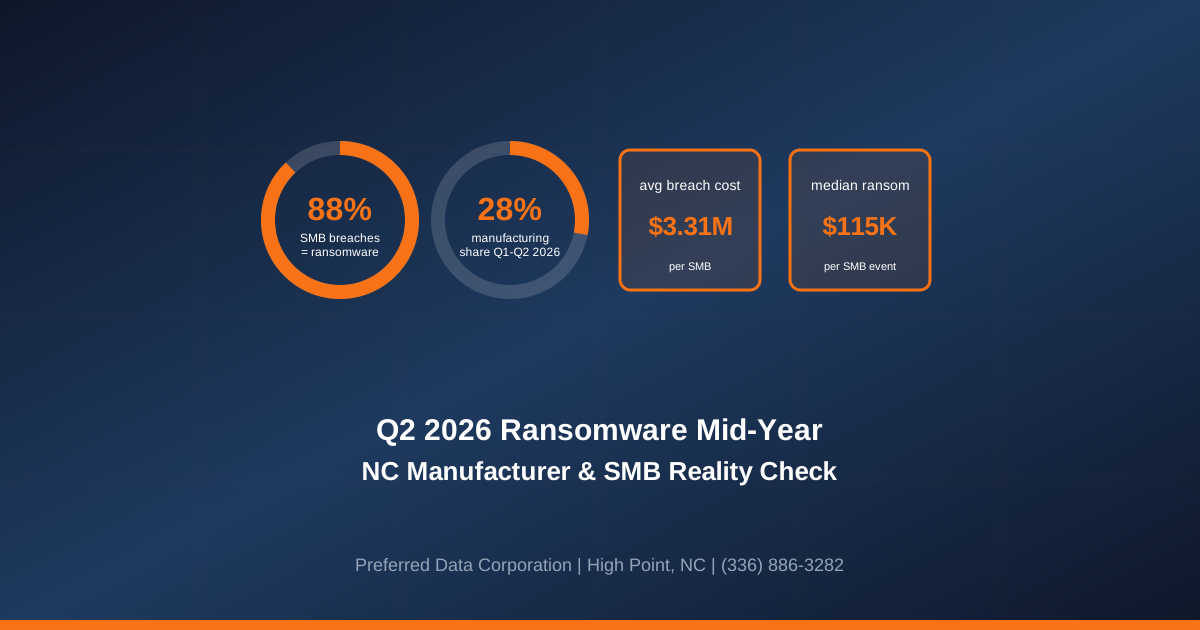
TL;DR: The 2026 mid-year ransomware picture is now clear. SMBs account for 88 percent of ransomware breaches (versus 39 percent for large enterprises), manufacturing is the top-targeted vertical for the third consecutive year at 28 percent of all incidents, construction jumped 44 percent year-over-year in Q1 alone, and the average SMB breach cost reached $3.31 million with a median ransom of $115,000. Manufacturing has the longest recovery time of any sector (72 hours) and the lowest cyber-insurance uptake (22 percent). For NC manufacturers, construction firms, and other SMBs, mid-year 2026 is the moment to lock in the fundamentals before Q3 attack volume typically climbs.
Key takeaway: The 2026 ransomware market is not slowing. Verizon's 2026 DBIR flags vulnerability exploitation as the second-most-common initial access vector, right behind credential abuse and ahead of phishing for the first time in three years. Edge devices, unpatched RMM, and MFA-less accounts are the three doors that must close before Q3.
Where does your NC business stand at mid-year 2026? Contact Preferred Data Corporation for a ransomware readiness assessment. BBB A+ rated since 1987. Call (336) 886-3282.
What Do the Q2 2026 Ransomware Numbers Actually Say?
The Q2 2026 numbers tell a consistent story across four major reports (BlackFog, Sophos, Verizon DBIR, SQ Magazine): ransomware volume has plateaued at an elevated new-normal, SMBs are the primary target, and manufacturing is the top-targeted vertical.
Key mid-year 2026 data points:
- 88 percent of SMB breaches involve ransomware (SQ Magazine 2026 SMB cyber statistics), versus 39 percent for large organizations.
- Manufacturing accounted for 28 percent of all ransomware incidents in the past 12 months (Sophos State of Ransomware 2026), holding the #1 position for the third consecutive year.
- Construction jumped 44 percent year-over-year in Q1 2026 alone, with 131 disclosed victims (BlackFog).
- Average SMB breach cost: $3.31 million. Median ransom payment: $115,000.
- Only 1 in 9 ransomware attacks is publicly disclosed per BlackFog Q1 2026: 2,160 undisclosed attacks vs 264 public.
- 96 percent of ransomware events involve data exfiltration with an average volume of 743 GB and a 7.7-day dwell window.
- Manufacturing recovery time averages 72 hours, the longest of any sector.
- Manufacturing cyber-insurance uptake is 22 percent, the lowest of any sector.
- Manufacturing invests 6 percent of IT budget in security, well below the 12-15 percent all-sector average.
For High Point manufacturers, Greensboro construction firms, and Charlotte professional-services offices, these numbers are the baseline that boards and insurance carriers now expect leadership to address.
| Sector | 2026 Ransomware Share | Recovery Time | Insurance Uptake | Security Budget % |
|---|---|---|---|---|
| Manufacturing | 28% | 72 hours | 22% | 6% |
| Construction | Rising (+44% YoY) | ~48 hours | ~30% | ~7% |
| Healthcare | ~15% | ~55 hours | ~55% | ~12% |
| Professional Services | ~10% | ~40 hours | ~45% | ~10% |
| Financial Services | ~9% | ~35 hours | ~70% | ~15% |
Why Are NC Manufacturers Uniquely Exposed?
North Carolina manufacturing is a top-target vertical in a top-target region. The Piedmont Triad hosts hundreds of small and mid-market manufacturers in furniture, textiles, aerospace, precision machining, and food processing, and the state's advanced-manufacturing corridor from Charlotte through Greensboro to the Research Triangle concentrates high-value IP and low security budget in the same envelope.
Three structural factors put NC manufacturers in the crosshairs:
- Legacy OT reality. PLCs, HMIs, and SCADA systems built for 20-year lifecycles run alongside modern ERP and MES on flat networks. Ransomware crossing from HR laptop to production floor takes minutes.
- Supplier concentration. A single Piedmont Triad plant may share IP with dozens of downstream OEMs. Ransomware that exfiltrates supplier drawings sees a resale market that dwarfs the ransom.
- 72-hour production downtime is business-ending. For a just-in-time supplier to Boeing, Volvo, John Deere, or Honda Aircraft, 72 hours of downtime triggers contract penalties that can exceed the ransom by orders of magnitude.
Key takeaway: For NC manufacturers, the risk equation is not "ransom or no ransom." It is "downtime penalty or investment in prevention." The math favors prevention by ~10-100x.
What Does the 2026 Attack Chain Actually Look Like?
The 2026 ransomware attack chain has shifted materially from 2023-2024. Understanding the chain guides where NC SMBs should invest for maximum defensive impact.
Typical 2026 ransomware chain:
- Initial access via vulnerable edge device (Kemp LoadMaster, Fortinet, Citrix, SonicWall, ScreenConnect) — often through a CVE published in the prior 30-60 days. See the June 29, 2026 disclosure of CVE-2026-8037 in Progress Kemp LoadMaster.
- Credential harvesting and lateral movement. Attackers exfiltrate credentials from browsers, LSASS memory, and RMM tools within hours.
- Backup destruction. Attackers now target backup infrastructure explicitly before encryption. Immutable, off-site, air-gapped backups are the single highest-value control.
- Data exfiltration. 96 percent of 2026 ransomware includes exfiltration. Average 743 GB per event. This is why "just restore from backup" is no longer a complete plan — the extortion pressure now comes from data disclosure.
- Encryption or data-theft-only extortion. Ransomware groups increasingly skip encryption entirely (data-theft-only), reducing operational complexity while maintaining pressure.
Each step in the chain is a defensive opportunity. A managed detection and response (MDR) provider with automated containment shortens the 7.7-day dwell window to hours, often minutes.
Explore Preferred Data's cybersecurity services
What Are the Highest-Value Controls for NC SMBs at Mid-Year?
The 2026 mid-year defensive checklist is short and prioritized by impact against real 2026 attack chains.
Top 10 controls, ranked:
- Immutable, off-site, tested backups. The single highest-value control. Verify restore time-to-recovery quarterly.
- 24/7 MDR with automated containment. Cuts dwell time from 7.7 days to minutes.
- Edge device patch discipline. 72-hour SLA on critical CVEs affecting internet-facing appliances.
- Phishing-resistant MFA on privileged accounts. Passkeys / FIDO2 defeat the device-code phishing surge documented in the FBI IC3 2025 report.
- RMM lockdown. Alerting on any RMM install outside change-management windows.
- Network segmentation. Domain controllers, backup servers, and OT / manufacturing systems on isolated VLANs.
- Least-privilege identity. Kill dormant accounts. No standing admin. Just-in-time elevation.
- Written incident response plan with quarterly tabletop. Includes counsel, cyber-insurance carrier, communications, and technical roles.
- Vendor oversight. SOC 2 or equivalent attestation on any vendor touching customer or operational data.
- User training with role-specific content. General awareness training is table stakes but insufficient — engineers, finance staff, and executives need tailored content.
For a Piedmont Triad manufacturer, controls #1, #2, #3, and #6 collectively prevent the majority of 2026 ransomware chains. For a Charlotte professional-services firm, controls #1, #2, #4, and #7 do most of the work.
Need a ransomware readiness assessment for your NC business? Call Preferred Data Corporation at (336) 886-3282 or schedule a consultation.
Where Should NC SMBs Focus Q3 2026 Investment?
Q3 typically shows an uptick in ransomware volume as attackers exploit slower vacation-season response and end-of-fiscal-year budget disorganization. NC SMBs entering Q3 should prioritize three investment categories.
Q3 2026 investment priorities:
- Backup validation and testing. If you have not done a full-system restore drill in 2026, do one in July. Every 2026 ransomware report identifies backup destruction as the pre-encryption step attackers most consistently execute.
- Edge device patch automation and monitoring. Move from ad hoc patching to a monitored quarterly cycle with 72-hour emergency SLA on critical CVEs. Include vendor-provided cloud VMs, not just on-prem appliances.
- 24/7 MDR onboarding for previously unmonitored environments. Manufacturing at 6 percent security budget cannot afford in-house SOC. Outsource it to a managed provider with automated containment and quarterly reporting.
Complementary Q3 initiatives include tabletop exercises timed for August (before the September / October surge), vendor risk questionnaires refreshed on 2026 attack patterns, and executive-level cyber-insurance renewal preparation.
Learn about Preferred Data's managed IT services
How Does Preferred Data Help NC SMBs Address the 2026 Ransomware Reality?
Preferred Data Corporation combines 37+ years of North Carolina IT expertise with a 24/7 security operations center, immutable backup design, edge-device management, and incident response. Our average client retention of 20+ years reflects the value of continuous relationships with NC manufacturers, construction firms, healthcare providers, professional-services offices, and financial institutions.
We deliver the 2026 mid-year controls package as an integrated service: MDR with automated containment, immutable backup, patch management with 72-hour critical-CVE SLA, MFA and identity governance, network segmentation, and quarterly readiness reporting.
For businesses within 200 miles of High Point, we deliver on-site response when the situation demands hands on keyboards.
Review our cybersecurity checklist
Frequently Asked Questions
Is manufacturing really the top ransomware target for the third year in a row?
Yes. Sophos State of Ransomware 2026 confirms manufacturing as the #1 targeted sector at 27.7 percent of all incidents observed in 2025 and continued top-target status through Q1-Q2 2026. Construction has emerged as a growing hotspot with a 44 percent YoY increase in Q1 2026.
What does "88 percent of SMB breaches involve ransomware" mean in practice?
For an SMB experiencing a security breach in 2026, there is an 88 percent probability the breach involves ransomware — either encryption, data-theft extortion, or both. Contrast with 39 percent for large enterprises. SMBs are the preferred target because they combine weak controls with real revenue and rapid payment behavior.
How does the "only 1 in 9 disclosed" statistic affect my planning?
BlackFog's Q1 2026 report documented 2,160 confirmed ransomware attacks vs 264 publicly disclosed. Public leak-site counts massively undercount the real threat. If you see leak-site data suggesting "only" 264 victims in the quarter, multiply by 8-9 for the real number.
My insurance carrier is asking for MFA, immutable backups, and 24/7 monitoring. Is that reasonable?
Yes, and it is now table stakes for cyber-insurance renewal. Manufacturing has the lowest insurance uptake at 22 percent partly because carriers are pushing back on inadequate controls. Meeting the three-control minimum keeps your policy in place and premiums controlled.
How fast can a managed provider improve my ransomware posture?
Ninety days is realistic for an SMB going from unprotected to defensible. Weeks 1-4: backup validation, edge patching, MFA on privileged accounts, MDR onboarding. Weeks 5-8: MFA everywhere, segmentation, dormant account cleanup. Weeks 9-12: tabletop, playbooks, quarterly cadence.
What if I get hit during Q3 2026?
Call (336) 886-3282 immediately. Our on-call incident responders start containment guidance within minutes. For clients within 200 miles of High Point, an engineer can be on-site within hours. Our full incident-response engagement includes forensics, restoration, communications support, and after-action review.