
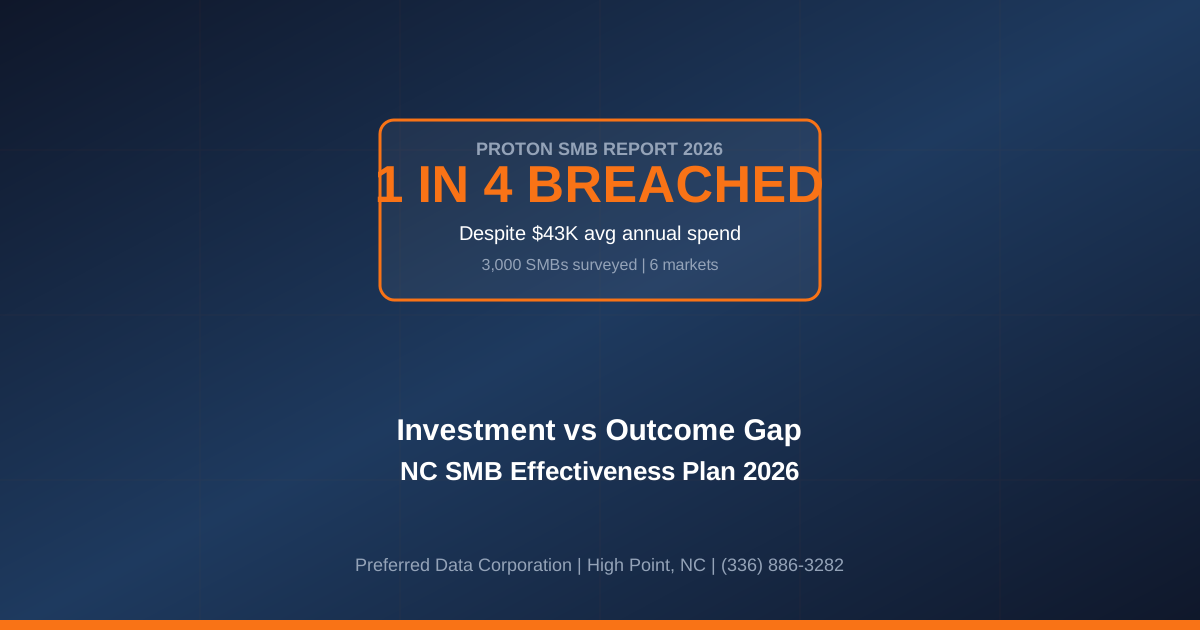
TL;DR: Proton's 2026 SMB Cybersecurity Report — released this week and covering 3,000 decision-makers across US, UK, Brazil, France, Germany, and Japan — found that 1 in 4 SMBs suffered a cyberattack or breach in the past 12 months despite an average annual cybersecurity spend of ~$43,000. 92% of SMBs have implemented "cybersecurity measures," but effectiveness collapses at human-error checkpoints: credentials shared via email and chat, security tools inconsistently used, and misplaced trust in "the cloud provider is handling it." NC SMBs need to move from spending on cybersecurity to measuring outcomes from cybersecurity — and that requires a different operating model.
Key takeaway: Buying more tools is not the same as being more secure. The 2026 data shows a 25% breach rate at $43K annual spend — the gap is not budget, it is effectiveness.
Have you measured your cyber ROI in 2026? Contact Preferred Data Corporation for a security effectiveness audit. Call (336) 886-3282.
What Did Proton's 2026 SMB Cybersecurity Report Find?
Proton surveyed 3,000 decision-makers at organizations with fewer than 250 employees across six major markets. The headline finding — 1 in 4 SMBs breached in the past 12 months despite average $43,000 annual cybersecurity investment — reframes the SMB security conversation.
Five findings NC SMBs should absorb:
- 25% annual breach rate at $43K average spend. Spending is not linearly correlated with outcomes.
- 92% have implemented cybersecurity measures. Coverage is not the problem. Consistency is.
- 57% of breach losses fall between $10,000 and $100,000. Consistent with US Chamber of Commerce data. This is a survivable range for some SMBs and existential for others.
- Credentials still circulate via email, chat, shared docs. Even in organizations with password managers deployed.
- SMBs assume "big cloud = safe." Many respondents could not explain how their data was encrypted or who had access.
For NC SMBs — Piedmont Triad manufacturers, Charlotte professional-services firms, Greensboro medical practices, Raleigh technology firms — the report validates what our region has seen in practice for two years: cyber spending grew faster than cyber outcomes.
Key takeaway: Cybersecurity spending is a lagging indicator of maturity. Effective cybersecurity is measured by breach probability reduction, mean-time-to-detect, mean-time-to-contain, and business continuity outcomes, not tools purchased.
Why Do 92% of SMBs "Have" Cybersecurity Yet 25% Still Get Breached?
Proton's findings decompose the effectiveness gap into four failure modes, each of which is directly observable in NC SMB environments.
Failure mode 1: Inconsistent tool usage. Organizations buy a password manager but do not enforce its use, so half the team uses it and the other half emails passwords. Same pattern with MFA, VPN, EDR agents, and secure file transfer.
Failure mode 2: Human error at critical checkpoints. Phishing training exists but does not measurably reduce click rate. Wire-transfer approval processes exist but have exceptions "for the boss." Vendor changes get approved from a single email.
Failure mode 3: Cloud shared-responsibility gaps. SMBs move data into SaaS platforms and assume the vendor's certifications equal their own compliance. In practice, the vendor secures the platform, the SMB is responsible for identity, access, and data classification.
Failure mode 4: Tool sprawl without integration. A typical NC SMB in 2026 owns 20-40 security tools (antivirus, EDR, email filter, cloud filter, DNS filter, backup, DLP, password manager, MFA app, secure email gateway, cloud CASB, and more). Without integration, alerts arrive in 20 different dashboards and no one correlates.
| Failure Mode | Symptom | Fix |
|---|---|---|
| Inconsistent tool usage | 50% MFA coverage | Enforced conditional access |
| Human error | Wire-transfer callbacks skipped | Written procedure, no exceptions |
| Cloud shared responsibility | "The cloud is secure" | Identity + access + classification ownership |
| Tool sprawl | 20+ dashboards | SIEM / XDR + managed SOC |
Are you seeing any of these failure modes in your environment? Request an effectiveness review — Preferred Data measures outcomes, not tool counts. (336) 886-3282.
What Does an Outcome-Focused SMB Cybersecurity Program Look Like?
Moving from "spending on cybersecurity" to "measuring outcomes from cybersecurity" requires a specific operating model. NC SMBs that make the shift generally follow six practices.
Practice 1: Measurable KPIs at the board level.
- Mean time to detect (MTTD) — how long from an initial compromise indicator to a confirmed incident?
- Mean time to contain (MTTC) — how long from confirmed incident to blast-radius containment?
- Phishing simulation click rate trend — is it going down or bouncing?
- Patch compliance rate — what percent of endpoints and edge devices are current per cycle?
- MFA coverage — what percent of privileged and standard user accounts have phishing-resistant MFA?
Practice 2: A single security operations owner.
- One person or one contracted managed provider accountable end-to-end.
- Escalation authority to the executive team, not to IT.
- Monthly executive briefing with the KPIs above.
Practice 3: Consolidated identity and access.
- One identity provider (Entra ID, Okta, Google Workspace) enforcing conditional access, MFA, and session controls.
- Just-in-time privileged access for administrative operations.
- No shared accounts, no service accounts with interactive login.
Practice 4: Consolidated endpoint and email defense.
- One EDR / MDR platform with a defined 24/7 response contract.
- One email gateway with anti-phishing, BEC detection, and DLP.
- One patch management platform with executive-visible dashboards.
Practice 5: Actual incident response playbooks.
- Written, tabletop-tested, and updated quarterly.
- Contacts current for legal counsel, forensics, cyber insurance, and law enforcement.
- Pre-authorized containment authority for the response team.
Practice 6: Vendor risk and shared-responsibility documentation.
- Written inventory of every SaaS platform storing regulated data.
- Written mapping of who is responsible for what — provider vs your team.
- Annual vendor risk assessment with material vendors.
How Should NC SMBs Budget for Cybersecurity in H2 2026?
The Proton data suggests that raising the budget without changing the operating model does not improve outcomes. NC SMBs planning H2 2026 cybersecurity budgets should follow a three-question test on every proposed line item.
Question 1: What outcome does this line item improve?
- If the answer is "checkbox for cyber insurance renewal," that is a valid outcome — but write it down.
- If the answer is "protects against ransomware," ask which stage of the kill chain and how you will measure.
Question 2: Does this integrate with what we already own?
- If yes, deploy and integrate.
- If no, ask why we are adding a new dashboard rather than consolidating.
Question 3: Who operates it 24/7?
- If the answer is "we will figure that out later," pause. Tools without operators are shelfware.
- If the answer is "our MSSP" or "our managed SOC," verify the contract covers this tool.
For an NC SMB at the reported $43K/year median, the practical H2 2026 optimization is often not more tools but a managed detection and response (MDR) contract that consolidates monitoring across the tools already owned. MDR pricing in the NC market typically runs $30-$80 per endpoint per year for a fully monitored, human-analyst-triaged service — a $40 blended rate on 100 endpoints is $4,000/year, well inside the median budget.
Explore Preferred Data's cybersecurity services
What Are the Highest-Impact Free Controls NC SMBs Should Implement?
Not every effectiveness gain requires spending. The following controls cost nothing in tooling and produce measurable outcome improvement inside 30 days.
Free control 1: Enforce MFA on every account.
- Cost: zero (Microsoft 365 and Google Workspace both include MFA at Business Basic level).
- Impact: 99%+ reduction in credential-based account takeover per Microsoft data.
Free control 2: Written incident response contacts.
- Cost: zero.
- Impact: hours saved in the first four hours of an incident — decisive for containment.
Free control 3: Tabletop-exercise IR quarterly.
- Cost: two hours of leadership time.
- Impact: uncovers gaps before an attacker does.
Free control 4: Executive-visible patch compliance dashboard.
- Cost: zero (built into most RMM platforms).
- Impact: closes the accountability gap that lets patches slide.
Free control 5: Backup restore test monthly.
- Cost: two hours of IT time.
- Impact: catches silent backup failures before you need them.
Free control 6: Vendor risk written inventory.
- Cost: one afternoon.
- Impact: shrinks the surprise-vendor-breach blast radius.
Key takeaway: Six free controls close the largest effectiveness gap Proton documented — enforcement, accountability, and preparation.
How Should Cyber Insurance Premiums Factor Into the H2 2026 Plan?
NC SMB cyber insurance premiums stabilized in 2024-2025 after the ransomware price surges of 2020-2022, then began climbing again in H1 2026 as insurers reprice around AI-augmented BEC and MSP supply chain incidents. The Proton 25% breach rate is consistent with insurer loss ratios.
Three insurance decisions for H2 2026:
- Confirm your control attestations are accurate. If you attested to MFA everywhere and only have MFA on 60% of accounts, your policy may fail to respond at claim time.
- Review the dependent-provider clause. Does your policy pay for business interruption caused by your MSP, payroll processor, or SaaS vendor's breach?
- Review the sublimits for ransomware and social engineering. Some policies cap ransomware to $250K or $500K and social engineering to $100K on a policy nominally sold as "$5M coverage."
Need cyber insurance broker coordination? Contact Preferred Data — we work with your broker to translate technical controls into policy attestations. (336) 886-3282.
How Does Preferred Data Deliver Outcome-Focused Cybersecurity for NC SMBs?
Preferred Data Corporation is a High Point, NC managed IT and cybersecurity provider serving Piedmont Triad manufacturers, construction firms, healthcare providers, professional-services offices, and financial institutions since 1987. Our 20+ year average client tenure is not an accident — it is the result of measurable outcome delivery rather than tool proliferation.
Our July 2026 managed cybersecurity engagement pattern:
- Security effectiveness audit at onboarding: MTTD baseline, MTTC baseline, patch compliance, MFA coverage, IR readiness.
- Consolidation plan — reducing dashboard count by integrating existing tools where possible before recommending new ones.
- 24/7 managed detection and response with automated containment authority.
- Monthly executive reporting to leadership with the KPIs above.
- Quarterly tabletop exercises and IR playbook updates.
- Cyber insurance broker coordination to ensure attestations reflect environment reality.
For NC SMBs within 200 miles of High Point, we deliver on-site engagement when required. Remote engagement is available across the state.
Learn about Preferred Data's managed IT services
Frequently Asked Questions
What was the headline finding of the Proton 2026 SMB Cybersecurity Report?
1 in 4 SMBs suffered a cyberattack or breach in the past 12 months despite an average annual cybersecurity investment of approximately $43,000. 92% of surveyed SMBs had implemented cybersecurity measures.
Why do 92% of SMBs "have" cybersecurity yet 25% still get breached?
Four common failure modes: inconsistent tool usage, human error at critical checkpoints (phishing, wire transfers, vendor changes), cloud shared-responsibility gaps, and tool sprawl without integration.
What financial losses do SMB breaches typically cause?
The Proton data shows 57% of breach losses fell between $10,000 and $100,000. Consistent with US Chamber of Commerce data. Survivable for larger SMBs, existential for smaller ones.
Should NC SMBs spend more on cybersecurity in H2 2026?
Not automatically. The Proton data shows spending is not linearly correlated with outcomes. Effectiveness gain comes from consolidation, integration, and human-error controls — not from adding more tools.
What is the highest-ROI H2 2026 investment for a mid-size NC SMB?
For most NC SMBs at 50-250 employees, a managed detection and response (MDR) contract that consolidates alerting and delivers 24/7 human-analyst triage typically produces the largest measurable outcome improvement per dollar spent.
Can Preferred Data audit our current cybersecurity effectiveness?
Yes. Call (336) 886-3282 for a security effectiveness audit. We measure MTTD, MTTC, patch compliance, MFA coverage, and IR readiness, then deliver a written prioritization aligned with your budget.