
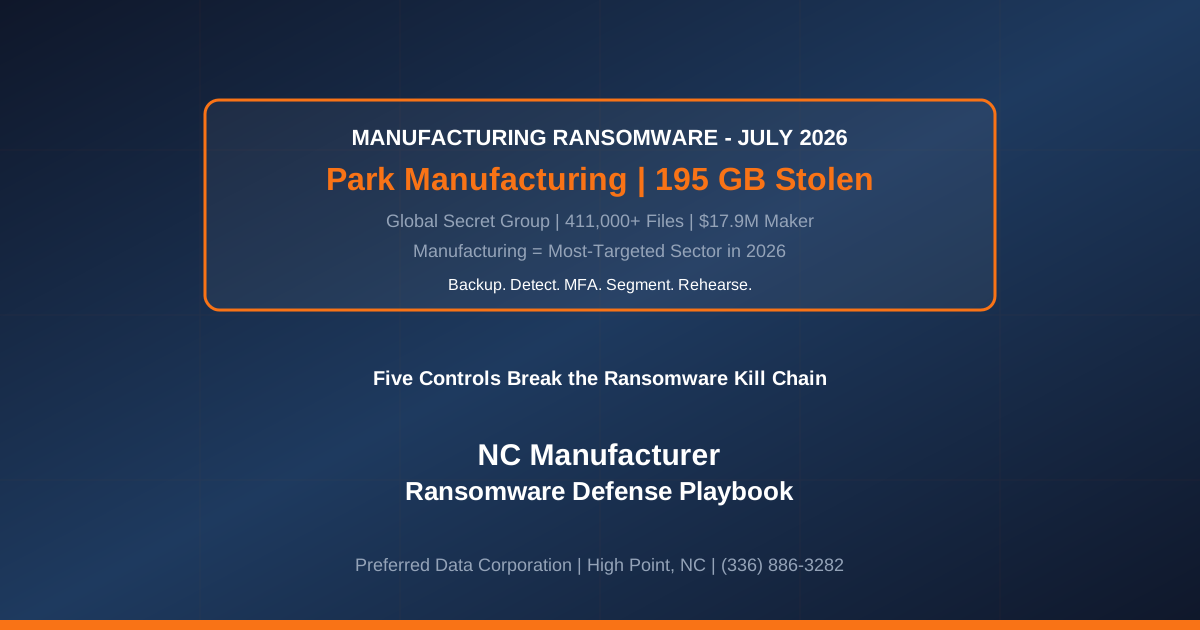
TL;DR: In late July 2026, the Global Secret Group ransomware crew claimed an attack on Park Manufacturing Corp, a roughly $17.9M-revenue, 50-to-100-employee appliance, electrical, and electronics manufacturer in Cambridge, Minnesota, exfiltrating 195 GB across more than 411,000 files. It lands in the middle of a documented surge: Help Net Security's mid-2026 report counts 146 active ransomware groups and manufacturing as the single most-targeted sector. For North Carolina's manufacturing base, Park Manufacturing is a mirror: a mid-market manufacturer the exact size of thousands of Piedmont Triad shops, hit for its data and its uptime. The defensible position is a small number of controls that provably blunt ransomware, deployed before the attacker calls.
Key takeaway: Small and mid-market manufacturers are now the primary ransomware target, not collateral damage. A 50-to-100-person shop holds exactly what these crews monetize: design files, customer and supplier data, financials, and a production line whose downtime is expensive enough to force a ransom conversation. The five controls that break the ransomware kill chain, immutable backup with tested restore, 24/7 detection and response, phishing-resistant MFA, OT/IT segmentation, and a rehearsed incident-response plan, are the same whether you make appliances in Minnesota or furniture in High Point.
Worried your plant is one phishing click from a Park Manufacturing scenario? Contact Preferred Data Corporation at (336) 886-3282 for a manufacturing-focused ransomware readiness assessment. BBB A+ rated, serving High Point, Greensboro, Winston-Salem, Charlotte, Raleigh, and the Piedmont Triad since 1987.
What happened to Park Manufacturing Corp?
Park Manufacturing Corp was named on the Global Secret Group leak site in July 2026, with the attackers claiming exfiltration of a large trove of company data. Per the incident disclosure, the claimed haul is 195 GB spanning 411,109 files and 48,413 folders from a manufacturer in the appliances, electrical, and electronics space, with annual revenue near $17.9 million and 50 to 100 employees, headquartered in Cambridge, Minnesota.
Three facts make this incident instructive for NC manufacturers:
- The victim profile is ordinary. This is not a Fortune 500 target. A $17.9M, sub-100-employee manufacturer is precisely the size band that dominates North Carolina's industrial base, which means the threat model transfers directly.
- The monetized asset is data. A 195 GB exfiltration is a double-extortion play: encrypt to stop production, and leak to force payment. Even a manufacturer with perfect backups still faces the data-exposure half of the threat.
- The timing is not a coincidence. Park Manufacturing is one incident inside a manufacturing-heavy ransomware wave, not an outlier event.
Why is manufacturing the most-targeted ransomware sector in 2026?
Manufacturing tops the ransomware target list because manufacturers combine high downtime costs, legacy operational technology, and historically thin security staffing, an ideal profitability equation for ransomware operators. Help Net Security's 2026 trend report identifies manufacturing as the most-hit sector, and the structural reasons are consistent across incidents.
- Downtime is unusually expensive. A stopped production line burns revenue by the hour and can trigger contractual penalties and lost orders, which raises the manufacturer's willingness to pay to restore operations quickly.
- OT and legacy systems widen the attack surface. Plant-floor PLCs, HMIs, and older Windows systems that cannot be patched on a modern cadence sit alongside the corporate network, giving attackers durable footholds.
- Security staffing has lagged growth. Many mid-market manufacturers still run lean internal IT that was scoped for uptime and help-desk work, not 24/7 threat detection, leaving detection gaps attackers exploit.
- The sector is data-rich. CAD and design files, supplier contracts, pricing, and customer data are exactly the material that makes double-extortion leaks credible and painful.
The broader data confirms the trend rather than softening it: the 2026 ransomware ecosystem has expanded to well over a hundred active groups competing for victims, and manufacturing remains at the front of the line.
What does a ransomware attack actually cost a mid-market manufacturer?
The headline ransom is usually the smallest line on the bill. The real cost is the sum of production downtime, recovery labor, breach-notification and legal exposure, and long-tail customer and reputational damage. The comparison below frames why prevention economics favor the manufacturer.
| Cost dimension | Reactive (no program) | Proactive (managed program) |
|---|---|---|
| Production downtime | Days to weeks of halted lines | Hours, from tested restore |
| Data exposure / extortion | Full 195GB-class leak risk | Contained, segmented blast radius |
| Recovery labor | Emergency, premium-rate scramble | Planned runbook execution |
| Breach notification / legal | NC ITPA and customer contract exposure | Prepared evidence and counsel path |
| Annual defensive cost | $0 until the incident | Predictable managed monthly spend |
The point is not that a program is free; it is that a program converts an unpredictable, business-ending event into a predictable operating expense, which is exactly the posture NC manufacturers should want in an uncertain 2026.
What five controls actually break the ransomware kill chain?
Five controls do the overwhelming majority of the defensive work, and they map directly to how these attacks unfold. This is the core of PDC's manufacturing cybersecurity program.
- Immutable backup with tested restore. Backups that attackers cannot alter or delete, verified by an actual restore test on a schedule. This neutralizes the encryption half of double extortion and is the single highest-ROI control a manufacturer can deploy. Data protection and backup is the foundation everything else sits on.
- 24/7 managed detection and response. Continuous monitoring with EDR and a SOC catches the intrusion during the reconnaissance and lateral-movement phase, hours or days before encryption, which is when a manufacturer with lean internal IT would otherwise be blind.
- Phishing-resistant MFA and RMM control. Most intrusions still start with a stolen credential or an abused remote-management tool. Phishing-resistant MFA plus an allowlist for remote-access software closes the most common front doors.
- OT/IT segmentation. Separating the plant floor from the corporate network means a corporate-side compromise cannot reach the PLCs and HMIs that run production, which is the difference between an IT incident and a plant shutdown.
- A rehearsed incident-response plan. A written, practiced runbook, including backup contacts, counsel, insurer, and a decision tree, turns the first chaotic hours into an execution exercise rather than an improvisation.
Want these five controls mapped to your specific plant and ERP? Call Preferred Data Corporation at (336) 886-3282 for a manufacturing ransomware readiness assessment.
Why does a local, manufacturing-focused MSP matter for this threat?
Ransomware response is a race, and the response is faster when the provider already understands your plant, your OT environment, and your data. A national break-fix vendor learning your network during the incident loses the hours that matter most. PDC has built manufacturing IT and cybersecurity expertise since 1987, on-site within 200 miles of High Point, with the industrial context, furniture, textile, appliance, and industrial production, that generic providers lack. That local, sector-specific presence is what converts a threat like the Park Manufacturing attack from an existential event into a managed one.
Frequently Asked Questions
Who is the Global Secret Group ransomware crew?
Global Secret Group is a ransomware operation that publicly claimed the Park Manufacturing attack on its leak site in July 2026, alleging exfiltration of 195 GB across more than 411,000 files. Like most 2026 groups, it uses double extortion, encrypting systems to halt operations while threatening to publish stolen data to force payment.
Is my small manufacturer really a target if I only have 50 to 100 employees?
Yes. Park Manufacturing is a $17.9M, 50-to-100-employee manufacturer, and it was targeted specifically. Manufacturing is the most-hit ransomware sector in 2026, and small-to-mid manufacturers are attractive precisely because they have valuable data and expensive downtime but often lack 24/7 detection. Size is not protection.
What is the single most important control to deploy first?
Immutable backup with a tested restore. It directly defeats the encryption half of a ransomware attack and gives you a recovery path that does not depend on paying. It must be immutable, so attackers cannot delete it, and tested, because an untested backup is a hope, not a control. Pair it immediately with 24/7 detection so you catch the intrusion before encryption.
Does immutable backup make me safe from data-leak extortion?
No, which is why backup alone is not a full program. A 195 GB exfiltration like Park Manufacturing's is a leak threat independent of encryption. You still need to prevent the intrusion in the first place through MFA, monitoring, and segmentation, and you need an incident-response plan that covers breach notification under the North Carolina Identity Theft Protection Act and customer contracts.
How does OT/IT segmentation protect my production line?
Segmentation puts a controlled boundary between your corporate network, where email and phishing live, and your operational technology, the PLCs, HMIs, and machines that run production. If an attacker compromises a corporate laptop, segmentation stops them from pivoting onto the plant floor, containing an IT incident before it becomes a production shutdown.
How fast can Preferred Data assess our ransomware readiness?
PDC can begin a manufacturing-focused readiness assessment quickly, evaluating your backup posture, detection coverage, MFA and remote-access controls, OT/IT segmentation, and incident-response readiness, then prioritizing the highest-impact gaps. Call (336) 886-3282 to schedule.
Related Resources
- Ransomware in 2026: More groups, more victims, no slowdown - Help Net Security
- Park Manufacturing Corp ransomware incident disclosure
- Preferred Data Cybersecurity Services
- Preferred Data Data Protection and Backup
- Preferred Data Manufacturing Industry Solutions
- Related: Ransomware 2026 H1 - 146 Groups, Qilin Leads, NC SMB Priorities
- Related: Qilin Ransomware Hits P&A Construction - NC Contractor Defense