
TL;DR: The OWASP GenAI Security Project's "State of Agentic AI Security and Governance" report, published June 1, 2026, with the Enterprise Adoption Maturity Model added June 3, 2026, is now the de facto industry benchmark for how organizations should govern autonomous AI agents. The report maps 42 regulatory instruments across 10 jurisdictions, layers a five-tier maturity model from "ad hoc" to "continuous monitoring," and tracks live incidents and exploits. For NC small businesses already running Microsoft Copilot agents, Claude Code, custom n8n / Lindy workflows, and CRM-embedded AI sales assistants, the question is no longer whether to govern agentic AI — it is whether your governance maturity matches your deployment tier.
Key takeaway: Governance maturity must equal or exceed agent capability. An NC SMB running an autonomous email-handling agent at "Level 0 — unaware" governance is the modern equivalent of running a production database without backups. Map every agent, score it on the OWASP maturity scale, then either raise governance or reduce agent autonomy.
Worried that your team has deployed AI agents faster than your policies and controls can catch up? Preferred Data Corporation runs managed AI governance, agentic-AI risk assessments, and Microsoft Copilot baselines for NC small businesses. Call (336) 886-3282 or request an AI governance review.
What is the OWASP "State of Agentic AI Security and Governance" report?
It is the OWASP GenAI Security Project's flagship 2026 publication on how to safely deploy, monitor, and govern autonomous AI agents. Per the official OWASP resource page and Infosecurity Magazine's June 2026 coverage, the report's headline additions in the 2026 edition are:
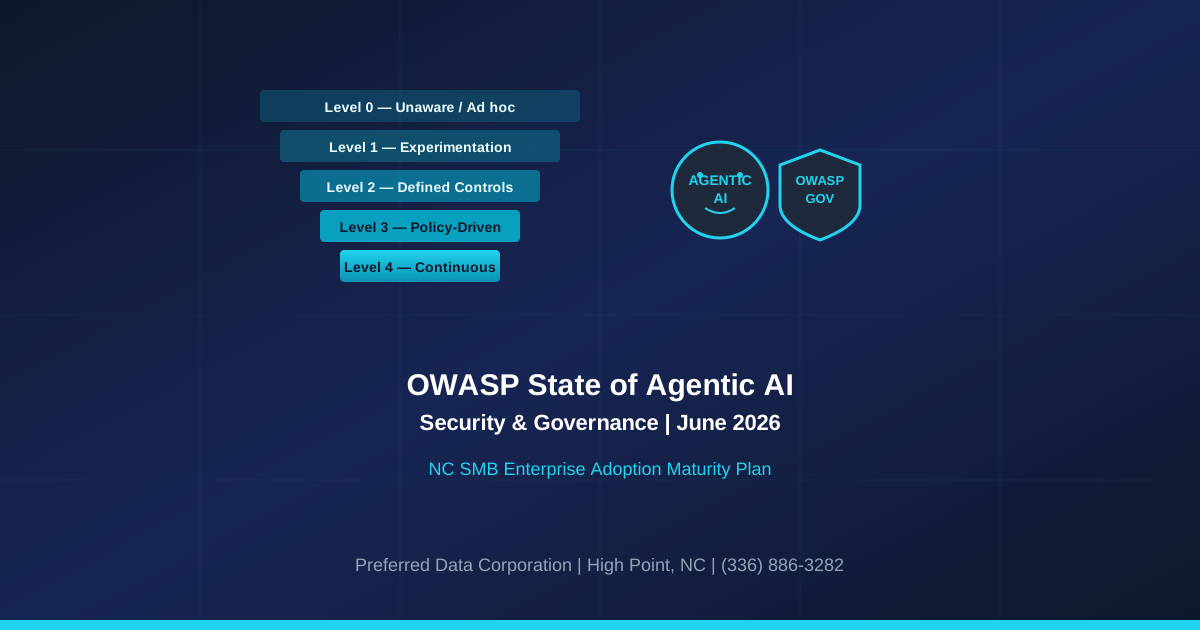
- Enterprise Adoption Maturity Model. Five tiers — Level 0 (unaware / ad hoc) through Level 4 (continuous monitoring with formal guardrails, telemetry, and policy-driven escalation).
- Live incidents and exploits tracker. A continuously updated record of in-the-wild agent compromises so organizations can pattern-match their own deployments against documented failure modes.
- Revised agent taxonomy. Clearer distinctions between tool-augmented LLMs, single-agent workflows, multi-agent orchestrations, and fully autonomous agents.
- New sections on agent identity, AI SBOM, and supply chain provenance. How to treat each agent as a first-class identity, how to maintain a software bill of materials for AI components, and how to validate the provenance of model weights and tool integrations.
- Regulatory landscape mapping. 42 instruments across 10 jurisdictions, including the EU AI Act, US state laws, and the FTC's March 11, 2026 AI policy statement.
Three reasons NC small businesses can no longer treat this as enterprise-only material:
- Agentic AI is already inside NC SMBs. Per Microsoft's 2026 Work Trend Index and Techaisle's 2026 SMB AI report, majority of SMBs have at least one production AI agent (Copilot Chat, Claude Code, Lindy, n8n, custom CRM agent) handling real workflows. Most have no documented governance for those agents.
- Regulatory pressure is no longer theoretical. Per the FTC's March 11, 2026 AI policy statement and O'Melveny's 2026 privacy compliance checklist, 20 US states now have comprehensive privacy laws with AI-specific provisions, and the FTC has signaled it will apply existing consumer-protection statutes to AI deployments without waiting for new legislation.
- Live incidents are documented in the OWASP tracker. Per the report's incident appendix, organizations are losing data, sending money, and exposing customers because deployed agents took actions outside their intended scope. The same risk surface applies at SMB scale, with fewer compensating controls.
What are the OWASP Top 10 risks for agentic AI?
Per the OWASP Top 10 for Agentic Applications 2026 framework and Palo Alto Networks' coverage, the ten categories an NC SMB should map every deployed agent against are:
- Agent goal hijacking — attacker manipulates the agent's objective via crafted input.
- Tool misuse and unintended execution — agent calls a tool with parameters that produce harm (delete files, send unintended emails, transfer funds).
- Agent identity and privilege abuse — agent assumes more privilege than intended or impersonates another principal.
- Missing or weak guardrails — no rate limits, no scope checks, no human-in-the-loop on high-impact actions.
- Sensitive data disclosure — agent surfaces PII, CUI, financials, or trade secrets to unintended audiences.
- Data poisoning — training or retrieval data contaminated to alter behavior.
- Resource exhaustion — runaway loops, token burn, infrastructure DoS by the agent itself.
- Supply chain vulnerabilities — compromised model weights, libraries, MCP servers, or tool integrations.
- Advanced prompt injection — crafted instructions embedded in documents, emails, or web pages that override the agent's intended policy.
- Over-reliance on autonomous decision making — humans stop checking the agent's output and the agent makes consequential errors at scale.
| Agentic AI risk | Typical NC SMB impact | OWASP maturity that mitigates it |
|---|---|---|
| Tool misuse — agent sends customer email with internal data | Loss of customer trust, FTC exposure | Level 2+ with scoped tool permissions |
| Goal hijack — prompt injection in inbound email rewrites agent objective | Wire fraud, data exfiltration | Level 3+ with policy-enforced action review |
| Identity / privilege abuse — agent uses an over-privileged service account | Mass deletion, lateral access | Level 2+ with per-agent identity |
| Sensitive data disclosure — agent indexes shared drive and surfaces PII | HIPAA, state privacy law exposure | Level 2+ with DLP-aware indexing |
| Supply chain — MCP server, tool extension, or model from untrusted source | Backdoor, exfiltration | Level 3+ with AI SBOM and provenance checks |
| Over-reliance — humans stop reviewing agent decisions | Compounding errors, audit findings | Level 4 with telemetry-driven sampling |
What is the OWASP Enterprise Adoption Maturity Model and where should an NC SMB sit?
Per the OWASP State of Agentic AI Security and Governance report and Infosecurity Magazine's summary, the maturity model defines five tiers:
- Level 0 — Unaware / Ad hoc. No formal recognition that agentic AI has distinct governance and security risks. Agents are deployed by individual employees without policy, inventory, or review.
- Level 1 — Experimentation without guardrails. Pilot agents with single workflows, no defined autonomy limits, no incident-response playbook.
- Level 2 — Defined scope and controls. Per-agent inventory, scoped tool permissions, documented data-access boundaries, baseline logging.
- Level 3 — Policy-driven governance. Per-agent identity, AI SBOM, supply chain provenance checks, human-in-the-loop on high-impact actions, formal change control.
- Level 4 — Continuous monitoring. Telemetry-driven sampling of agent decisions, automated red-teaming, policy-driven escalation, integration with SIEM and incident response.
The practical starting point per the OWASP guidance: identify the most autonomous agent your organization is running today, and either raise governance maturity to match its capability tier, or reduce the agent's capability tier to match your current governance. An NC SMB running a single Microsoft Copilot Chat seat at Level 0 is acceptable. An NC SMB running an autonomous Lindy agent that books meetings, sends invoices, and accesses HR records at Level 0 is a documented control gap.
Quotable definition: Agentic AI governance maturity is the formal alignment between an agent's autonomy (what it can decide and act on without human review) and the organization's controls (inventory, identity, scope, logging, telemetry, and human oversight). When autonomy outruns controls, the agent becomes the equivalent of an unmonitored employee with admin rights.
Need help mapping every deployed agent to a maturity tier this quarter? Call (336) 886-3282 or book an AI governance review.
What should an NC small business do in the next 30 days?
Run a five-step plan that builds an agent inventory, scores each agent, and closes the most dangerous gaps first. The plan:
- Inventory every deployed agent (week 1). Pull a list of every Copilot, Claude Code seat, Lindy bot, n8n workflow, custom GPT, Cursor agent, CRM AI assistant, and embedded LLM feature in use. Include shadow-IT agents employees signed up for on personal cards.
- Tag each agent by autonomy and data scope (week 1-2). What can the agent decide? What can it act on (send email, write to CRM, transfer funds, modify code, delete records)? What data does it read?
- Score each agent on the OWASP maturity model (week 2). Place each agent on the Level 0-4 scale based on current controls. Highlight agents whose autonomy exceeds your governance.
- Close the highest-risk gaps first (week 2-4). Per-agent identity (no shared service accounts), scoped tool permissions, DLP-aware data access, human-in-the-loop on high-impact actions, logging to your SIEM or log management system.
- Document the policy and train staff (week 3-4). Acceptable-use policy for AI agents, intake process for new agents, quarterly review cadence, incident response playbook for agent misbehavior.
Key takeaway: Inventory + autonomy tagging + maturity scoring + targeted gap closure + documented policy = a defensible OWASP-aligned answer. Any one of those five missing leaves the SMB exposed to the next prompt-injection or tool-misuse incident.
How does Preferred Data Corporation help close OWASP agentic AI gaps for NC SMBs?
PDC has run managed Microsoft 365 / Copilot deployments, custom AI integrations, and software development for NC small businesses since 1987. We bring four things to the OWASP agentic-AI governance response:
- AI transformation services: Inventory every deployed agent, score against OWASP maturity, implement per-agent identity and scoped tool permissions, integrate logging with your SIEM, design human-in-the-loop policy for high-impact actions.
- Managed cybersecurity services: DLP-aware data classification so Copilot, Claude, and custom agents do not index regulated data, integration with NIST AI RMF and FTC compliance posture.
- Software development: Build custom guardrails into in-house agents, implement AI SBOM and supply-chain provenance checks for MCP servers and tool extensions, design policy-enforced action review.
- Managed IT services: Day-to-day Microsoft 365 and Copilot administration, shadow-AI discovery, acceptable-use policy enforcement.
For NC manufacturers in High Point and the Piedmont Triad piloting agents for procurement and quality, NC distributors in Greensboro and Winston-Salem deploying CRM AI assistants, and NC professional services firms in Charlotte and Raleigh using Copilot for client work, the OWASP-aligned governance program is a quarterly managed engagement, not a one-time policy document.
Ready to align your NC SMB AI deployments with OWASP agentic governance? Call (336) 886-3282 or book an AI governance review.
Frequently Asked Questions
Does the OWASP guidance apply to small businesses, or only large enterprises?
It applies to any organization deploying autonomous agents. Per the OWASP State of Agentic AI Security and Governance report, the maturity model scales from individual experimentation to enterprise-wide governance. An NC SMB with three Copilot seats, two custom GPTs, and a Lindy sales bot is in scope.
How does this interact with NIST AI RMF and the FTC March 11 AI policy?
Per the FTC's AI policy page and the NIST AI Risk Management Framework, the OWASP guidance maps cleanly to NIST AI RMF functions (Govern, Map, Measure, Manage) and supports the FTC's expectation that organizations maintain an inventory of AI tools, classify risk, and document oversight. OWASP gives the operational detail; NIST AI RMF and FTC define the regulatory expectation.
What is "AI SBOM" and why does an SMB need one?
An AI Software Bill of Materials is an inventory of the model weights, libraries, datasets, tool integrations, and MCP servers that compose an AI agent. Per the OWASP State of Agentic AI report, AI SBOM is the equivalent of a software SBOM and is required to answer "where did this model come from, who signed it, what data trained it, and what tools can it call." For SMBs deploying open-weight models or third-party MCP servers, AI SBOM is the supply-chain control.
What is the most common agentic AI failure mode in 2026?
Per the OWASP incidents tracker and Capsule Security's analysis, prompt injection combined with tool misuse remains the dominant initial vector. An agent reads attacker-controlled content (an email, a web page, a PDF), the content rewrites the agent's objective, and the agent uses its legitimate tool permissions to act on the new objective.
How does this affect Microsoft Copilot deployments specifically?
Microsoft Copilot agents operate within Microsoft 365 with permissions inherited from the user. Per Microsoft's Copilot governance documentation, DLP, sensitivity labels, and Purview policy define what the agent can index and surface. OWASP maturity Level 2 or higher for Copilot requires a documented data classification baseline and DLP rules, not just a license.
How long does an OWASP-aligned governance rollout take for an NC SMB?
For a typical NC SMB with five to twenty deployed agents, the initial inventory, scoring, and high-risk gap closure runs four to six weeks. Quarterly review cadence keeps the program current. Per the OWASP guidance, 80% of the work is governance (inventory, policy, training) and 20% is technology (DLP, identity, telemetry).
Related Resources
- AI Transformation Services - Managed AI governance and Copilot baselines for NC SMBs
- Managed Cybersecurity Services - DLP, data classification, agent telemetry integration
- Software Development Services - Custom guardrails for in-house AI agents
- AI Agents Inside the Perimeter: Shadow AI Governance for NC SMBs - Companion shadow-AI write-up
- Agentic AI Browsers Prompt Injection NC SMB Governance - Companion browser-agent governance write-up
- Contact Preferred Data Corporation - AI governance review for NC SMBs