
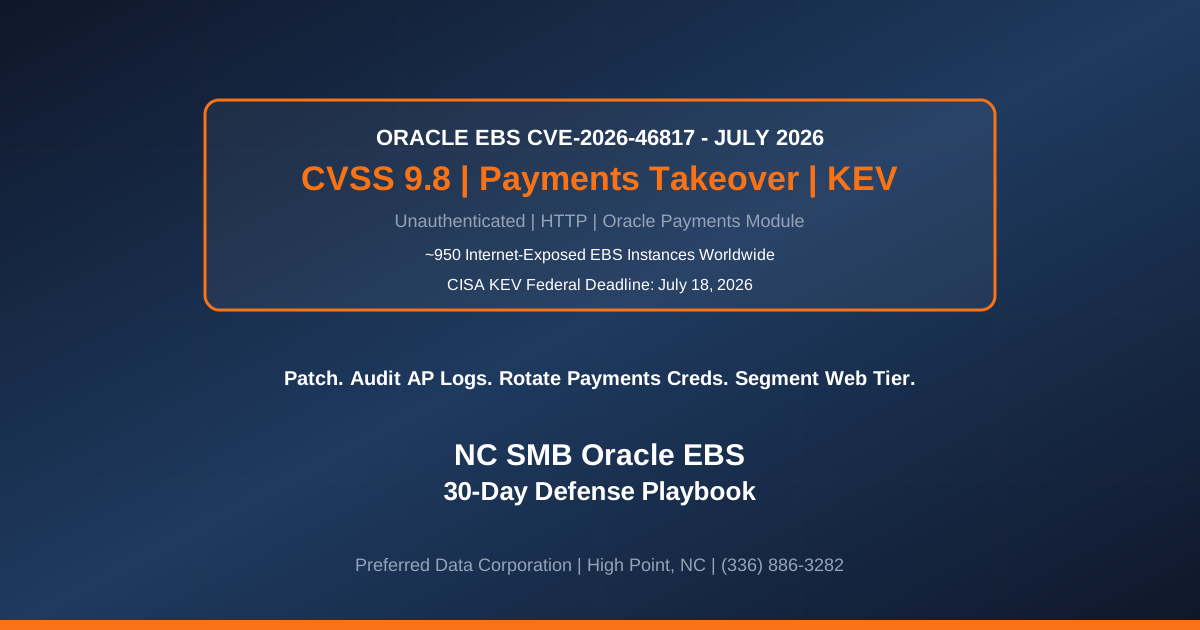
TL;DR: Oracle E-Business Suite (EBS) CVE-2026-46817 is a CVSS 9.8 unauthenticated remote takeover of the Oracle Payments module (File Transmission component), affecting EBS versions 12.2.3 through 12.2.15. Oracle shipped fixes in the May 2026 Critical Patch Update (released May 28) and a supplementary CPU on June 16, 2026. CISA added CVE-2026-46817 to its Known Exploited Vulnerabilities Catalog on July 15, 2026 with a July 18 remediation deadline. Public honeypots recorded the first in-the-wild exploitation attempts over the June 27-28 weekend, and researchers observed "approximately 950 internet-exposed EBS instances" still unpatched into mid-July. For a North Carolina SMB manufacturer, distributor, or professional services firm running Oracle EBS, the practical meaning is a full compromise of Oracle Payments — the module that stores bank routing numbers, vendor payment instructions, and AP disbursement workflows — with zero authentication required.
Key takeaway: Any NC SMB running Oracle EBS 12.2.x that has not deployed the May 28, 2026 CPU (or the June 16 supplementary CPU) is behind CISA's federal deadline, exposed to a live exploit chain, and outside the safe harbor most cyber-insurance policies now require. Priority for the next 30 days: (1) confirm EBS version, (2) apply CPU, (3) audit AP disbursement logs, (4) rotate Payments module credentials, (5) segment the EBS web tier off the public internet.
Need an emergency Oracle EBS patch and AP-fraud assessment? Contact Preferred Data Corporation at (336) 886-3282 for a two-week Oracle EBS security review. BBB A+ rated, serving High Point, Greensboro, Winston-Salem, Charlotte, Raleigh, and the Piedmont Triad since 1987.
What Is Oracle EBS CVE-2026-46817 and Why Is It So Serious?
CVE-2026-46817 is a CVSS 9.8 improper-privilege-management flaw in the File Transmission component of the Oracle Payments product inside Oracle E-Business Suite 12.2. Per Oracle's May 28, 2026 Critical Patch Update advisory, an unauthenticated attacker with network access via HTTP can fully compromise Oracle Payments — no credentials, no user interaction, no phishing pretext. The CVSS 3.1 vector reflects low attack complexity plus zero authentication, which is the specific combination that makes a vulnerability trivially exploitable at scale.
- Attack vector. Remote HTTP request to the EBS web tier reaches the Payments File Transmission handler. There is no login prompt in front of the vulnerable code path.
- Blast radius. Rescana's technical writeup documents complete confidentiality, integrity, and availability compromise of Payments, including the ability to rewrite vendor bank instructions and initiate outbound disbursement files.
- Affected releases. EBS versions 12.2.3 through 12.2.15, which is the entire supported 12.2 release train, are affected. Older 11i releases are past end-of-support and receive no fix; extended-support customers on 12.1.3 should confirm coverage with their Oracle account team.
For an NC SMB, the operational translation is that a single unauthenticated attacker can pivot from the internet directly into the AP disbursement workflow — the highest-blast-radius module inside the ERP after the general ledger.
When Did Active Exploitation Start and Where Are We Today?
The timeline compresses tightly, which is the pattern for high-CVSS, unauthenticated ERP flaws in 2026.
- May 28, 2026 — Oracle publishes the May Critical Patch Update, including a fix for CVE-2026-46817. SecurityWeek's coverage marked the CPU as high priority.
- June 16, 2026 — Oracle issues a supplementary CPU reinforcing the May fixes after researchers identified partial-mitigation gaps.
- June 27-28, 2026 — Public honeypots record the first in-the-wild exploitation attempts against internet-exposed EBS instances.
- July 15, 2026 — CISA adds CVE-2026-46817 to the Known Exploited Vulnerabilities catalog, per CISA KEV catalog entries, and sets a July 18, 2026 federal remediation deadline under Binding Operational Directive 22-01 (with BOD 26-04 emergency-cadence overlay).
- Mid-July 2026 — Independent scan data from multiple sources counts roughly 950 internet-exposed EBS instances worldwide still on vulnerable builds.
The 48-day gap between patch availability (May 28) and public exploitation (June 27-28) matches the compressing time-to-exploit trend documented in the 2026 Verizon Data Breach Investigations Report, which found that vulnerability exploitation overtook stolen credentials as the number-one breach entry vector for the first time in the report's 19-year history.
Which NC SMBs Are Most Exposed to Oracle EBS Attacks?
Oracle EBS 12.2 is heavily concentrated in three NC SMB verticals that PDC serves. Any operator in these segments should treat the CPU as an emergency, not a routine quarterly patch.
- Discrete and process manufacturers running EBS Financials, Manufacturing, Order Management, and Payments together. The Piedmont Triad's furniture, textile, food, chemical, and metals manufacturers commonly run EBS as the ERP of record; Charlotte-region industrials the same.
- Distributors and wholesalers using EBS for AP disbursement to a broad supplier base. High vendor counts multiply the fraud blast radius — an attacker with Payments write access can quietly reroute one vendor's bank instructions and disappear.
- Professional services and engineering consultancies that acquired EBS as part of a larger organization or use it for project accounting. These deployments often have older 12.2.3-12.2.9 builds and thinner patching capacity.
The exposure profile that matters most is any EBS deployment where the web tier is directly reachable from the public internet. The 950-instance internet-exposure figure tracks the population that a Shodan-armed attacker can trivially enumerate.
How Does the Oracle EBS Attack Chain Compare to Other 2026 ERP Attacks?
CVE-2026-46817 sits in a broader 2026 pattern of ERP and business-application flaws being weaponized within weeks of patch release. The following comparison shows how the EBS incident fits alongside other Q2/Q3 2026 ERP-adjacent exploits.
| Vulnerability | Product | CVSS | Patch Date | First Exploit | KEV Date | Federal Deadline |
|---|---|---|---|---|---|---|
| CVE-2026-46817 | Oracle EBS Payments | 9.8 | May 28, 2026 | Jun 27-28, 2026 | Jul 15, 2026 | Jul 18, 2026 |
| CVE-2026-58644 | SharePoint Server on-prem | 9.8 | Jul 14, 2026 | Jul 15, 2026 | Jul 16, 2026 | Jul 19, 2026 |
| CVE-2026-56164 | SharePoint Server on-prem | 8.8 | Jul 14, 2026 | Jul 14, 2026 | Jul 14, 2026 | Jul 17, 2026 |
| CVE-2026-15409/15410 | SonicWall SMA1000 | 10.0/7.2 | Jul 2026 | Jul 2026 | Jul 15, 2026 | Jul 17, 2026 |
Three patterns matter for NC SMBs: (1) unauthenticated remote takeover is now the modal high-severity CVE class, (2) time from patch to exploit is compressing to a matter of days-to-weeks, and (3) CISA KEV catalog turnaround plus BOD 26-04 has effectively imposed a 3-to-7-day federal remediation cadence that private-sector cyber insurers are now mirroring in underwriting attestations.
What Should NC SMB Oracle EBS Operators Do in the Next 30 Days?
The following five-workstream plan compresses PDC's Oracle EBS incident-response methodology into a 30-day sprint. Treat item 1 as "before end of week" if you are still on a pre-May-28 build.
- Confirm EBS version and CPU status. Run
SELECT release_name, patch_level FROM apps.fnd_product_installationsand cross-check against the Oracle May 2026 CPU advisory. If you are on 12.2.3-12.2.15 without the May 28 or June 16 patches, you are exposed. - Deploy the CPU in a maintained window. Standard EBS CPU deployment is 4-8 hours of downtime for the middle-tier restart plus adop (Online Patching) cycle. Schedule the maintenance window this week; do not wait for the next quarterly cadence.
- Audit Oracle Payments disbursement logs. Pull the last 90 days of
AP_PAYMENT_HISTORY_ALLandIBY_FD_PAYMENT_INSTRUCTIONS_ALLrecords; look for vendor bank-instruction changes, off-cycle payment batches, and any Payments-module logins from unfamiliar IP ranges. Cross-reference with your bank's outbound wire log. - Rotate Payments module credentials. Change any service accounts that touch the Payments module (SYSTEM, APPLSYS, APPS, IBY_USER equivalents in your environment). Rotate any encryption keys or wallet passwords per Oracle's Advanced Security post-incident guidance.
- Segment the EBS web tier. No production EBS web tier should be directly reachable from the public internet in 2026. Front the environment with a WAF, put it behind a VPN, or move it inside a private ZTNA overlay. If you still need vendor-portal access, put that on a separate Oracle Endeca or self-service portal and gate access with MFA.
What Are the Cyber Insurance and NC ITPA Implications If You Get Hit?
The Payments module holds the exact data class that triggers North Carolina's Identity Theft Protection Act (N.C.G.S. § 75-65) notification threshold when compromised: financial account numbers with the routing information needed to access them. If an attacker exfiltrates or alters your vendor payment instructions, the resulting disclosure is a reportable breach under NC ITPA, with the following practical consequences.
- NC Attorney General notification is required "without unreasonable delay" once you determine the breach affects one or more NC residents. Employees, W-2 recipients, and NC-resident vendors on file all count.
- Cyber insurance evidence. Underwriters are increasingly demanding attestation on ERP patch cadence, EDR coverage of ERP web/app tiers, and MFA on privileged ERP accounts. Missing the July 18 KEV deadline is now a documented pattern-of-neglect factor in claims disputes.
- Business email compromise / AP-fraud coverage. Standard BEC/AP-fraud coverage typically excludes losses stemming from "known unpatched vulnerabilities exploited more than 30 days after patch availability." CVE-2026-46817's May 28 patch date puts an unpatched deployment past that threshold.
The right posture is to combine the technical remediation above with a written incident-preparedness attestation that your Oracle EBS environment is (a) inventoried, (b) patched to current CPU, (c) monitored by a 24/7 SOC, (d) segmented behind identity-aware access, and (e) has an IR runbook with defined roles.
Ready for a two-week Oracle EBS security assessment for your NC business? Contact Preferred Data Corporation at (336) 886-3282 or use our contact form. Preferred Data has served the Piedmont Triad since 1987 and holds a BBB A+ rating.
Frequently Asked Questions
Is Oracle EBS Cloud (Fusion) affected by CVE-2026-46817?
No. CVE-2026-46817 affects on-premises Oracle E-Business Suite 12.2.3 through 12.2.15. Oracle Fusion Cloud ERP is a separate product line and is not listed as affected. If you are on Fusion Cloud, verify with your Oracle account team, but the CVE advisory scopes the exposure to EBS on-prem.
What is the CVSS score of CVE-2026-46817?
CVE-2026-46817 carries a CVSS 3.1 base score of 9.8 (Critical). The vector reflects network attack vector, low attack complexity, no privileges required, no user interaction, unchanged scope, and high impact to confidentiality, integrity, and availability of the Oracle Payments module.
How can I tell if I have already been exploited?
Look for four indicators: (1) unexplained changes to IBY_FD_PAYMENT_INSTRUCTIONS_ALL (vendor bank routing edits) in the last 60 days; (2) off-cycle payment batches in AP_PAYMENT_HISTORY_ALL that don't match your AP calendar; (3) HTTP requests to /OA_HTML/AppsLocalLogin.jsp, /OA_HTML/BindMode.jsp, or Payments-specific endpoints from unfamiliar IPs in your web-tier access logs; (4) new database-level connections to the IBY schema from application accounts that don't normally reach it.
Does the CPU require full downtime?
Yes. Oracle EBS Critical Patch Update deployment on 12.2 requires an adop (Online Patching) cycle plus a middle-tier restart. Plan for a 4-to-8-hour maintenance window depending on your patch size and cutover complexity. Prep in a dev/test environment first, but do not defer production deployment beyond a single business week given active exploitation.
What if we are on an older EBS release like 12.1.3 or 11i?
Oracle EBS 11i is past end of premier and extended support and does not receive a fix for CVE-2026-46817. EBS 12.1.3 extended support customers should confirm patch availability with their Oracle account team. If you are on 11i or unpatched 12.1.3, the pragmatic path is to (a) immediately front-end the environment with a WAF that can block the vulnerable File Transmission handler URLs, (b) remove any internet exposure, and (c) budget a migration to 12.2.x or Fusion Cloud in the next 12-18 months.
How does this fit with our existing cyber insurance requirements?
2026 cyber-insurance underwriting typically requires attested evidence of (a) documented patch cadence with SLA on Critical CVEs, (b) EDR on all servers including ERP web/app tiers, (c) MFA on privileged ERP accounts, and (d) 24/7 monitoring with alerting on ERP-specific events. Missing the CISA KEV July 18 deadline creates a demonstrable pattern-of-neglect risk to claim payout. PDC includes ERP patch attestation in the quarterly evidence packet we assemble for client renewals.
Related Resources
- CVE-2026-46817 Oracle E-Business Suite active exploitation coverage — The Hacker News
- CISA KEV Catalog
- Preferred Data Managed IT Services
- Preferred Data Cybersecurity Services
- Preferred Data Custom Software & ERP Support
- Related: 622-CVE Microsoft July 2026 Patch Tuesday — NC SMB Triage Plan
- Related: Section 122 Tariff Aftermath — NC SMB Landed-Cost Reset