
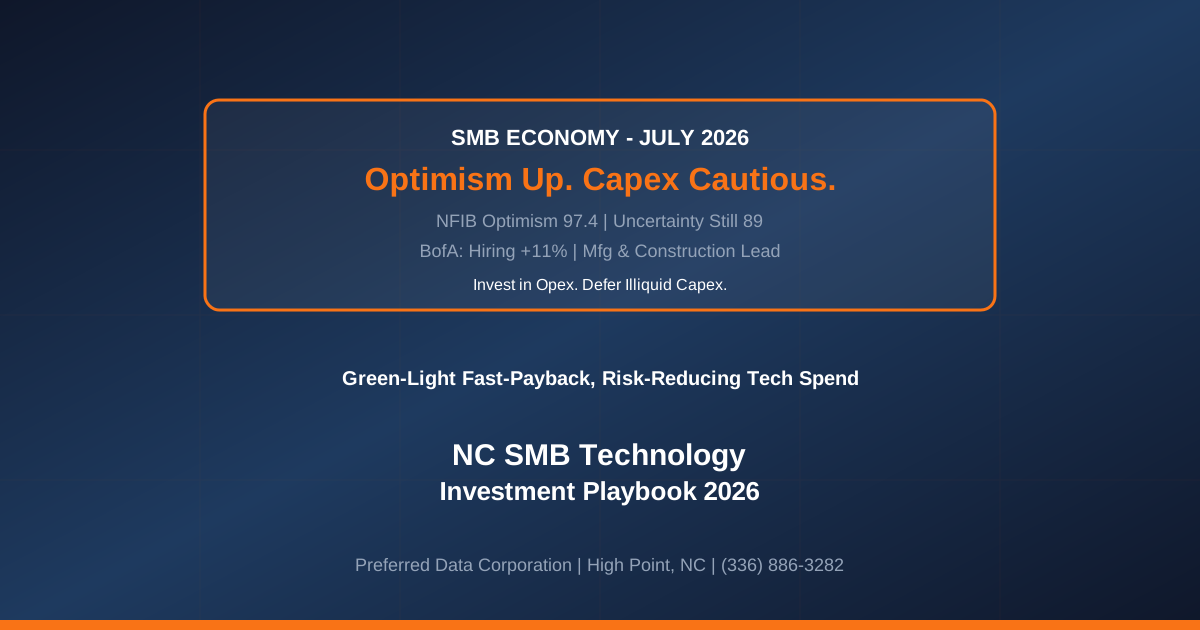
TL;DR: The small-business mood is improving, but the checkbook is still cautious. NFIB's latest Small Business Optimism Index rose 2.1 points to 97.4, nearing its 52-year average of 98.0, and Bank of America's July 2026 Small Business Checkpoint is titled "Signs of improvement," with payments to hiring firms up 11% year-over-year and construction and manufacturing posting the strongest hiring. Yet the same data shows an Uncertainty Index still well above its historical average and owners approaching capital spending with caution as high interest rates persist. For North Carolina small businesses, the July 2026 question is not whether to invest in technology, but which technology spend earns the highest, most predictable return without betting the balance sheet on a capex gamble.
Key takeaway: "Cautious optimism" is exactly the environment where the wrong technology move, a large, debt-financed capex bet, does the most damage, and the right move, converting technology into a predictable operating expense that raises productivity and lowers risk, does the most good. Green-light the spend that pays back inside the year and reduces downside (managed IT, cybersecurity, automation of your costliest workflow). Defer the spend that locks up cash at today's interest rates without a fast, measurable return. The improving sentiment is the signal to invest; the persistent caution is the instruction to invest in opex, not capex.
Want a technology budget matched to a cautious-optimism economy? Contact Preferred Data Corporation at (336) 886-3282 for a 2026-2027 IT investment review. BBB A+ rated, serving High Point, Greensboro, Winston-Salem, Charlotte, Raleigh, and the Piedmont Triad since 1987.
What does the July 2026 small-business data actually say?
The data tells a two-sided story: sentiment and hiring are improving, but uncertainty and interest-rate caution are keeping capital spending restrained. Both sides matter for how you budget technology.
- Optimism is recovering. The NFIB Small Business Optimism Index rose 2.1 points to 97.4, driven by improving expectations for business conditions and real sales, moving back toward the 52-year average of 98.0.
- Hiring is holding, with sector strength. Bank of America's July 2026 Checkpoint reports payments to hiring firms up 11% year-over-year, with construction and manufacturing posting the strongest hiring, two sectors central to NC's economy.
- Caution has not lifted. NFIB's Uncertainty Index, though down slightly, remains at 89, well above its historical average of 68, with high interest rates keeping owners measured on hiring and capital spending.
- Tariff cash is in motion. NFIB notes an estimated 23.4% of tariff payments made directly to Customs and Border Protection have been returned to filing small businesses as of June, a modest but real liquidity event for NC importers.
The net picture is an economy where it makes sense to invest, but where the form of the investment, opex versus capex, matters more than the headline decision to invest.
Why does "cautious optimism" change how you should budget technology?
Cautious optimism rewards technology spending that is reversible, fast-paying, and risk-reducing, and punishes spending that is large, illiquid, and slow to return, because the caution is fundamentally about interest rates and uncertainty, not about a lack of opportunity.
- Interest rates raise the cost of capex. Every dollar tied up in a financed hardware refresh or on-prem build-out competes with a working-capital line that is more expensive than it was two years ago. Opex technology, managed services on a monthly retainer, avoids that lock-up entirely.
- Uncertainty rewards optionality. With the Uncertainty Index still elevated, the ability to scale a technology commitment up or down is worth real money. A managed-service contract flexes; a purchased server does not.
- Improving sales justify productivity spend. Because sales expectations are improving, investments that let existing staff handle more volume, automation, better systems, pay back faster than they would in a shrinking market. This is the spend to accelerate, not defer.
The mistake to avoid is reading "optimism is up" as license for a big capital bet. The correct read is: the opportunity is real, so capture it with the lowest-risk, highest-liquidity instrument available, which is operating-expense technology.
Which technology spend should NC SMBs green-light versus defer?
Sort every technology decision by two questions: does it pay back inside a year, and does it reduce downside risk? The table below applies that filter to the common 2026 spending choices.
| Technology decision | Green-light now | Why |
|---|---|---|
| Managed IT retainer | Yes | Converts loaded FTE overhead into predictable opex; raises uptime |
| Cybersecurity / MDR | Yes | Reduces catastrophic downside; often cuts insurance premiums |
| Automating your costliest workflow | Yes | Fast, measurable payback as sales volume rises |
| Cloud migration of aging on-prem | Usually | Trades capex refresh for scalable opex |
| Large financed hardware refresh | Defer / lease | Locks cash at today's rates with slow return |
| On-prem infrastructure build-out | Defer | Illiquid capex; poor fit for an uncertain, high-rate window |
The pattern is consistent: the "green-light" rows are opex, fast-paying, or risk-reducing, and the "defer" rows are large, illiquid capex. That is the cautious-optimism playbook in one table.
How should you turn improving sentiment into a concrete tech plan?
Run a five-step budgeting sequence that captures the upside of improving conditions while respecting the persistent caution. This is the structure of PDC's business-growth technology planning.
- Rebase to opex where you can. Convert IT overhead into a managed IT retainer so a large share of technology cost becomes predictable and flexes with the business.
- Fund the downside protection. Prioritize cybersecurity and managed detection, because in an uncertain year the cost of a breach is the exact shock a cautious owner cannot absorb, and the spend often self-funds through insurance savings.
- Automate the single most expensive workflow. Pick the one process that most limits how much your current team can handle, then automate it so improving sales convert to margin instead of headcount you are cautious to add.
- Lease, don't finance, unavoidable hardware. Where hardware must refresh, use hardware-as-a-service so the cost stays opex and off the interest-rate-sensitive capex line. Hardware procurement can be structured this way.
- Deploy the tariff refund deliberately. If you received a Customs refund, treat it as a one-time fund for a high-return technology project, not general operating cash it will quietly absorb.
Ready to build this plan for your business? Call Preferred Data Corporation at (336) 886-3282 for a technology investment review calibrated to the July 2026 economy.
Why a managed-services model fits this economy best
A managed-services model is purpose-built for a cautious-optimism environment because it delivers enterprise-grade capability as a predictable, flexible operating cost, exactly the risk profile owners want when rates are high and certainty is scarce. Instead of financing a server and hiring the staff to run it, an NC SMB gets managed IT, security, and infrastructure as a monthly line item that scales with the business. For manufacturers and construction firms, the two sectors BofA flags as strongest in hiring, that predictability lets the business lean into growth without adding the fixed overhead a cautious balance sheet cannot justify. PDC has helped NC businesses make exactly this capex-to-opex shift since 1987, through multiple rate cycles.
Frequently Asked Questions
What is the NFIB Small Business Optimism Index reading for July 2026?
The NFIB Small Business Optimism Index rose 2.1 points to 97.4, moving back toward its 52-year average of 98.0. The gain was driven by improving expectations for business conditions and real sales, though the Uncertainty Index remained elevated at 89, well above its historical average of 68.
Is now a good time for small businesses to invest in technology?
Yes, but in the right form. With optimism improving and sales expectations rising, productivity-raising and risk-reducing technology pays back quickly. But because high interest rates and elevated uncertainty persist, the smart move is operating-expense technology, managed services, cybersecurity, targeted automation, rather than large, debt-financed capital purchases.
What does the Bank of America Small Business Checkpoint say for July 2026?
The July 2026 Checkpoint, titled "Signs of improvement," reports payments to hiring firms up 11% year-over-year, with construction and manufacturing posting the strongest hiring and finance improving the most. It also notes persistent cost pressures, reinforcing that conditions are improving but not fully clear.
Should I use my tariff refund on technology?
If you received a Customs refund, it is well suited to fund a one-time, high-return technology project, such as automating a costly workflow or hardening security, rather than being absorbed into general operating cash. Treating it as dedicated project capital ensures the liquidity produces a durable productivity or risk-reduction gain.
Why is opex technology better than capex in a high-rate environment?
Capex ties up cash and often relies on financing that is more expensive when rates are high, and it is illiquid if conditions change. Opex technology, delivered as managed services, keeps cost predictable, flexes with the business, and avoids competing with your working-capital line. In a cautious, high-rate year, that liquidity and optionality are worth a great deal.
How can Preferred Data help align our tech budget to this economy?
PDC provides a technology investment review that sorts your planned spend into fast-payback opex to green-light and slow, illiquid capex to defer or restructure, then builds a managed-services plan that fits a cautious-optimism budget. Call (336) 886-3282 to schedule.
Related Resources
- NFIB: Small Business Optimism Picks Up in June
- Bank of America Small Business Checkpoint, July 2026
- Preferred Data Managed IT Services
- Preferred Data Business Growth Solutions
- Preferred Data Cybersecurity Services
- Related: Fed July 29 Rate Pivot - NC SMB Tech Budget Plan
- Related: 94% SMB MSP Adoption - In-House IT Unviable