
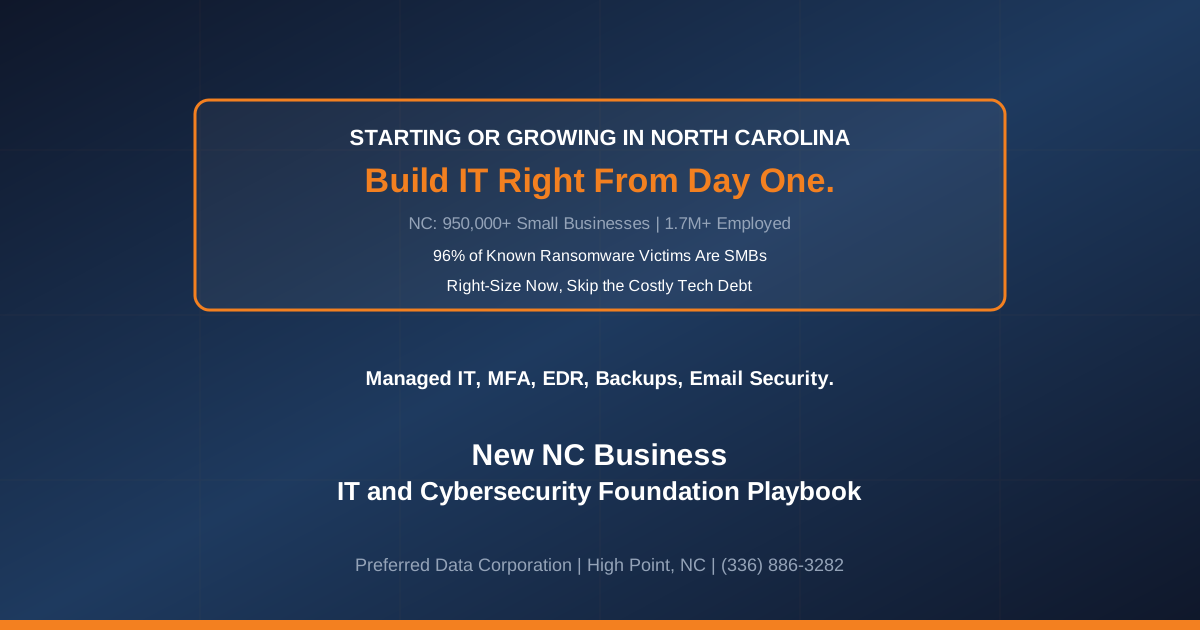
TL;DR: North Carolina is home to more than 950,000 small businesses employing over 1.7 million people, nearly 47% of the state's private workforce, and new business formation remains high nationally heading into late 2026. Yet inflation is now owners' single most important problem, cited by 21% in June 2026 per the NFIB Small Business Optimism survey. The smartest move for a new or fast-growing NC business is to build a right-sized IT and cybersecurity foundation from day one, because retrofitting it after growth or a breach costs far more than doing it right the first time.
Key takeaway: Every dollar you spend building a clean IT and security foundation at launch is a dollar you do not spend later untangling tech debt, recovering from an incident, or re-platforming under pressure. Start right, and technology compounds in your favor instead of against you.
Starting or growing a business in the Piedmont Triad and want technology done right from the start? Contact Preferred Data Corporation at (336) 886-3282 for a right-sizing consultation. BBB A+ rated and serving High Point, Greensboro, Winston-Salem, Charlotte, Raleigh, and the Piedmont Triad since 1987.
Is now a good time to start a business in North Carolina?
Yes. New business applications remain elevated and national new business formation remains high per the SBA Office of Advocacy, supported by more affordable financing, and the NFIB Small Business Optimism Index rose 2.1 points in June 2026 to 97.4, nearing its 52-year average of 98.0. North Carolina in particular is a strong place to launch.
The North Carolina backdrop for a new business is genuinely favorable:
- A deep small business base. North Carolina is home to more than 950,000 small businesses employing over 1.7 million people, nearly 47% of the state's private workforce, per the NC SBTDC State of Small Business.
- A recognized innovation hub. The Research Triangle of Raleigh, Durham, and Chapel Hill is a major technology and life-science center, and the broader Piedmont Triad, anchored by High Point, Greensboro, and Winston-Salem, adds manufacturing and industrial depth.
- Improving conditions. With optimism climbing back toward its long-run average and financing more affordable, the runway for a well-run startup is opening rather than closing.
The opportunity is real, but so is the pressure on costs, which is exactly why day-one discipline matters.
Why is inflation the top concern for new business owners?
Because rising prices squeeze a young business before it has margin to absorb them. Inflation is small business owners' single most important problem, cited by 21% in June 2026 per the NFIB survey, up from 18% in May and the highest reading since October 2024, with taxes (19%) and labor quality (19%) close behind.
For a new NC business, that cost pressure shapes every technology decision:
- Cash is scarce at launch. Cost pressure remains a live constraint on small firms per the Bank of America Small Business Checkpoint, so every technology dollar has to earn its place.
- Overspending and underspending both hurt. Buy too much and you burn cash you do not have; buy too little or too cheaply and you accumulate tech debt that costs more to fix later.
- The answer is right-sizing, not cutting corners. The goal is a foundation matched to your actual size and risk, one that scales as you grow rather than one you outgrow or have to rip out.
Key takeaway: In a high-inflation environment a new business cannot afford to waste money, and cheap, unplanned technology is one of the most expensive things you can buy. Right-sizing from the start protects cash now and prevents far larger costs later.
Want to spend your limited startup dollars where they actually matter? Call Preferred Data at (336) 886-3282 or explore our Managed IT and Cybersecurity services.
What IT does a new small business actually need?
A new business needs a small, deliberate core: reliable managed IT support, security controls on every account and device, tested backups, and standardized, properly licensed hardware and software. This is not enterprise complexity; it is a handful of foundational pieces that prevent the most common and most expensive early mistakes.
The day-one IT and security foundation, in order:
- Managed IT support. A partner who keeps systems patched, monitored, and running so you are not troubleshooting your own network instead of serving customers.
- Multi-factor authentication (MFA) everywhere. Turn it on for email, finance, and every critical login from the first day, before bad habits set in.
- Endpoint protection (EDR). Modern endpoint detection and response on every laptop and workstation, not just consumer antivirus.
- Tested cloud backups. Automated backups you have actually restored from, so a failure or ransomware event is a recovery, not a disaster.
- Email security. Filtering and anti-phishing on your business email, the channel through which most attacks arrive.
- A written security baseline and acceptable-use policy. A short, clear document that sets password, device, and data rules for you and every hire.
- Standardized, licensed hardware and software. Consistent, properly licensed equipment and applications instead of a patchwork of personal devices and unlicensed tools.
Build these seven and you have covered the fundamentals that most small businesses only address after something breaks.
Why build security in from day one instead of later?
Because small businesses are the primary target, and retrofitting security after growth or an incident is far more expensive than building it in. Per the Verizon 2026 Data Breach Investigations Report, 96% of ransomware victims where organization size was known were small and midsize businesses. New businesses are not too small to be attacked; they are exactly the size attackers prefer.
Building security in early beats bolting it on for three concrete reasons:
- The threat does not wait for you to scale. With SMBs making up 96% of size-known ransomware victims per the 2026 DBIR, a brand-new business with weak controls is a target on launch day, not years later.
- Retrofitting is disruptive and costly. Adding MFA, EDR, backups, and policy to a business that has already sprawled across personal devices, shared passwords, and unmanaged apps means untangling habits and data, not just flipping switches.
- Clean foundations enable growth. Standardized, secured systems make it far easier to add employees, pass a client or insurer security review, and pursue compliance-driven work later.
Key takeaway: Security is not an upgrade you buy once you are big enough to afford a breach. For a new business it is table stakes, and the cheapest time to install it is before you have anything sprawling to protect.
How much should a new business budget for IT and security?
Enough to cover the seven foundational pieces at a scale matched to your headcount and risk, delivered through a predictable monthly managed services model rather than unpredictable emergency spending. A local managed IT partner is usually more cost-effective than an unplanned do-it-yourself approach or a premature in-house hire, and it turns technology from a surprise expense into a fixed, plannable cost.
Three budgeting principles for a cost-conscious NC startup:
- Favor predictable operating cost over lumpy capital shocks. Managed services spread cost into a steady monthly figure, which is easier to plan around when inflation is owners' top concern per the NFIB survey.
- Right-size to today, with room to scale. Pay for the protection your current size warrants, using a foundation that grows with you rather than one you outgrow or over-buy.
- Price in the cost of not doing it. With 96% of size-known ransomware victims being SMBs per the 2026 DBIR, the downside of skipping the basics dwarfs the monthly cost of covering them.
Ready to put a predictable, right-sized IT plan in place? Call (336) 886-3282 or learn about our Cloud Solutions.
DIY IT vs. a managed IT partner: which is right?
For most new NC businesses, a managed IT partner beats both do-it-yourself IT and a premature in-house hire on cost, coverage, and risk. Doing it yourself consumes the founder's time and leaves gaps; a first in-house hire is expensive and single-threaded; a managed partner delivers a full team and full toolset for a predictable monthly cost. The table below compares the three paths.
New business technology: three paths compared
| Factor | DIY / founder-run | First in-house IT hire | Managed IT partner |
|---|---|---|---|
| Cost profile | Hidden (founder's time) | High fixed salary plus benefits | Predictable monthly fee |
| Coverage | Gaps and reactive | Single person, limited hours | Full team, proactive monitoring |
| Security depth | Usually incomplete | Depends on one hire | MFA, EDR, backups, email security built in |
| Scales with growth | Poorly | Slowly, more hires needed | Yes, by design |
| Resilience if someone leaves | N/A | Single point of failure | Continuity from a team |
| Time to value | Slow | Recruiting and ramp | Fast onboarding |
For a business watching every dollar, the managed partner path typically delivers the broadest protection for the most predictable cost, which is why it is the common choice for new and growing firms across the Piedmont Triad.
How does Preferred Data help new NC businesses?
Preferred Data Corporation helps new and growing North Carolina businesses stand up a right-sized IT and cybersecurity foundation from day one and scale it as they grow. Through our Managed IT, Cybersecurity, and Cloud Solutions services, we deploy managed support, MFA, endpoint protection, tested cloud backups, email security, a written security baseline, and standardized, properly licensed systems, all sized to your business rather than an enterprise you are not yet. As a firm founded in 1987, with 39 years serving North Carolina businesses and a 20-plus year average client tenure, we build foundations meant to last.
Because we are local, on-site within 200 miles of High Point, we can meet with founders in person, set up the environment correctly, and stay accountable as the business grows through its next hire, location, or compliance requirement. Explore our business growth solutions to see how we support companies through each stage.
Get a right-sizing consultation for your new or growing business. Contact Preferred Data Corporation at (336) 886-3282. We deliver Managed IT, Cybersecurity, and Cloud Solutions for small businesses across High Point, Greensboro, Winston-Salem, Charlotte, Raleigh, and the Piedmont Triad. Serving the region since 1987, BBB A+ rated.
Frequently Asked Questions
What technology does a brand-new small business need first?
A new small business needs a short, deliberate core: managed IT support, multi-factor authentication (MFA) on every important account, endpoint protection (EDR) on every device, tested cloud backups, email security, a written security baseline and acceptable-use policy, and standardized, properly licensed hardware and software. Building these seven from day one prevents the most common and most expensive early mistakes.
Are new and small businesses really targeted by cyberattacks?
Yes, more than most owners assume. Per the Verizon 2026 Data Breach Investigations Report, 96% of ransomware victims where organization size was known were small and midsize businesses. A new business with weak controls is a target on launch day, not years later, which is why security belongs in the foundation rather than in a future upgrade.
Should a new business hire in-house IT or use a managed provider?
For most new North Carolina businesses, a managed IT partner is more cost-effective than a first in-house hire or a do-it-yourself approach. A managed partner delivers a full team and full security toolset for a predictable monthly fee, avoids the single point of failure of one employee, and scales as you grow, which matters when inflation is owners' top concern per the NFIB June 2026 survey.
Is now a good time to start a business in North Carolina?
Conditions are favorable. New business formation remains high nationally per the SBA Office of Advocacy, small business optimism rose to 97.4 in June 2026 per NFIB, and North Carolina is home to more than 950,000 small businesses employing over 1.7 million people. The main headwind is cost, so a right-sized, cash-efficient technology plan is essential.
How much should we budget for IT as a startup?
Budget enough to cover the seven foundational pieces at a scale matched to your headcount and risk, delivered as a predictable monthly managed services cost rather than unpredictable emergency spending. Right-size to your current stage with room to scale, and weigh the monthly cost against the downside of skipping the basics, given that 96% of size-known ransomware victims are SMBs.
Can Preferred Data help a business that is just getting started?
Yes. We set up right-sized managed IT, cybersecurity, and cloud foundations for new and growing North Carolina businesses, sized to your stage rather than an enterprise. Founded in 1987 and on-site within 200 miles of High Point, we serve startups and established firms across High Point, Greensboro, Winston-Salem, Charlotte, Raleigh, and the greater Piedmont Triad.
Related Resources
- NFIB Small Business Optimism, June 2026
- SBA Office of Advocacy - Small Business in Seconds, July 2026
- NC SBTDC State of Small Business 2026
- Verizon 2026 Data Breach Investigations Report findings
- Bank of America Small Business Checkpoint, July 2026
- Preferred Data Managed IT Services
- Preferred Data Cybersecurity Services
- Preferred Data Cloud Solutions