
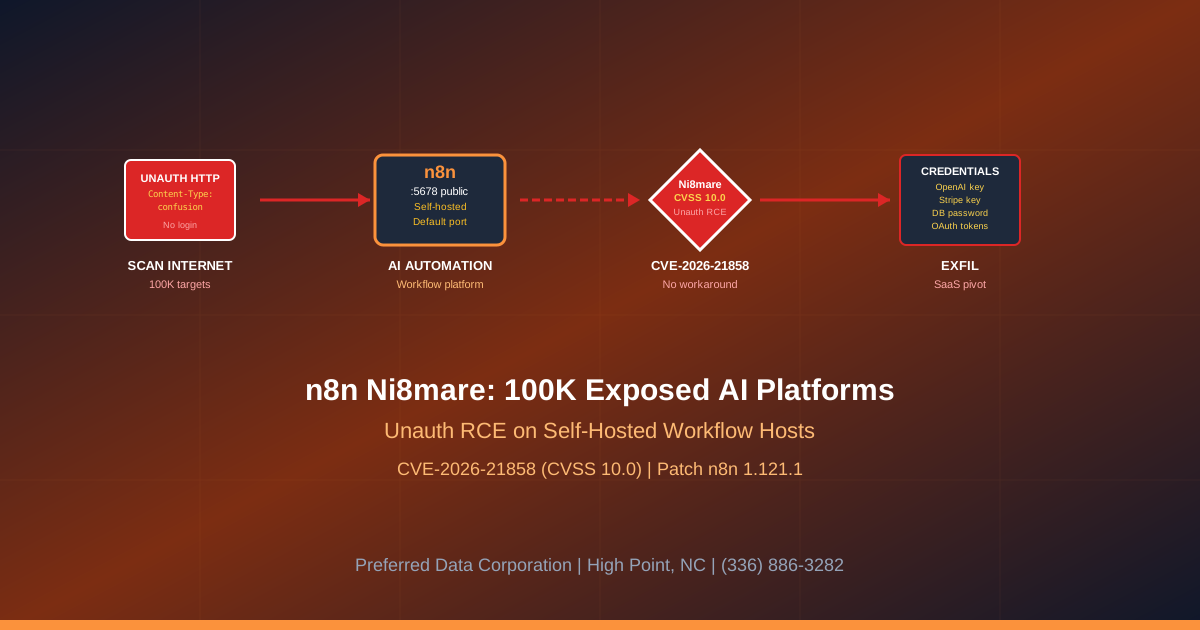
TL;DR: A maximum-severity vulnerability in n8n - the open-source AI agent and workflow automation platform - tracked as CVE-2026-21858 and codenamed "Ni8mare" by Cyera Research Labs, exposes about 100,000 n8n servers globally to unauthenticated full remote code execution with no workaround. Per The Hacker News reporting, the content-type confusion flaw allows an attacker to overwrite internal variables, read arbitrary files, and achieve full RCE - all without any login. The fix is n8n version 1.121.1 or later. NC small businesses running self-hosted n8n for AI agents, copilots, or workflow automations need to confirm the patch this week.
Key takeaway: AI automation tooling reaches production faster than its security posture catches up. A self-hosted n8n exposed to the internet on the default port - which is the most common SMB deployment - is a one-HTTP-request foothold for an unauthenticated attacker. Patch the host or take it off the public internet today.
Need to verify your AI automation stack is safe? Preferred Data Corporation has supported NC small businesses since 1987 and can audit your AI tooling this week. Call (336) 886-3282 or request an AI automation audit.
What is n8n, and why is the SMB story about it now?
n8n is the leading open-source no-code/low-code workflow automation platform - the "Zapier you self-host" - and over the last 18 months it became one of the most common SMB on-ramps to AI agent adoption. Per n8n's own documentation, the platform integrates LLM providers, vector stores, hundreds of SaaS APIs, and arbitrary code execution nodes into visual workflows that NC SMB business analysts can build without traditional engineering staff.
That accessibility is the value proposition and the risk. A self-hosted n8n is an HTTP server that exposes a web admin UI, an API, and a webhook surface. Per The Register's coverage, about 100,000 n8n servers are reachable on the public internet at any time - the platform's docker-compose quickstart makes it trivially easy to spin up an exposed instance, and most SMB owners never close the public port after the first deployment.
Ni8mare changes the calculus. The flaw is unauthenticated. The flaw has no workaround. The flaw gives full RCE. Per Cyera Research Labs' disclosure, an attacker can pivot from an exposed n8n directly into whatever the n8n instance is connected to - which for SMB deployments is typically the CRM, email, Slack, GitHub, S3 buckets, OpenAI keys, and the business's whole automation stack.
What is CVE-2026-21858, the Ni8mare flaw?
CVE-2026-21858 is a content-type confusion vulnerability in n8n, scored CVSS 10.0 - the maximum severity. Per SocRadar's analysis, the flaw lets an unauthenticated attacker manipulate HTTP request headers to overwrite internal application variables. From there the attacker can read arbitrary files from the underlying system, then escalate to full remote code execution.
Three-step attack pattern:
- HTTP request to the n8n public endpoint with a crafted Content-Type header. The mismatch tricks the application's request parser into treating the body in a way it should not.
- Internal variable overwrite. The crafted parsing path lets the attacker overwrite trusted internal state - the exact mechanism Cyera Research Labs disclosed in November 2025 and detailed publicly on the January 2026 CVE assignment.
- Arbitrary file read or RCE. The attacker reads OS files (env vars, secrets, credentials) and pivots to executing code with the n8n process's privileges.
Per Rapid7's coverage, the disclosure landed alongside related n8n flaws (N8scape and others), meaning the platform has been under sustained security scrutiny for months. The fix is n8n 1.121.0 (released November 18, 2025), but defenders should run 1.121.1 or later to cover the post-disclosure follow-up fixes.
Quotable definition: Content-type confusion is a class of HTTP parser bug where an attacker sends a request whose declared Content-Type does not match the body format the application expects. The mismatch lets the attacker reach into the application's internal request-handling logic, often bypassing input validation and authentication, and is one of the most common patterns in modern unauthenticated RCE disclosures.
Why are NC small businesses uniquely exposed to Ni8mare?
Because the n8n adoption curve in NC SMBs is steep and the security posture curve is flat. Per Field Effect's coverage, the typical SMB deployment is:
- A single n8n docker container on a single VPS
- The default port (5678) bound to a public interface
- A self-signed cert or a Cloudflare tunnel as the only TLS layer
- A handful of "admin" workflows that store live API keys for OpenAI, Stripe, Mailgun, HubSpot, Salesforce, and the SMB's database
When an unauthenticated RCE lands on that host, the attacker gets all of it - the OpenAI key that the SMB pays per-token for, the Stripe key that can refund transactions, the database credential that backs the customer portal, and the OAuth tokens to every SaaS the n8n instance was wired to.
| Asset class | Stored in typical n8n | What an attacker does with it |
|---|---|---|
| OpenAI / Anthropic API keys | Yes (in credentials store) | Pump bills with abuse usage |
| Database credentials | Yes (for workflow data nodes) | Exfiltrate the customer database |
| Email provider keys (Mailgun, SendGrid, Resend) | Yes | Send phishing as the SMB |
| Slack OAuth tokens | Yes | Read all internal channels |
| Cloud storage keys (S3, R2, GCS) | Yes | Exfiltrate documents, deploy malware |
| Payment provider keys (Stripe, Square) | Yes | Refund fraud, payment redirection |
| Source control tokens (GitHub PAT) | Frequently | Plant a backdoor in source code |
| Customer data webhooks | Yes | Pivot to the customer-facing system |
Which NC small businesses are most exposed?
NC SMBs that adopted n8n - or any low-code AI automation platform - between 2024 and 2026 without a security review, and NC SMBs whose business analyst or office manager runs the n8n instance instead of IT. Per SecurityWeek's coverage, the platform is now widely deployed in SMB customer-service, lead-routing, and AI-agent workflows.
Highest-exposure NC SMB profiles:
- NC manufacturers in High Point, Winston-Salem, and Greensboro using n8n to bridge ERP/MES, CRM, and customer-service AI agents. A compromised n8n instance is a foothold inside the manufacturing operational stack. See our AI transformation services page for governance.
- NC professional services firms in Charlotte and Raleigh using n8n to summarize client documents or auto-route engagement requests. Client documents and engagement metadata are the target.
- NC distributors with n8n-driven order-entry, inventory sync, or supplier integration workflows. Inventory data, supplier pricing, and order history all flow through the n8n.
- NC SMBs running n8n on a cheap VPS with no MSP-managed perimeter. The default-port-public deployment is the easiest scan target.
- NC SMBs whose n8n is "shadow IT" - the business analyst stood it up without involving IT. Per Cybersecurity News reporting, shadow-IT n8n is one of the fastest-growing SMB shadow categories of 2026.
Worried that an n8n instance you forgot about is still exposed? Call (336) 886-3282 or request an AI automation inventory.
What should NC small businesses do in the next 14 days?
Run a five-step plan. None of these require new product purchases. Most are configuration and discipline.
- Inventory every n8n instance the business runs (days 1-2). Include "official" instances on managed infrastructure, shadow-IT instances on personal cloud accounts, and dev/staging instances stood up for evaluation. Per Cyera's advisory, the most-exploited n8n instances are the ones nobody is officially monitoring.
- Upgrade every instance to n8n 1.121.1 or later (days 2-5). Per the n8n release notes, the upgrade is a standard docker pull and restart for self-hosted deployments. n8n Cloud customers are patched at the host level.
- Move every n8n instance off the public internet (days 5-10). Put it behind a reverse proxy with authentication, a VPN, a Cloudflare Access policy, or a Tailscale ACL. Per Help Net Security's prior coverage, 100,000 exposed n8n instances is too many; making yours one fewer is the highest-leverage operator move this week.
- Rotate every credential the n8n instance stores (days 5-10). API keys, OAuth tokens, database passwords - assume disclosure for any credential that lived on a pre-1.121.1 n8n that was internet-reachable. Reference our Cybersecurity services page for managed credential rotation.
- Add AI automation governance to the quarterly compliance calendar (day 14 forward). Policy: no internet-exposed AI automation host. Policy: vendor-vetted platforms only. Policy: SMB IT (or MSP) signs off on every new AI tool. Train the business analyst who wrote the first n8n flow. The next platform-level CVE is coming.
Key takeaway: The single most important step this week is removing the n8n admin UI from the public internet. The patch matters; the perimeter posture matters more, because the next n8n CVE will land too.
Self-hosted vs managed: which path makes sense for NC SMBs?
The Ni8mare disclosure is the right moment to revisit the build-vs-buy decision on AI automation infrastructure. Per Gartner's 2026 SMB AI automation guidance, the operational burden of self-hosted AI tooling is higher than most SMB owners model when they choose the platform.
| Deployment model | Cost per month | Security responsibility | Patch responsibility | NC SMB best fit |
|---|---|---|---|---|
| Self-hosted n8n on SMB VPS | $10-50 | 100% SMB / MSP | 100% SMB | NC SMBs with mature IT |
| Self-hosted n8n on managed VPS via MSP | $100-500 | Shared SMB / MSP | Shared SMB / MSP | NC SMBs ready to scale |
| n8n Cloud (managed) | $20-300 | Shared SMB / vendor | Vendor | Most NC SMBs |
| Vendor-hosted AI automation (Zapier, Make, etc.) | $20-500 | Mostly vendor | Vendor | Risk-averse NC SMBs |
| Bespoke MSP-built integration | $500-5000 | MSP | MSP | NC SMBs with custom needs |
For NC SMBs without dedicated DevOps capacity, the managed tier is almost always the right answer. The marginal cost difference is a few hundred dollars a month; the marginal risk difference is a CVSS-10 unauthenticated RCE.
How does Preferred Data Corporation help NC SMBs harden AI automation?
PDC has supported NC small businesses since 1987 and treats AI automation infrastructure as a security-first procurement decision. We bring three things to the Ni8mare conversation:
- AI transformation services: Vendor-vetted AI automation platform selection, security review of self-hosted vs managed trade-offs, governance policy for AI tool adoption, and the integration patterns that let NC SMBs ship AI features without inheriting platform-level CVE risk.
- Cybersecurity services: AI tool inventory, exposed admin panel sweep, credential rotation runbooks, and incident response for suspected n8n compromise. We help NC SMBs find the shadow-IT n8n that nobody on the leadership team knew was running.
- Managed IT services: Continuous AI infrastructure posture monitoring, automated patch tracking for self-hosted AI platforms, perimeter hardening, and the day-to-day operational work that keeps the next AI platform CVE from being a same-week incident. For NC manufacturers in High Point, distributors in Greensboro, and professional services firms in Charlotte and Raleigh, the managed baseline is what makes a Ni8mare-class event a 4-hour patch task rather than a 4-week credential-rotation marathon.
For small business owners in High Point, the Piedmont Triad, Greensboro, Winston-Salem, Charlotte, and Raleigh, the Ni8mare disclosure is the cue to formalize AI automation governance. The CISA SMB resources frame this clearly: SMBs face enterprise-grade exposure with a fraction of the staff. A trusted local partner closes the gap.
Ready to audit your AI automation stack this week? Call (336) 886-3282 or book an AI automation review.
Frequently Asked Questions
What is the Ni8mare flaw in n8n?
Per Cyera Research Labs, Ni8mare is the codename for CVE-2026-21858, a CVSS 10.0 content-type confusion vulnerability in the n8n workflow automation platform. It allows unauthenticated remote attackers to overwrite internal variables, read arbitrary files, and achieve full remote code execution with no user interaction and no workaround.
How many n8n servers are exposed?
About 100,000 globally, per Cyera Research Labs as reported by The Register. Most are SMB-owned, default-port deployments that were never put behind a VPN or reverse proxy after the initial install.
What version of n8n fixes the flaw?
n8n 1.121.0 (released November 18, 2025) introduced the patch; defenders should run 1.121.1 or later to cover post-disclosure follow-up fixes. Per Field Effect, there is no configuration workaround. Patching or taking the instance off the public internet are the only mitigations.
What credentials should I rotate?
Every credential stored in the n8n credentials vault: OpenAI/Anthropic API keys, OAuth tokens for SaaS integrations, database passwords, cloud storage keys, payment provider keys, and source control tokens. Assume disclosure for any credential that lived on a pre-1.121.1 n8n that was reachable on the public internet.
Is n8n Cloud affected?
The n8n Cloud (managed) tier is patched at the host level by the vendor. SMB customers on the managed tier do not need to take action beyond standard credential hygiene. Per the n8n changelog, self-hosted is the at-risk deployment model.
Should NC small businesses use n8n at all?
Yes, when the deployment is secure and the data flowing through it is appropriately classified. n8n is a powerful and economical platform. The risk is not the platform; it is the deployment posture. Most NC SMBs are better served by n8n Cloud or by a managed self-hosted deployment on infrastructure their MSP runs.
Related Resources
- AI Transformation Services for NC Businesses - Vendor-vetted AI automation
- Cybersecurity Services for NC Small Businesses - AI tool inventory and incident response
- Managed IT Services for NC Businesses - Continuous AI infrastructure monitoring
- Mastra npm easy-day-js Supply Chain: NC SMB Defense 2026 - AI framework supply chain
- Shadow AI Governance: NC SMB Defense 2026 - Shadow-IT AI risk
- AI Governance Small Business Risk Management NC 2026 - AI policy framework
- Contact Preferred Data Corporation - AI automation audit for NC SMBs