
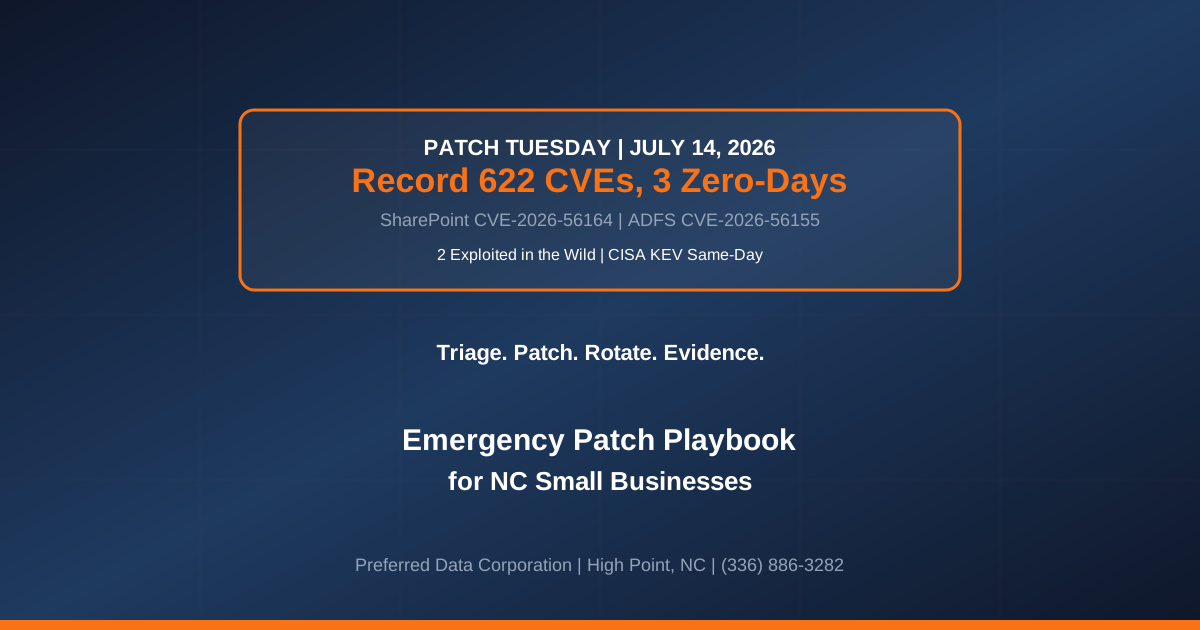
TL;DR: On July 14, 2026, Microsoft shipped the largest Patch Tuesday in its history: 622 CVEs (roughly triple June's already-record 200), including three zero-day vulnerabilities. Two are being actively exploited: CVE-2026-56164, a missing-authentication elevation-of-privilege flaw in on-premises SharePoint Server (2016, 2019, Subscription Edition) that any unauthenticated attacker with network reach can trigger, and CVE-2026-56155, an elevation-of-privilege flaw in Active Directory Federation Services (AD FS). CISA added both to the Known Exploited Vulnerabilities (KEV) catalog the same day with a July 17 federal deadline. Microsoft attributes the CVE surge to AI-driven vulnerability discovery inside Microsoft Security Response Center. Every NC SMB running on-prem SharePoint or hybrid AD FS federation needs an emergency 72-hour patch window this week.
Key takeaway: 622 CVEs in one month is not a patching problem; it is a triage problem. If your MSP is still running a monthly "we test everything for two weeks" cadence, you are 30 to 60 days behind the actively-exploited zero-days. Patch SharePoint and AD FS this week. Everything else follows the normal SLA.
Do you run SharePoint on-premises or AD FS in a hybrid tenant? Contact Preferred Data Corporation for a same-week emergency patch and compromise-hunt engagement. BBB A+ rated. On-site within 200 miles of High Point. Call (336) 886-3282.
What Actually Shipped in the July 14, 2026 Patch Tuesday?
Microsoft's July 14, 2026 security update is the largest single-month release in the company's history. Public tallies range from 570 to 622 CVEs depending on which sources count Chromium-based Edge, Mariner, and Azure-hosted services in the total. Two of the three zero-days are actively exploited today.
Three concrete facts every NC SMB should treat as confirmed:
- 622 CVEs total, three zero-days. Two zero-days are actively exploited (CVE-2026-56164 SharePoint and CVE-2026-56155 AD FS). One is publicly disclosed but not yet exploited (CVE-2026-50661, a BitLocker security-feature-bypass requiring physical access).
- 59 CVEs rated "Critical." Of the critical set, 48 are remote-code-execution flaws, 9 are elevation of privilege, 1 is security feature bypass, and 1 is spoofing.
- CISA KEV additions the same day. CVE-2026-56164 and CVE-2026-56155 both went straight to the Known Exploited Vulnerabilities catalog with the July 17 remediation deadline for federal agencies. Private-sector cyber insurance policies increasingly treat KEV listing as the trigger for the "reasonably foreseeable" exposure standard.
Microsoft attributes the surge in CVE volume to accelerated AI-driven vulnerability discovery inside the Microsoft Security Response Center. Independent researchers, notably at Zero Day Initiative, Qualys, and Tenable, corroborate the pattern: AI-assisted variant analysis is now surfacing dozens of related bugs from each single reported issue, and Microsoft is choosing to ship the entire clustered set rather than defer.
Key takeaway: The 622-CVE month is not an outlier. It is the new baseline. NC SMBs need a patch operating model that assumes 300-plus CVEs a month is normal and that AI-discovered bug clusters land in batches. "Read every CVE before we patch" no longer scales.
Why Is CVE-2026-56164 (SharePoint) So Dangerous for NC SMBs?
CVE-2026-56164 is a missing-authentication-for-critical-function flaw in on-premises SharePoint Server that lets an unauthenticated attacker elevate privileges over the network. In plain English: an attacker who can reach the SharePoint Web Front End on TCP 80 or 443 can gain elevated access without a valid account.
Three concrete failure modes NC SMBs need to guard against this week:
- Public-facing SharePoint sites. Many NC manufacturers, distributors, and construction firms still expose SharePoint 2016 or 2019 to the internet for partner document exchange. Any of those instances is directly exposed.
- Internal SharePoint reachable from a compromised endpoint. A ransomware crew with a single foothold on a laptop can pivot to internal SharePoint over the LAN without any additional credential theft. This is the classic 2024-2026 initial-access-to-domain-dominance path.
- Legacy SharePoint on Windows Server 2016/2019 domain controllers or co-located hosts. Small SMBs with SharePoint co-located with Exchange, file services, or the domain controller are one attacker step away from full domain takeover.
The vulnerability affects all supported on-premises SharePoint versions: Subscription Edition, 2019, and 2016. SharePoint Online (Microsoft 365) is not affected. NC SMBs that migrated to SharePoint Online during the 2020-2024 M365 rollouts are outside the blast radius. NC SMBs that kept on-premises SharePoint for regulatory, cost, or legacy-integration reasons are directly exposed.
CISA's July 14 KEV addition and same-day emergency advisory ("CISA Urges SharePoint Hardening After New Exploitations") signal that federal defenders are seeing real exploitation, not theoretical risk.
What Should NC SMBs Do About CVE-2026-56155 (AD FS)?
CVE-2026-56155 is an elevation-of-privilege flaw in Active Directory Federation Services (AD FS) rooted in insufficient granularity of access control. An authenticated attacker with low local privileges on an AD FS server can escalate to administrator. Because AD FS servers issue security tokens for downstream Microsoft 365, Salesforce, Workday, and hundreds of other SaaS applications, an attacker with admin on an AD FS server can silently impersonate any user across the entire federated estate.
Three specific behaviors NC SMBs should treat as required:
- Patch AD FS servers this week. Windows Server 2012, 2012 R2, 2016, 2019, 2022, and 2025 all shipped fixes in the July 14 cumulative updates. Apply them in a same-week emergency window; do not wait for the normal monthly cycle.
- Rotate AD FS token-signing and token-decryption certificates. If an attacker had admin access during the exposure window, the certificates in memory may already be exfiltrated. Rotation is a 30-minute operation and closes the "attacker has your signing key" scenario.
- Audit AD FS admin sign-ins for the last 90 days. Look for interactive logins from unfamiliar IPs, off-hours, or new devices. Any anomaly is a P0 incident.
For NC SMBs that federated M365 to on-premises AD DS via AD FS in the 2018-2022 hybrid identity wave, this is the single highest-impact patch in the July release. A compromised AD FS is functionally a compromised Microsoft 365 tenant.
How Should NC SMBs Prioritize 622 CVEs in a Single Week?
The volume problem is real. A 40-person NC SMB with a two-person internal IT team cannot review 622 CVE writeups in a single week and make sensible patch decisions. The correct answer is not "read every CVE." The correct answer is a tiered prioritization model.
Comparison: Legacy monthly patch cadence vs 2026 tiered emergency-plus-baseline model.
| Dimension | Legacy Monthly (Pre-2026) | Tiered 2026 Model |
|---|---|---|
| Volume assumption | 100-150 CVEs/mo | 300-600 CVEs/mo (AI-discovered clusters) |
| Test window | 2 weeks all patches | 24-72 hours KEV; 2 weeks baseline |
| Decision unit | Individual CVEs | CVE tiers (KEV, exploited, critical, other) |
| Change window | 1 per month | 3 tiers per month (emergency, priority, baseline) |
| SharePoint zero-day path | Waits for month-end window | Same-week patch, no test gate |
| AD FS zero-day path | Waits for month-end window | Same-week patch, credential rotation |
| Cyber insurance signal | "We patch monthly" | "We patch KEV in 72 hours" |
| CVE reading effort | Impossible at 600/mo | Read tier-1 (KEV) only; delegate tier-2/3 to MSP |
The right-hand column is not aspirational. It is what every NC SMB with a competent managed IT partner delivers today. The wrong-hand column is what most NC SMBs still run, and the gap between the two is what makes ransomware crews so productive against SMBs.
This is exactly the patch operating model Preferred Data delivers as part of our Managed IT Services and Cybersecurity practice. We separate KEV emergencies from baseline monthly rollout, run the emergencies inside a documented 72-hour SLA, and give you an evidence packet your cyber insurance broker will accept.
What About CVE-2026-50661 (BitLocker) and the Other 619 CVEs?
CVE-2026-50661 is a publicly disclosed but not-yet-exploited security-feature-bypass in Windows BitLocker's device encryption. Exploitation requires physical access to the affected device, so the risk profile is different from a network-borne zero-day. It matters most to NC SMBs with mobile workforces (sales laptops, field-service laptops, executive travel laptops) where a lost or stolen device is a routine event. Patch on the normal cadence and rotate BitLocker recovery keys for any device that is unaccounted for.
The remaining ~619 CVEs cluster into predictable buckets: Windows kernel, Office suite, Azure services, .NET runtime, SQL Server, and Edge/Chromium. Baseline monthly rollout with a 14-day pilot ring is appropriate for the entire remainder. Do not conflate the two exploited zero-days with the volume of the release.
Ready to run this week's emergency patch cycle with confidence? Call PDC at (336) 886-3282 or request a same-week SharePoint and AD FS patch engagement. We patch, rotate certificates, audit sign-in logs, and hand back a documented evidence packet.
Why the AI-Discovered CVE Surge Changes the SMB Threat Model
The technical story of the record 622 CVE month is Microsoft's internal AI-assisted variant analysis. The strategic story is that attackers have the same tools. Every vulnerability class that Microsoft's AI clusters and ships in one big batch is also being clustered by adversary AI on the offensive side.
Three second-order effects NC SMBs should expect:
- Shorter median time-to-exploit. The 2025 industry median for internet-facing infrastructure was 5 days from patch release to first observed exploitation. The AI-driven acceleration is compressing that toward 48-72 hours for high-impact CVEs.
- Batch-and-monetize by ransomware crews. Groups like Qilin, Play, Akira, and RansomHub increasingly wait for Patch Tuesday, harvest KEV additions, and hit unpatched SMBs in coordinated waves during Tuesday-through-Friday of the patch week.
- A documented KEV cadence helps at renewal. It gives you a written answer when an insurance application asks how quickly you patch.
For NC manufacturers, construction firms, professional-services offices, and financial institutions, the compound effect is that the difference between a well-run and a poorly-run patch program is now the difference between a normal cyber premium and an uninsurable renewal.
How Preferred Data Runs Patch Tuesday for NC SMBs
Preferred Data Corporation has spent 39 years supporting NC manufacturers, construction firms, healthcare providers, professional-services offices, and financial institutions through exactly this kind of patch-volume shock. Our Patch Tuesday operating model has four layers.
PDC's four-layer 2026 Patch Tuesday model for NC SMBs:
- Tuesday evening triage. Within four hours of Microsoft's release, we identify KEV additions, actively-exploited CVEs, and any CVE affecting a system in your specific inventory. You get a same-day executive summary with the tier-1 patch list.
- Wednesday-Thursday emergency deployment. Tier-1 patches deploy to a pilot ring on Wednesday morning and to production on Thursday. SharePoint, AD FS, Exchange, and internet-facing appliances are always tier-1 when they carry a KEV.
- Following two weeks baseline rollout. Tier-2 and tier-3 patches follow the standard 14-day rollout with rings, monitoring, and rollback plans.
- End-of-month evidence packet. You receive a monthly report documenting every KEV remediation time, every deviation with justification, and every rollback. This is the evidence packet your cyber insurance broker, your CMMC assessor, and your board's audit committee expect.
Cost for a typical 40-100 person NC SMB: baseline included in our Managed IT Services subscription. Emergency-only engagements for SMBs without an MSP: $3,500-$7,500 per Patch Tuesday cycle. The alternative, a ransomware event during the 72-hour post-Patch-Tuesday exploitation window, is a $150,000-$500,000 incident-response engagement plus the ransom and the downtime.
Frequently Asked Questions
What is CVE-2026-56164 and why is it dangerous?
CVE-2026-56164 is a missing-authentication elevation-of-privilege flaw in on-premises Microsoft SharePoint Server (2016, 2019, and Subscription Edition). An unauthenticated attacker who can reach the SharePoint Web Front End over the network can escalate privileges without any user interaction. CISA added it to the Known Exploited Vulnerabilities catalog on July 14, 2026, and Microsoft confirms in-the-wild exploitation.
Does CVE-2026-56164 affect SharePoint Online in Microsoft 365?
No. The vulnerability affects on-premises SharePoint Server only. SharePoint Online (Microsoft 365) is not vulnerable. NC SMBs that migrated to SharePoint Online during the 2020-2024 M365 rollouts are outside the blast radius for this CVE.
How is CVE-2026-56155 in AD FS different from a generic Windows privilege-escalation bug?
Active Directory Federation Services (AD FS) issues authentication tokens for downstream applications like Microsoft 365, Salesforce, Workday, and hundreds of other SaaS platforms in the typical NC SMB stack. An attacker with admin on AD FS can silently mint tokens for any federated user, which is functionally equivalent to compromising every SaaS application the organization uses.
What is CVE-2026-50661 and do we need to patch it immediately?
CVE-2026-50661 is a publicly disclosed but not-yet-exploited security-feature-bypass in Windows BitLocker device encryption. Exploitation requires physical access, so the urgency is lower than a network-borne zero-day. Patch on your normal monthly cadence and rotate BitLocker recovery keys for any laptop that is lost, stolen, or unaccounted for.
Should we still test patches for two weeks before deploying?
Not for KEV-listed CVEs. The industry has moved to a two-tier model: tier-1 KEV emergency patches deploy inside 24-72 hours with a light pilot ring, and tier-2 baseline patches follow the traditional 14-day cycle. Blocking a KEV patch for two weeks of testing is the exact behavior ransomware crews plan around.
How does our cyber insurance renewal see this?
If your renewal questionnaire asks how quickly you patch, a documented 72-hour KEV cadence gives you a clear, written answer.
What if we run SharePoint on Windows Server 2012 R2 or a version out of support?
Then the July 14 CVE is the least of your problems. Windows Server 2012 R2 exited even extended security updates and any SharePoint on that platform is unsupported end-to-end. Preferred Data delivers same-week migration planning and cutover for legacy SharePoint estates. Call (336) 886-3282.
Related Resources
- Managed IT Services for NC Small Businesses
- Cybersecurity Services
- Cloud Solutions and Microsoft 365 Migration
- Contact PDC — request a same-week SharePoint and AD FS patch engagement