
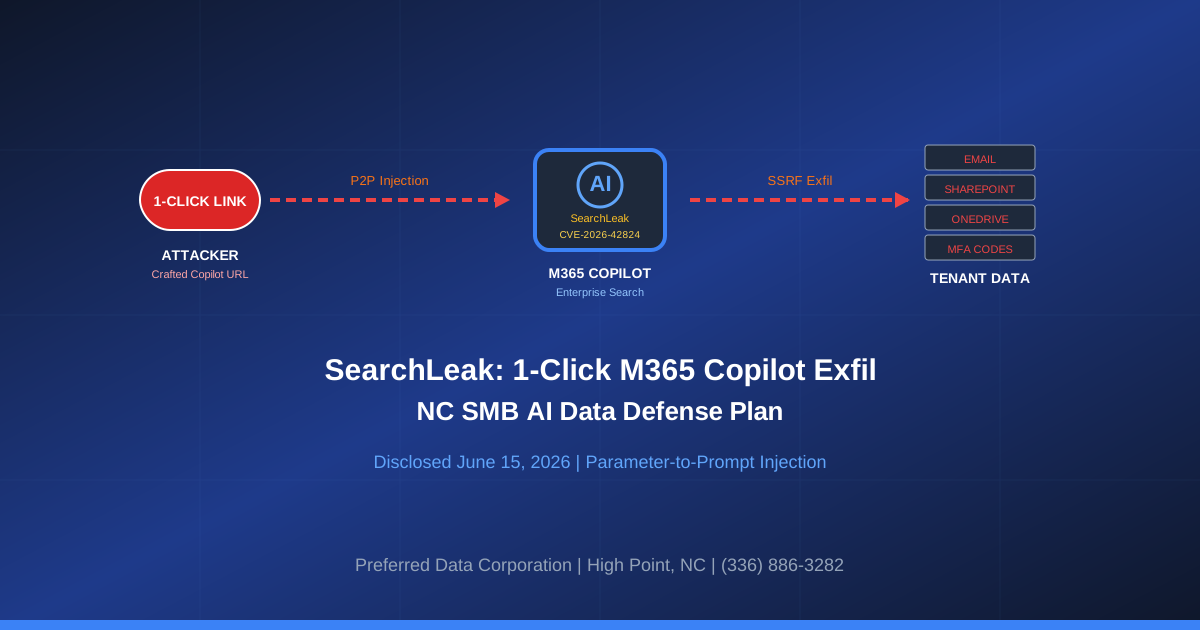
TL;DR: On June 15, 2026, Varonis Threat Labs disclosed SearchLeak, tracked as CVE-2026-42824, a one-click data exfiltration chain that let attackers pull emails, calendar entries, SharePoint and OneDrive content, and even MFA codes out of Microsoft 365 Copilot Enterprise Search. The chain combined a Parameter-to-Prompt Injection (P2P) bug with an HTML injection race condition and a server-side request forgery; Microsoft has patched the issue server-side per The Hacker News coverage. NC small businesses rolling out Copilot now need a governance baseline that assumes the AI assistant is a high-privilege user, not a passive search box.
Key takeaway: SearchLeak is a one-click attack against an AI assistant that sees everything in the tenant. The patch closes this specific flaw; the governance lesson - that prompt-injected content can act as the user - applies to every future Copilot vulnerability and every SMB rolling out AI.
Rolling out M365 Copilot at your NC business - or already running it? Preferred Data Corporation has supported NC small businesses since 1987 and can audit your Copilot exposure this week. Call (336) 886-3282 or request a Copilot governance review.
What is SearchLeak (CVE-2026-42824) and what data did it expose?
SearchLeak is a one-click vulnerability chain in Microsoft 365 Copilot Enterprise Search disclosed by Varonis Threat Labs and tracked as CVE-2026-42824. With a single click on a crafted link delivered by email, Teams, Slack, or any messaging channel, an attacker could exfiltrate emails, calendar details, indexed SharePoint and OneDrive files, and even one-time MFA codes from the victim's mailbox. Per The Hacker News reporting, Microsoft assigned the flaw its maximum severity rating and patched it server-side before public disclosure.
Three reasons NC SMBs should treat this disclosure as a governance event, not just a "patched, move on":
- AI as a privileged identity. Copilot reads everything the user can read - mailbox, calendar, OneDrive, SharePoint, Teams. A vulnerability in the AI assistant is a vulnerability that touches the entire data estate at once.
- One click, no warning. Per BleepingComputer coverage, the attack required only a single click on a link that looked benign; there was no second prompt, no MFA challenge, no obvious download.
- Patched is not protected. Microsoft patched SearchLeak server-side; the next prompt-injection chain has not been disclosed yet. NC SMBs need acceptable-use, data-classification, and review policies that survive the next vulnerability.
How did the SearchLeak attack chain actually work?
The chain stitched together three classes of bug into a one-click exfiltration. Per Varonis Threat Labs' technical writeup, step one was a Parameter-to-Prompt Injection (P2P) - a new class of AI-specific vulnerability where attacker-controlled URL parameters end up inside the prompt the LLM executes. Step two was an HTML injection race condition that let the attacker render attacker-controlled markup in the Copilot response pane. Step three was a server-side request forgery (SSRF) that let the rendered markup trigger an outbound request carrying the exfiltrated data.
The five-step attack chain:
- Attacker crafts a Copilot link with malicious parameters that smuggle a prompt-injection payload through query strings.
- Victim clicks the link in an email, Teams message, or Slack DM. The link looked like a normal Copilot search URL.
- Copilot executes the injected prompt as if it were a legitimate search request from the user.
- HTML injection renders attacker-controlled markup in the Copilot response pane during a race condition Varonis identified.
- SSRF exfiltrates the data by triggering an outbound HTTP request that carries the user's mailbox contents, MFA codes, and indexed file content to the attacker.
Quotable definition: SearchLeak (CVE-2026-42824) is a one-click vulnerability chain in Microsoft 365 Copilot Enterprise Search disclosed by Varonis Threat Labs on June 15, 2026, that combined Parameter-to-Prompt Injection with HTML injection and SSRF to silently exfiltrate emails, calendar entries, SharePoint and OneDrive content, and MFA codes from a victim's tenant.
Why is Parameter-to-Prompt Injection a new category of risk for NC SMBs?
Because Parameter-to-Prompt Injection (P2P) is the AI-era version of SQL injection. Per Varonis Threat Labs, P2P happens when attacker-controlled inputs (typically URL parameters) flow into the LLM prompt without proper sanitization, so the model executes the attacker's instructions as if they came from the legitimate user. Every NC SMB that deploys Copilot, ChatGPT Enterprise, Claude for Work, or an in-house RAG application now ships an attack surface that traditional web application firewalls do not understand and traditional SIEM rules do not detect.
| Risk class | Traditional defense | Defense vs. AI prompt injection |
|---|---|---|
| SQL injection | Parameterized queries, WAF | N/A - different attack surface |
| XSS / HTML injection | Output encoding, CSP | Partial - relevant to the second-stage rendering |
| SSRF | Network egress allowlist | Yes - same defense applies to AI tools |
| Prompt injection (P2P) | None of the above | Input/output filtering at the AI tier, scoped tool use, human-in-the-loop |
| Data exfiltration via AI | DLP on mail/file | Partial - DLP does not see AI prompt traffic |
The reason traditional defenses fall short: the attack lives inside a prompt the model is supposed to follow. There is no malformed payload to block, no malware to scan, no shell command to detect. The defense lives at the AI application layer - prompt sanitization, scoped tool permissions, output filtering before rendering, and clear separation between "data the model reads" and "instructions the model obeys." Per CSO Online's analysis of AI-era risks, governance is the long-term answer; the next CVE will close before the next attack class is named.
Which NC small businesses are most exposed to SearchLeak-style risk?
NC SMBs that have deployed Microsoft 365 Copilot (or any tenant-wide AI assistant) without a documented governance baseline. The Copilot license sells itself on broad data access - the whole point is that it can summarize anything in the tenant. That value proposition is also the blast radius when an injection vulnerability lands.
The highest-exposure NC SMB profiles:
- NC manufacturers in High Point, Winston-Salem, and Greensboro running Copilot on SharePoint document libraries. Engineering drawings, BOMs, customer pricing, and supplier contracts are all indexed by Copilot. An injection vulnerability turns the assistant into a one-click data leak channel. See our Managed IT services for tenant-hardening guidance.
- NC distributors in Greensboro, Charlotte, and Raleigh with Copilot connected to financial workbooks. Account ledgers, customer master data, and pricing files live in the tenant; the assistant sees all of it.
- NC professional services firms (legal, accounting, consulting) in Raleigh, Charlotte, and Winston-Salem. Client work product lives in OneDrive and SharePoint. Copilot is the productivity argument; SearchLeak is the governance counter-argument.
- NC SMBs with email-based MFA workflows. Per The Hacker News, SearchLeak could read MFA codes from inbound mail. NC SMBs that still use email-delivered OTPs for any business system are exposed beyond Copilot itself.
- NC defense contractors with Copilot in scope. CMMC 2.0 treats Copilot's data access as in-scope for CUI handling; an AI exfiltration event in scope is reportable.
Worried that your Copilot rollout has more reach than your governance plan accounts for? Call (336) 886-3282 or request a Copilot exposure review.
What governance steps should NC SMBs take this week?
Run a five-step plan over the next 14 days. SearchLeak is patched; the goal of the plan is to be ready for the next disclosure and to make sure your Copilot deployment is configured before the next clickable link arrives.
- Inventory Copilot licenses and connectors (days 1-3). List every user with a Copilot license, every SharePoint site indexed, every OneDrive folder reachable, and every Microsoft Graph connector enabled. Per Microsoft's Copilot security guidance, what Copilot can see is governed by tenant permissions, not Copilot itself.
- Audit oversharing in SharePoint and OneDrive (days 3-7). Run a permissions report; identify sites and folders shared with "Everyone except external users" or anonymous links. Copilot will index whatever the user can access; tenant-wide oversharing becomes Copilot-wide exfiltration risk.
- Move email-delivered MFA off the tenant (days 5-10). Switch from email OTP to authenticator-app or hardware-key MFA on every business system. Per Varonis, email-delivered MFA was one of the data classes SearchLeak exfiltrated.
- Publish an AI assistant acceptable-use policy (days 7-12). Document what users may paste into Copilot, what data classifications may be summarized, what is forbidden, and what to do when a prompt looks suspicious. Reference our Cybersecurity services for templated policies.
- Train end users on prompt-injection awareness (days 10-14). Most users do not know that clicking a Copilot link can do harm. Run a 30-minute briefing covering SearchLeak and the broader pattern of prompt-injection attacks. Repeat quarterly.
Key takeaway: The first action is inventory. NC SMBs cannot govern data they did not know Copilot could read. A two-day permissions audit is the highest-ROI security step in the next two weeks.
How does Preferred Data Corporation help NC SMBs govern Microsoft 365 Copilot?
PDC has supported NC small businesses since 1987 and treats AI assistants as tier-one identities in the tenant. We bring three things to the SearchLeak conversation:
- AI Transformation services: Copilot rollout governance, SharePoint and OneDrive permissions remediation, acceptable-use policy authoring, and prompt-injection awareness training for NC SMBs adopting M365 Copilot, ChatGPT Enterprise, or Claude for Work.
- Cybersecurity services: Tenant hardening reviews, DLP policy configuration for AI tools, MFA modernization off of email-delivered codes, and incident-response runbooks for suspected AI data exfiltration events.
- Managed IT services: Monitored tenant configuration baselines, patch posture for connected applications, identity and conditional access policies, and the day-to-day operational work that keeps the Copilot deployment governed in production. For NC manufacturers in High Point, distributors in Greensboro, and professional services firms in Charlotte and Raleigh, the managed baseline is what keeps the AI assistant from becoming an unmanaged exfiltration channel.
For small business owners in High Point, the Piedmont Triad, Greensboro, Winston-Salem, Charlotte, and Raleigh, SearchLeak is the cue to formalize Copilot governance now rather than after a clickable link arrives. The CISA SMB resources frame this clearly: SMBs face enterprise-grade exposure with a fraction of the staff. A trusted local partner closes the gap.
Ready to govern the Copilot deployment already running in your tenant? Call (336) 886-3282 or book a Copilot governance review.
Frequently Asked Questions
What is CVE-2026-42824 / SearchLeak?
CVE-2026-42824, dubbed SearchLeak, is a one-click vulnerability chain in Microsoft 365 Copilot Enterprise Search disclosed by Varonis Threat Labs on June 15, 2026. It combined Parameter-to-Prompt Injection with HTML injection and SSRF to silently exfiltrate emails, calendar entries, SharePoint and OneDrive content, and MFA codes from the victim's tenant.
Is SearchLeak patched?
Yes. Microsoft patched SearchLeak server-side before disclosure; per The Hacker News, no user action is required to receive the fix. The governance lesson - that prompt-injected content can act as the user - remains relevant for every future Copilot vulnerability.
What is Parameter-to-Prompt Injection (P2P)?
Per Varonis Threat Labs, Parameter-to-Prompt Injection is a class of AI vulnerability where attacker-controlled inputs (typically URL parameters) flow into the LLM prompt without sanitization, causing the model to execute the attacker's instructions as if they came from the legitimate user. It is the AI-era counterpart to SQL injection.
Does MFA stop SearchLeak?
No. The attack ran inside the user's authenticated Copilot session - there was no second authentication prompt to challenge. Worse, SearchLeak could exfiltrate email-delivered MFA codes, breaking the security of any other system that relied on email OTP.
Which NC SMBs are most exposed?
NC SMBs that have deployed M365 Copilot without a permissions audit on SharePoint and OneDrive, NC SMBs that still rely on email-delivered MFA for business systems, NC professional services firms with client work product in the tenant, and NC defense contractors handling CUI inside Copilot scope.
What is the first thing an NC SMB should do this week?
Run a SharePoint and OneDrive permissions audit. Identify sites or folders shared with "Everyone except external users" or anonymous links. Copilot indexes whatever the user can access, so tenant-wide oversharing becomes the blast radius for the next AI prompt-injection bug. Then publish an acceptable-use policy and brief end users.
Related Resources
- AI Transformation Services for NC Businesses - Copilot governance, policy, and end-user enablement
- Cybersecurity Services for NC Small Businesses - Tenant hardening and DLP for AI tools
- Managed IT Services for NC Businesses - Monitored tenant baselines and identity policy
- Microsoft 365 Copilot Prompt Injection CVE-2026-26129 NC SMB 2026 - Earlier Copilot injection lesson
- AI Agents Inside the Perimeter: Shadow AI Governance NC 2026 - Shadow AI risk for NC SMBs
- Microsoft 365 Security Settings NC 2026 - Tenant baseline configuration
- Contact Preferred Data Corporation - Copilot governance review for NC SMBs