
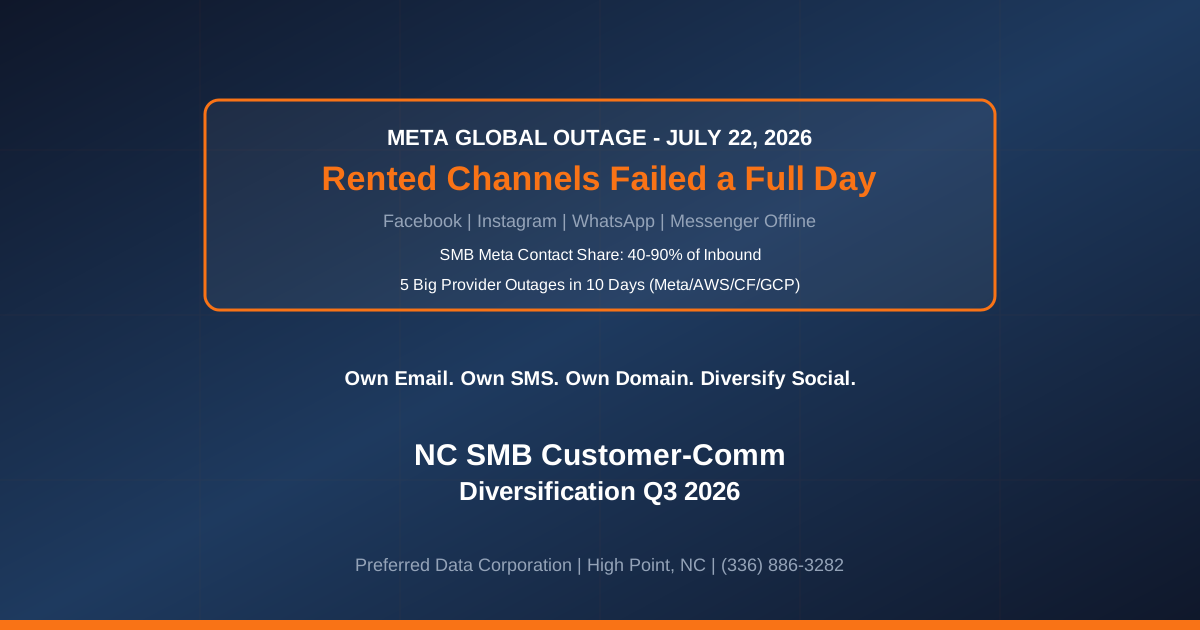
TL;DR: On Wednesday, July 22, 2026, Meta suffered a global outage that took Facebook, Instagram, and WhatsApp offline for millions of users, across every continent Meta operates in. Per demandsage's internet outage statistics tracker, it was the largest single-provider social outage of Q3 2026 to date, and it hit two days before the AWS us-west-2 outage of July 24. For NC small businesses that run 40-90% of customer communication through Meta channels — Piedmont Triad furniture DTC brands on Instagram Shopping, Charlotte-area restaurants on WhatsApp Business, Triangle service businesses using Facebook Messenger for lead intake — a Meta outage is not an inconvenience, it is a lost sales day. The July 22 event validated a lesson NC SMBs have been putting off: the customer relationship you rent from Meta is not the customer relationship you own.
Key takeaway: A resilient NC SMB customer-communication stack in 2026 has an owned foundation (email list + SMS list + CRM in your control) and rented channels (Meta, Google, TikTok) layered on top — not the other way around. If Meta going down for four hours takes your bookings, your lead intake, or your customer-service channel offline, you are running a platform-dependent business without the diversification any risk manager would recommend.
Need a two-week customer-communication diversification assessment? Contact Preferred Data Corporation at (336) 886-3282 for a right-sized first-party-data and channel-resilience review. BBB A+ rated, serving High Point, Greensboro, Winston-Salem, Charlotte, Raleigh, and the Piedmont Triad since 1987.
What Happened During the July 22, 2026 Meta Outage?
Meta lost service on Facebook, Instagram, WhatsApp, and Messenger simultaneously on Wednesday, July 22. Per isinternetup.com's July 2026 outage log, the outage was globally distributed and affected users on every continent. Downdetector spikes cleared over several hours; the WhatsApp Business API and Meta's Marketing API also went dark, which cut off the ad-optimization and audience-sync jobs that Meta advertisers depend on to keep campaigns running.
The broader July 2026 outage picture per the same tracker included:
- July 14 — Cloudflare's 1.1.1.1 public DNS resolver experienced a global outage that affected DNS-dependent applications worldwide.
- July 15-16 — Google Cloud's europe-west4-a region had a power and cooling incident that pushed workloads into failover for European customers.
- July 16 — AWS CloudFront VPC-origins outage affected many customer-facing SaaS API paths.
- July 22 — Meta global outage.
- July 24 — AWS us-west-2 external-connectivity outage (Apple Pay, DoorDash, Reddit, Hulu, PSN offline).
Five significant provider outages in ten days. Any NC SMB that only diversifies against one of these — say, having a Google presence "in case Meta goes down" — is missing the pattern: the entire consumer-facing platform layer is in a period of elevated incident frequency.
Why Are Meta Outages Worse for NC SMBs Than for Enterprises?
Three structural reasons NC SMBs feel Meta outages harder than large brands.
- Higher share of total customer contact through Meta. A typical NC SMB DTC brand or hyper-local service business runs 40-90% of customer inbound (DMs, comments, WhatsApp messages, Messenger threads) through Meta properties. Large brands still get most of their inbound through owned channels — support tickets, email, phone — with Meta as one of many.
- Weaker fallback infrastructure. Enterprises have branded email, SMS shortcodes, in-app messaging, and call centers. Many NC SMBs have a Gmail account, a personal cell number for the owner, and a Meta presence. When Meta goes down, there is no backup channel of comparable scale.
- Ad-spend concentration. Per WordStream / Meta industry data, the median SMB Meta ad-spend concentration is 60-75% of total digital budget. When the Marketing API goes down during a campaign, the pacing and audience-sync failures cost more than the outage window itself; recovery of ad-account health can take 24-72 hours.
The convergence explains why a four-hour Meta outage often costs NC SMBs a full day of pipeline and one to three days of recovery drag.
What Are the Five Highest-Impact NC SMB Customer-Comm Diversification Moves?
A Q3 2026 customer-communication diversification playbook, in decreasing order of universal applicability.
- Own your email list on infrastructure you control. Export your Meta audience data (custom audiences, engaged followers) and enrich against your CRM. Grow the owned email list through opt-in mechanisms on your website, at point-of-sale, and via QR codes on printed materials. Owned email is the single most-resilient customer channel — no platform can turn it off.
- Stand up an SMS list on a business-SMS platform. Business SMS (via TCR-registered 10DLC numbers, or a short code for higher-volume senders) is the second-most-resilient channel. Grow the SMS list with explicit opt-in language and a two-tap unsubscribe. Deliverability rules are strict; work with a partner who knows the compliance requirements.
- Establish a branded-domain email address for every customer-facing role. Not "[email protected]" — an actual email at your own domain ([email protected]). This makes your outreach less likely to hit spam, gives you a fallback if a personal Gmail account is compromised, and lets you enforce MFA and DMARC/DKIM/SPF on the domain.
- Diversify social presence beyond Meta. Google Business Profile, LinkedIn (for B2B), TikTok, YouTube Shorts, and Pinterest all have material NC SMB audiences and none of them shared Meta's July 22 outage. Post the same content strategically across two or three; do not become dependent on Meta's algorithm alone.
- Update your CRM to track "channel of first contact" and "current preferred channel" per customer. Two fields per contact. When Meta goes down, you can filter for "customers currently preferring email or SMS" and continue the relationship. Most NC SMB CRMs do not track this and consequently cannot execute an outage-window pivot.
Executed together, the five moves reduce the "Meta went down and my day is over" pattern to "Meta went down and my SMS + email channels absorbed the demand."
Owned vs Rented Customer Channels: The Q3 2026 Reality
The following comparison shows the resilience characteristics of each channel type.
| Channel | Owned or Rented | Deliverability Risk | Outage Risk | Right For |
|---|---|---|---|---|
| Branded email + your own domain | Owned | Low (with DMARC/DKIM/SPF) | Very low | Newsletter, transactional, order confirmation |
| Business SMS (10DLC/short code) | Semi-owned | Very low (with TCR registration) | Very low | Booking reminders, order updates, urgent |
| Owned website + branded blog | Owned | Zero | Zero (with proper hosting) | Long-form marketing, SEO, thought leadership |
| Facebook / Instagram Meta channels | Rented | Medium (algorithm-dependent) | High (July 22 event) | Discovery, community, retargeting |
| WhatsApp Business | Rented | Low (once connected) | High (July 22 event) | International customer service |
| Google Business Profile | Rented | Low | Medium | Local discovery, reviews |
| TikTok | Rented | Medium | Medium | Brand awareness, younger demos |
| Rented | Low | Low | B2B lead gen, professional services | |
| Direct mail | Owned | Low | Zero | Local trust building, printed collateral |
For most NC SMBs, the goal is a stack that puts owned channels at 40-60% of customer contact and rented channels at 40-60%, with an active migration plan to convert rented-channel followers into owned-list contacts.
What About WhatsApp — Isn't That My Primary Customer-Service Channel?
For NC SMBs with international customers, immigrant-owned businesses, and hospitality operators serving international travelers, WhatsApp is often the single largest inbound-message channel. The July 22 outage took it down globally.
Three specific WhatsApp resilience moves.
- Publish an out-of-band contact method in your WhatsApp business profile. A phone number, an email, or an SMS shortcode that customers can use when WhatsApp is down. Most SMBs do not, and their July 22 experience was silence.
- If you use WhatsApp Business API through a Business Solution Provider (BSP), understand the SLA. BSPs vary widely in their outage response. Ask specifically about incident notification, message-queue behavior during outages, and recovery-time commitments.
- Migrate high-value conversations into your CRM or a persistent-record system. WhatsApp is a channel, not a system of record. If your only history of a $50,000 furniture-order conversation is in a WhatsApp thread on the owner's personal phone, you have a customer-continuity problem beyond outage risk.
What Does a Right-Sized NC SMB Customer-Comm Diversification Plan Actually Cost?
A representative 30-90 day rollout for a typical 20-100 seat NC SMB.
- Owned email stack. Migration to a CRM-connected email platform (HubSpot Starter, ActiveCampaign, MailerLite): $50-$500/month depending on list size, plus $2,000-$8,000 in setup and design.
- Business SMS platform. 10DLC registration, TCR fees, and a monthly platform fee: $200-$1,500/month depending on volume.
- Branded email domain and DMARC/DKIM/SPF setup. $50-$300/year for domain and DNS, plus $500-$1,500 in setup with a competent MSP.
- CRM baseline (channel-tracking fields). Included in most CRM plans; setup is a 2-4 hour engagement.
- Content diversification. Ongoing operating expense — typically an existing marketing-labor line, redirected.
Total 90-day investment for a right-sized rollout is $6,000-$18,000 in setup plus $500-$3,000/month in ongoing platform costs. For most NC SMBs, this pays for itself the first time a Meta outage costs a day of sales it would otherwise have absorbed.
Which NC SMB Verticals Face the Highest Meta-Concentration Risk?
Four segments carry disproportionate exposure and should be at the front of the Q3 diversification review.
- DTC brands and specialty retailers on Instagram Shopping. Instagram is often 50-80% of discovery and 30-60% of order pipeline. A four-hour Meta outage is a measurable revenue hit; a 24-hour outage (rare but possible) is catastrophic.
- Restaurants, food-service, and hospitality operators using WhatsApp Business and Facebook Messenger for bookings. The July 22 outage lost a full day of reservations for many hospitality operators; the recovery was a Thursday-morning scramble.
- Local service businesses (contractors, salons, mobile services) using Instagram + Google Business Profile. These SMBs' business is discovery; Instagram outage plus any Google incident compounds into a lead-gen drought day.
- NC nonprofits and community organizations using Facebook Groups for member engagement. Facebook Groups do not have an owned-equivalent alternative, and a Meta outage cuts direct member engagement entirely.
For all four, the actionable move is the same: run the Q3 diversification assessment, own the email and SMS list, and use Meta channels for discovery and community rather than as the primary system of record.
Ready for a two-week customer-communication diversification assessment for your NC business? Contact Preferred Data Corporation at (336) 886-3282. Serving High Point, Greensboro, Winston-Salem, Charlotte, Raleigh, and the Piedmont Triad since 1987.
Frequently Asked Questions
When did the July 22, 2026 Meta outage start and end?
Per isinternetup.com's July 2026 outage log, the outage began mid-day on Wednesday, July 22, 2026 and lasted several hours globally, with a long tail on WhatsApp Business API and Meta Marketing API. Facebook, Instagram, WhatsApp, and Messenger were all affected. The exact window varied by geography and by user population.
Was the July 22 Meta outage a cyberattack?
No public evidence has been shared indicating a cyberattack. Meta has historically attributed similar outages to backbone routing changes and internal configuration errors (the October 2021 six-hour outage is the reference case). Regardless of cause, the operational impact for NC SMBs is the same: plan for it as an incident category, not as a "one-off."
How much of my marketing budget should be Meta versus other channels?
There is no single answer, but a useful heuristic for 2026 is: no single rented channel should exceed 40% of your customer-contact concentration or 50% of your digital ad spend. If Meta is currently 70%+, the diversification path is to hold Meta constant in absolute dollars and grow other channels underneath it, not to cut Meta abruptly. Growth into Google, LinkedIn (for B2B), and email/SMS is typically the first-order move.
What is 10DLC and why does it matter for business SMS?
10DLC (10-Digit Long Code) is the modern regulated framework for A2P (application-to-person) SMS from businesses in the US. Registration through TCR (The Campaign Registry) is required, and deliverability outside the framework is materially worse in 2026 than it was three years ago. Any NC SMB planning to use SMS as a customer-communication channel should work with a partner who handles TCR registration and deliverability optimization, not roll their own.
Can I own my Instagram followers if I diversify?
Partially. You cannot export a functional follower list with contact information from Instagram, but you can build an on-platform strategy that funnels engaged followers to an owned channel (email opt-in via link-in-bio, SMS opt-in via story-swipe, offline promotion at physical events). The goal is to convert rented reach into owned contact over time, not to abandon the rented platform.
How does customer-communication diversification interact with the BCDR/cloud-outage playbook?
Directly. Both are applications of the same underlying principle — single-provider dependency creates blast-radius risk, and resilience comes from thoughtful diversification. PDC's July 24 AWS outage BCDR playbook applies the same discipline to cloud-infrastructure architecture. NC SMBs that treat the two as one Q3 initiative typically see 20-30% cost efficiencies vs treating them as separate projects.
Related Resources
- Internet & Cloud Outages July 2026 tracker — isinternetup.com
- Internet outage statistics 2026 — DemandSage
- Preferred Data Managed IT Services
- Preferred Data Custom Software & Data Integration
- Preferred Data Cloud Solutions
- Related: AWS July 24 US-West-2 Outage — NC SMB Multi-Region BCDR
- Related: Cloud Outage Resilience Multi-Cloud Strategy 2026
- Related: Business Continuity Planning for NC Manufacturers 2026