
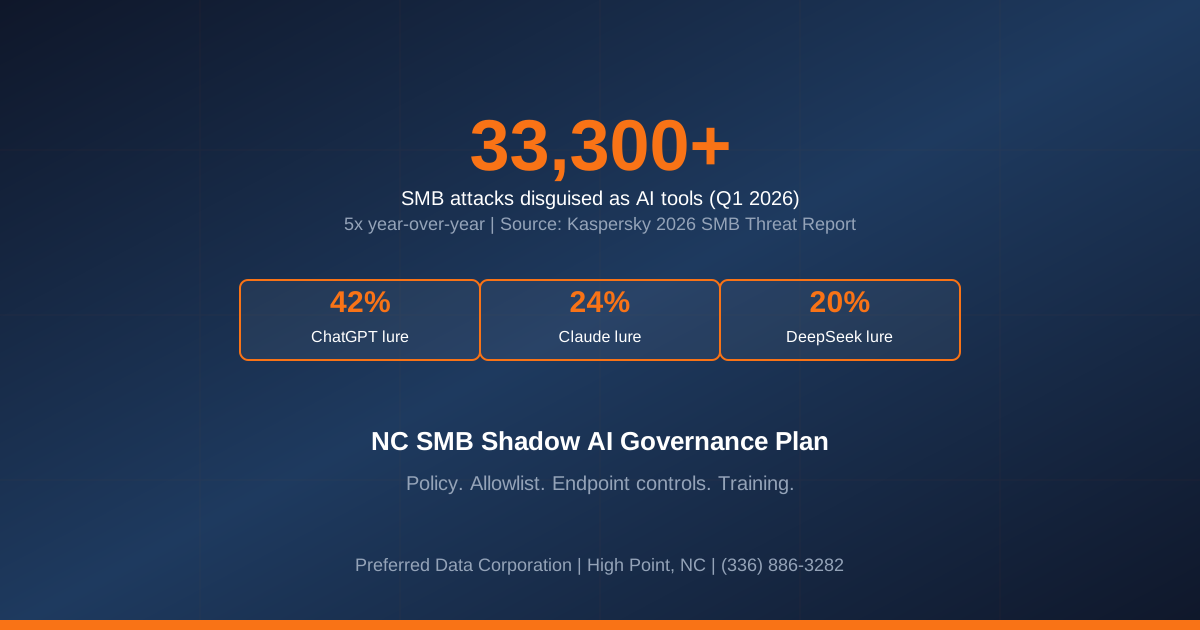
TL;DR: Kaspersky's 2026 SMB Threat Landscape report, released ahead of International SMB Day (June 27), documents 33,300+ cyberattacks on small and medium-sized businesses in the first four months of 2026 that were disguised as popular AI services — a nearly 5x increase versus the same period in 2025 and 39% more than attacks disguised as office and collaboration tools. ChatGPT was impersonated in 42% of these attacks, Claude in 24%, and DeepSeek in 20%. Kaspersky identified 1,100+ unique malicious samples across five AI services, a 21% increase year-over-year. For NC SMBs, this is the concrete disclosure event that turns "we should have an AI policy" into "we need an AI acceptable-use policy, an allowlist, and endpoint controls by end of Q3 2026."
Key takeaway: Every AI tool your team is using without an IT sign-off is a shadow AI installation. In a threat environment where five times more malware wears an AI costume than a year ago, shadow AI is not a productivity risk — it is a malware distribution channel.
Do you have a written AI acceptable-use policy and an approved-tools allowlist? Contact Preferred Data Corporation for an AI governance and shadow-AI audit. BBB A+ rated. On-site within 200 miles of High Point. Call (336) 886-3282.
What Does the Kaspersky 2026 SMB Threat Report Actually Say?
Kaspersky's June 27, 2026 report is the largest publicly available data set on SMB-targeted malware disguised as AI tools. Between January and April 2026, Kaspersky solutions blocked more than 33,300 attacks on SMBs where the malicious payload masqueraded as a popular AI service. That figure is approximately 5x the January-April 2025 count and 39% higher than the count of attacks disguised as traditional office and collaboration tools (Word, Excel, Teams, Zoom).
Key data points from the report:
- 33,300+ SMB attacks disguised as AI tools in Q1 2026 (January-April).
- 5x year-over-year increase vs. January-April 2025.
- 1,100+ unique malicious samples across the five most-impersonated AI services (a 21% increase YoY).
- ChatGPT was impersonated in 42% of these attacks.
- Claude in 24% — reflecting Claude's rise in market share among developers and mid-market users.
- DeepSeek in 20% — reflecting the January 2026 release of DeepSeek R1 and the subsequent surge in curiosity downloads.
- 415,000 attacks in the same period disguised as fake messenger and video conferencing apps — a related supply-chain phishing pattern.
The malware payloads observed by Kaspersky include information stealers (credentials, cookies, MFA seeds, crypto wallet data), remote access trojans (persistent backdoor access), backdoors used for downstream ransomware deployment, and adware / PUA payloads that create browser-hijacking persistence.
Key takeaway: The malware business model has followed the market. Attackers spend social engineering effort on the tools users actually want to try. In 2026, that means AI.
Why Are NC SMBs Especially Vulnerable to Fake AI Tool Attacks?
NC SMBs — Piedmont Triad manufacturers evaluating generative AI for shop-floor documentation, Charlotte professional-services firms testing Claude for drafting, Greensboro construction companies trying ChatGPT for RFP response, Raleigh healthcare providers piloting AI transcription — all share a common vulnerability profile:
- Small IT teams cannot review every AI tool a user wants to try. The default answer becomes "download it and see" instead of "submit a change request."
- Trust in "popular" AI brands is high. Users assume ChatGPT.exe, Claude Installer, or DeepSeek Setup is legitimate because the brand is legitimate.
- Endpoint controls are inconsistent. Many SMB fleets still allow user-initiated installs, do not enforce SmartScreen / Gatekeeper, and do not gate AI SaaS access at the DNS or browser layer.
- AI evaluation culture is high. Users are actively hunting for the "best AI tool" and are more willing to download from search results, TikTok links, or Discord shares than they would be for other software.
- BYOD and shadow SaaS. Users evaluate AI tools on personal devices then bring the workflow to work — leaking corporate data and importing malware simultaneously.
For NC manufacturers pursuing Industry 4.0 initiatives, the shadow-AI problem intersects with OT/IT convergence risk. A shop-floor supervisor who downloads a "ChatGPT desktop app" that turns out to be an infostealer has just handed the attacker credentials that pivot from the office network into the plant floor.
What Payloads Are Actually Being Delivered by Fake AI Tool Attacks?
Kaspersky and other threat-intelligence vendors have observed the following payload categories delivered via fake AI installers in 2026:
| Payload Type | Business Impact | Detection Difficulty |
|---|---|---|
| Infostealers (RedLine, Lumma, Vidar, StealC) | Credential theft, session token theft, crypto wallet exfiltration | Medium — signature-based AV catches most known variants |
| Remote Access Trojans (Async RAT, XWorm) | Persistent backdoor, keystroke logging, screen capture | Medium — behavioral EDR catches most |
| Backdoors for Ransomware (SmokeLoader, GuLoader) | Second-stage payload delivery, ransomware deployment | High — often heavily obfuscated |
| Adware / PUA (bundled Chrome hijackers) | Browser session hijacking, ad injection, traffic redirection | Low — most AV catches |
| Cryptominers | CPU / GPU consumption, elevated power costs | Low — most AV catches |
| Wipers (rare but rising) | Data destruction | Medium — detection depends on trigger conditions |
The most dangerous class in 2026 is the credential-theft-plus-second-stage combination: an infostealer harvests session tokens and MFA seeds, sells them on a criminal marketplace, and 30-60 days later a ransomware affiliate uses those credentials for initial access into the SMB. The user never sees the connection between "I downloaded ChatGPT.exe in April" and "we got hit with ransomware in June."
What Does an AI Acceptable-Use Policy Look Like for an NC SMB?
An AI acceptable-use policy (AUP) is a 2-4 page document that answers three questions for every employee: which AI tools they may use, what data they may input into AI tools, and what they must do before adopting a new AI tool.
Minimum required policy elements:
- Approved AI tools allowlist. The specific SaaS applications and desktop apps that IT has vetted. Includes the sanctioned entry point (URL, corporate SSO login, IT-managed installer).
- Data classification rules. Which data classes (Public, Internal, Confidential, Restricted) may be entered into which AI tools. Restricted / CUI / PHI data typically bans public AI tools entirely.
- Prohibited actions. No downloading AI installers from search results, torrent sites, GitHub forks, or social media links. No pasting customer data or code into public LLMs. No connecting personal AI subscriptions to work accounts.
- Request-a-new-tool process. The workflow for evaluating a new AI tool — 5-10 business day IT security review, vendor risk questionnaire, DPA review.
- Incident reporting. How employees report a suspected fake AI installer, a suspicious AI SaaS login, or data pasted in error.
- Enforcement. Consequences for violation, including disciplinary escalation for repeat violations.
For NC manufacturers subject to CMMC, DFARS, or ITAR, the AI AUP must include explicit CUI handling rules. For healthcare providers, PHI. For financial services, GLBA / FFIEC-scoped data.
Key takeaway: An AI AUP is not a productivity brake. It is the document that lets you say "yes" to AI adoption without saying "yes" to shadow AI. The alternative is not "no AI" — the alternative is "AI plus malware."
What Technical Controls Actually Stop Fake AI Tool Attacks?
Policy is necessary but insufficient. Technical controls turn the policy into an enforced boundary.
Endpoint controls (must-haves):
- Application allowlisting. Windows Defender Application Control (WDAC), AppLocker, or equivalent macOS gatekeeper posture. Deny user-installed executables by default.
- Behavioral EDR. CrowdStrike, SentinelOne, Microsoft Defender for Endpoint, Sophos Intercept X. Configured with AI-lure signatures active.
- Removal of local admin rights from standard users. This alone stops the majority of drive-by installer attacks.
- Enforced SmartScreen / Gatekeeper. Block unsigned installers.
Network / DNS controls (must-haves):
- DNS filtering / secure web gateway. Cisco Umbrella, Cloudflare Gateway, Zscaler, DNSFilter. Block newly registered domains, known typosquats (chatgpt-download[.]com, claude-installer[.]org), and known malicious ASNs.
- SaaS allowlist / CASB. Approved AI SaaS platforms allowed; unapproved AI SaaS blocked at the browser or proxy level.
- Browser isolation for high-risk categories. Users can visit an unknown AI service in an isolated browser session that cannot download or paste data.
Identity controls (must-haves):
- Phishing-resistant MFA on every corporate identity. FIDO2 / passkeys for admins.
- Conditional access policies that gate SaaS AI access to managed devices only.
- Continuous access evaluation (CAE) to revoke tokens on user termination, device compromise, or high-risk sign-in.
Detection controls (must-haves):
- 24/7 SOC monitoring for infostealer detonation, RAT beaconing, and credential-theft indicators.
- Threat-intelligence feeds for known fake AI tool infrastructure.
- Post-download detonation in a sandbox for user-initiated installs.
How Should NC SMBs Sequence an AI Governance Rollout in Q3 2026?
A 90-day AI governance rollout is achievable for a typical NC SMB (50-500 employees). The sequence:
Weeks 1-2: Discovery.
- Inventory current AI tool usage via endpoint telemetry, SaaS discovery, browser history sampling, and employee survey.
- Identify the top 5-10 AI tools in actual use.
- Classify by risk (Approved / Conditional / Prohibited).
Weeks 3-4: Policy.
- Draft AI acceptable-use policy with input from Legal, HR, IT, and business unit leads.
- Draft data classification rules.
- Draft request-a-new-tool workflow.
Weeks 5-8: Technical controls.
- Deploy DNS filtering and SaaS allowlist controls.
- Roll out application allowlisting to a pilot group, then fleet-wide.
- Configure EDR AI-lure signatures.
- Deploy conditional access policies for AI SaaS.
Weeks 9-10: Training.
- All-hands training on the AI AUP.
- Manager training on the request-a-new-tool workflow.
- Role-specific training for high-risk functions (developers, marketing, finance).
Weeks 11-12: Monitoring and iteration.
- SOC dashboards for shadow AI detection.
- Monthly review with business unit leads.
- Quarterly policy refresh.
Explore Preferred Data's AI transformation services
How Does Fake AI Malware Intersect With Ransomware in 2026?
The Kaspersky data point that matters most for NC SMBs is not the 33,300 attacks — it is the payload class. When infostealers are the primary payload, the SMB gets breached twice: once when the malware detonates and steals credentials, and again 30-90 days later when a ransomware affiliate purchases those credentials on a criminal marketplace and uses them for initial access.
The 2026 attack chain:
- April 2026: Marketing team member downloads "ChatGPT desktop app" that turns out to be RedLine Stealer.
- April 2026: Malware harvests browser session tokens (Microsoft 365, Salesforce, Slack), credential store, MFA seed for the SMB.
- May 2026: Stolen credentials sold on a Russian-language criminal forum for $50-$500 depending on the SMB's revenue.
- June-July 2026: Ransomware affiliate purchases the credentials, logs in as the marketing team member, escalates privileges over 7-14 days.
- July 2026: Encryption event over a Friday-afternoon or holiday weekend.
The SMB never made the connection between "we let people try new AI tools" and "we got hit with ransomware." The AI AUP with technical controls breaks the chain at step 1.
Learn about Preferred Data's cybersecurity services
How Does Preferred Data Deliver AI Governance for NC SMBs?
Preferred Data Corporation delivers integrated AI transformation and cybersecurity services for NC manufacturers, construction firms, healthcare providers, professional-services offices, and financial institutions. With 37+ years of North Carolina IT expertise and an average client retention of 20+ years, we combine AI enablement (helping clients adopt AI safely) with AI defense (protecting against AI-lure malware and shadow AI risk).
Our AI governance engagement includes shadow-AI discovery, AI acceptable-use policy drafting, approved-tools allowlist configuration, endpoint and network control deployment, employee training, and 24/7 SOC monitoring for AI-lure malware detonation. We also deliver AI transformation services for clients ready to sequence approved AI adoption — from Microsoft 365 Copilot rollout to custom generative AI use cases integrated with your existing PDC Software Suite deployment.
For businesses within 200 miles of High Point, we deliver on-site policy workshops and technical rollouts.
Review our cybersecurity checklist
Frequently Asked Questions
What is the Kaspersky 2026 SMB Threat Landscape report?
Kaspersky's annual assessment of malware and phishing threats targeting SMBs. The 2026 edition was released ahead of International SMB Day (June 27, 2026) and covers threat activity from January through April 2026, comparing year-over-year trends.
Which AI tools are most commonly impersonated by malware?
Per Kaspersky, ChatGPT (42%), Claude (24%), and DeepSeek (20%) are the top three impersonated AI services in Q1 2026 SMB-targeted malware. Kaspersky identified 1,100+ unique malicious samples across five AI applications, a 21% increase versus 2025.
How do fake AI tool installers reach SMB users?
Common vectors: search engine ads for AI tool downloads that redirect to malicious sites, typosquat domains (chatgpt-download[.]com, claude-app[.]org), social media links (TikTok, Discord, Telegram), YouTube tutorial descriptions with malicious download links, and phishing emails promoting "free premium AI access."
Should we block ChatGPT and Claude at the firewall?
No. Blocking is not a viable strategy — users will find workarounds and shadow-adopt. The correct posture is: allow the legitimate SaaS URLs of approved AI tools, block downloads of installers from unknown sources, deploy DNS filtering to catch typosquats, and enforce SaaS allowlist policies at the CASB / browser layer.
What is the difference between AI enablement and AI governance?
AI enablement is helping employees adopt approved AI tools safely and productively. AI governance is the policy, technical, and monitoring framework that defines which AI tools are approved and what data may be used with them. Both are required — enablement without governance creates shadow AI; governance without enablement drives shadow AI adoption.
Can Preferred Data build our AI governance program in 90 days?
Yes. Our AI governance engagement is a 90-day rollout for a typical 50-500 employee SMB. Call (336) 886-3282 to discuss timelines and scope.
Does our cyber insurance require an AI governance policy?
Increasingly, yes. 2026 cyber insurance renewal questionnaires now routinely ask about AI acceptable-use policy, employee AI training, and shadow-AI monitoring. Not having a documented AI AUP can drive premium increases or coverage exclusions.