
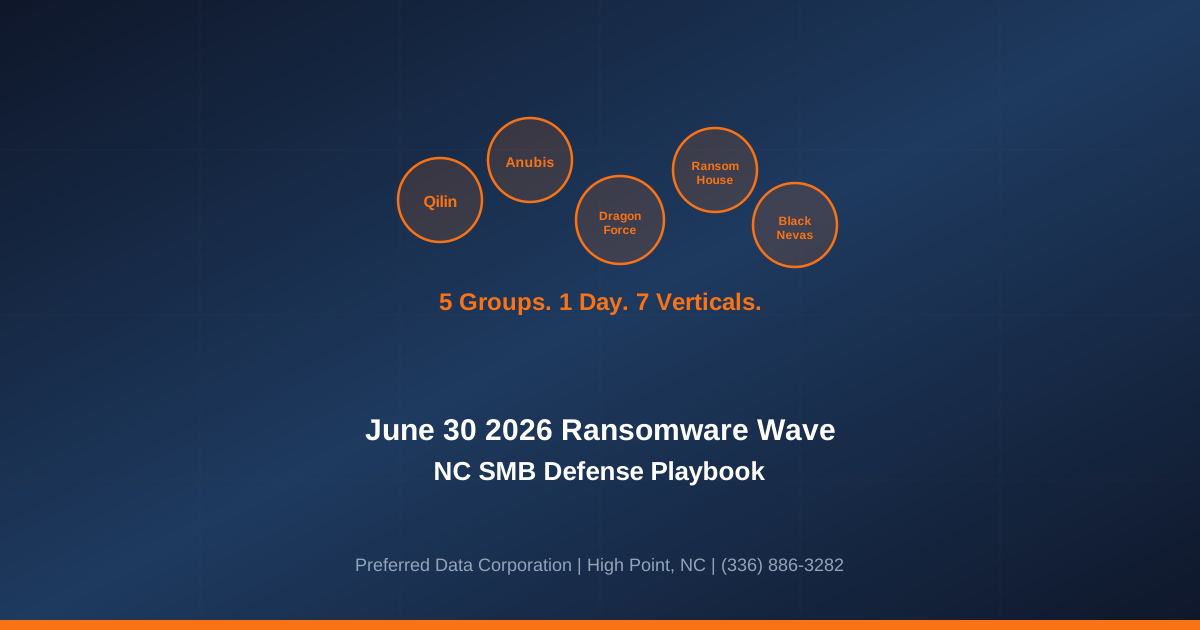
TL;DR: On June 30, 2026, at least five active ransomware groups — Qilin, Anubis, DragonForce, RansomHouse, and BlackNevas — simultaneously published victim disclosures on their leak sites. The named victims span healthcare (Boston Orthotics & Prosthetics, Bristol Place Corporation), construction and real estate (Bonacio Inc.), agriculture technology (Agroprime), legal services (Kaliact Ancheta et Associés), fashion manufacturing (KUNERT), and financial services (Abans Financial). Every vertical on that list has direct North Carolina SMB analogs. This is not a coincidence — it is the shape of the 2026 ransomware market, where SMBs account for 88 percent of ransomware breaches and manufacturing takes 28 percent of the total attack share.
Key takeaway: No single vertical is safe. If your business is a Piedmont Triad orthotics clinic, a Charlotte real estate developer, an NC agri-tech firm, a Greensboro law office, a High Point apparel manufacturer, or a Raleigh community bank, one of the five groups that struck on June 30, 2026 has already proven it will attack your industry, your size, and your region.
Is your NC business prepared for a ransomware event this week? Contact Preferred Data Corporation for a ransomware readiness assessment. BBB A+ rated, on-site response within 200 miles of High Point. Call (336) 886-3282.
What Happened on June 30, 2026?
At least five active ransomware groups published new victim disclosures on the same day, targeting SMBs across seven verticals in North America and Europe. The named victims include a New England orthotics and prosthetics provider (Boston Orthotics & Prosthetics), an upstate New York construction and real estate firm (Bonacio Inc.), a family-owned healthcare services firm (Bristol Place Corporation), a German legwear manufacturer (KUNERT Fashion), a boutique law and accounting firm (Kaliact Ancheta et Associés), a Sri Lankan financial services company (Abans Financial), and an agri-tech startup (Agroprime).
The groups behind the disclosures are the top of the current ransomware market: Qilin (leading Q1 2026 by victim count per BlackFog), DragonForce, RansomHouse, BlackNevas, and Anubis. These are ransomware-as-a-service operators; the affiliates that run the intrusions are broadly distributed and target opportunistically. Their victims are not hand-picked - they are whoever left a Kemp LoadMaster unpatched, whoever clicked a device-code phishing link, or whoever ran an unpatched FortiGate.
| Ransomware Group | June 30 Vertical Focus | Q1-Q2 2026 Notes |
|---|---|---|
| Qilin | Healthcare, manufacturing | #1 by disclosed victims per BlackFog Q1 2026 |
| DragonForce | Construction, professional services | Fast-rising RaaS; multi-affiliate model |
| RansomHouse | Legal, financial services | Data-theft-only extortion pattern |
| BlackNevas | Fashion, apparel manufacturing | Multi-language leak site; EU focus |
| Anubis | Healthcare, small business | Active since late 2025; SMB-heavy targeting |
Why Are Ransomware Crews Hitting SMBs So Aggressively?
SMBs are the highest-yield target for ransomware crews because they combine weak controls with real revenue. According to SQ Magazine's 2026 SMB cyber report, 88 percent of SMB breaches now involve ransomware (versus 39 percent for large enterprises), the average SMB breach cost is $3.31 million, and the median ransom payment reaches $115,000. Manufacturing, the most-targeted sector for the third year running per Sophos, invests only 6 percent of IT budget in security and has the lowest cyber-insurance uptake at 22 percent.
Three forces converge to drive the SMB targeting pattern:
- Automation. Initial-access brokers use AI-augmented reconnaissance to scan the entire IPv4 space for vulnerable Kemp LoadMasters, FortiGates, and Citrix NetScalers. Every SMB with an unpatched edge device is a candidate.
- Payout velocity. SMBs are more likely to pay quickly because they cannot survive extended downtime. Median SMB downtime after a ransomware attack now exceeds 21 days per Sophos.
- Weak segmentation. SMB networks are typically flat. A phish on the receptionist's PC reaches the domain controller and the production ERP in under an hour.
For a High Point orthotics clinic or a Charlotte design-build firm, the actuarial reality is simple: absent 24/7 detection and immutable backups, a ransomware event is a matter of when, not if.
Key takeaway: The SMBs that survive ransomware in 2026 share three attributes: a written incident response plan tested in the last 12 months, immutable off-site backups that have been restore-tested in the last 90 days, and 24/7 monitoring by a security operations center with automated containment.
What Should NC SMBs Do This Week?
The remediation playbook is short, and every step maps to something you can start today. Do not wait for a formal risk assessment. Start with the actions that block the most common initial-access vectors.
This-week checklist:
- Verify backups. Confirm that at least one backup copy is immutable (S3 Object Lock, WORM tape, or equivalent), off-site, and encrypted. Perform a restore test on a non-critical file share.
- Patch edge devices. Firewalls, VPN concentrators, load balancers (see the CVE-2026-8037 Kemp LoadMaster advisory), and RMM tools. Any critical CVE from the last 30 days on an internet-facing device is an emergency.
- MFA on everything. Email, VPN, RMM, cloud console, and privileged workstations. Use phishing-resistant MFA (passkeys / FIDO2) for privileged accounts.
- Kill dormant accounts. Every departing employee's account and every long-forgotten service account is a wide-open door. Audit and disable.
- Segment the network. At minimum, put backup infrastructure, domain controllers, and OT / manufacturing systems on separate VLANs with strict east-west rules.
- Tabletop. Walk the leadership team through a ransomware scenario. Who calls the SOC? Who calls counsel? Who calls the bank? Who talks to the press?
Vertical-specific priorities:
- Healthcare (like Boston Orthotics and Bristol Place): HIPAA Security Rule mandates specific technical safeguards; a ransomware event that exposes PHI triggers the HHS Breach Notification Rule. Immutable PHI backups are table stakes.
- Construction and real estate (like Bonacio): Project files, blueprints, and payment applications are the crown jewels. Segment job-site laptops from HQ payment systems.
- Legal and accounting (like Kaliact Ancheta): Client confidentiality is the entire business. A single leaked matter number can end a firm. Assume-breach data classification is non-negotiable.
- Manufacturing (like KUNERT): OT / IT convergence risk. Ransomware on the HR laptop can stop the plant floor within an hour without segmentation.
- Financial services (like Abans): FTC Safeguards Rule enforcement in 2026 reaches $51,744 per day per violation for missing written information security programs.
Explore Preferred Data's cybersecurity services
How Do NC SMBs Detect Pre-Ransomware Activity?
The gap between initial access and encryption is where SMBs win or lose. BlackFog's Q1 2026 State of Ransomware report puts the average dwell window at 7.7 days and the average exfiltration volume at 743 GB. Detection during that window prevents 100 percent of the encryption damage.
Highest-value detection signals:
- Impossible travel and device-code phish patterns in Microsoft 365 sign-in logs. Device-code phishing surged 37x in 2026 per Push Security.
- Unusual RMM activity. ScreenConnect, ManageEngine, and AnyDesk are the top-three post-exploitation tools for 2026 ransomware affiliates. Any RMM install outside the change-management window is a P1 alert.
- Large outbound HTTPS transfers from file servers, backup servers, and domain controllers.
- Shadow copy deletion on Windows servers (
vssadmin delete shadows) is a canonical pre-encryption signal. - New admin accounts created outside the normal HR provisioning workflow.
A managed detection and response (MDR) provider with a 24/7 SOC catches each of these signals in minutes, not the days a human review cycle takes.
Need 24/7 ransomware detection for your NC business? Call Preferred Data Corporation at (336) 886-3282 or schedule a consultation.
How Does Preferred Data Help NC SMBs Survive the 2026 Ransomware Market?
Preferred Data Corporation combines 37+ years of North Carolina IT expertise with a 24/7 security operations center, immutable backup design, incident response, and vendor-neutral edge-device management. Our average client retention is 20+ years, and we serve manufacturers, construction firms, healthcare providers, professional-services offices, and financial institutions across the Piedmont Triad, Charlotte, and Raleigh.
Our ransomware readiness engagement covers backup validation, edge-device patch audit, MFA rollout, network segmentation, tabletop facilitation, and continuous monitoring - the six controls that matter most in the June 30, 2026 threat environment.
For businesses within 200 miles of High Point, we deliver on-site response when the situation demands hands on keyboards.
Review our cybersecurity checklist
Frequently Asked Questions
My business is too small to be a ransomware target. True?
False. SMBs account for 88 percent of ransomware breaches in 2026 per SQ Magazine, and ransomware crews now target sub-50-employee businesses because they pay faster and have weaker controls than large enterprises.
If I have cyber insurance, do I still need to invest in defense?
Yes. Cyber insurance covers a portion of breach costs but does not prevent operational shutdown, reputational damage, or contract loss. Manufacturing has the lowest insurance uptake at 22 percent, and carriers are tightening requirements. Most 2026 policies require MFA, immutable backups, and 24/7 monitoring before they will bind coverage.
How much does immutable backup cost for an SMB?
Immutable backup adds roughly $2-$15 per protected TB per month on top of standard backup pricing, depending on the platform (Wasabi, S3 Object Lock, Rubrik, Veeam Hardened Repository). For a typical SMB with 2-10 TB of critical data, immutable backup costs $50-$1,500 per month. The average SMB ransomware recovery cost is $3.31 million.
What is a realistic timeline to get from unprotected to defensible?
Ninety days is realistic for an SMB working with an experienced MSP. Weeks 1-2: backup validation, edge patching, MFA on privileged accounts. Weeks 3-6: MFA everywhere else, segmentation, MDR onboarding. Weeks 7-12: tabletop, playbooks, quarterly review cadence.
Should I pay a ransom if I get hit?
Consult counsel before making that decision, and involve your cyber-insurance carrier if you have one. OFAC sanctions apply to payments to specific groups. Groups like Qilin and RansomHouse have re-extorted victims who paid. The FBI recommends against paying. The right answer is almost always to focus on rapid recovery from backups.
Can Preferred Data help during an active ransomware incident?
Yes. Call (336) 886-3282 immediately. Our on-call incident responders start containment guidance within minutes, and for clients within 200 miles of High Point, an engineer can be on-site within hours.