
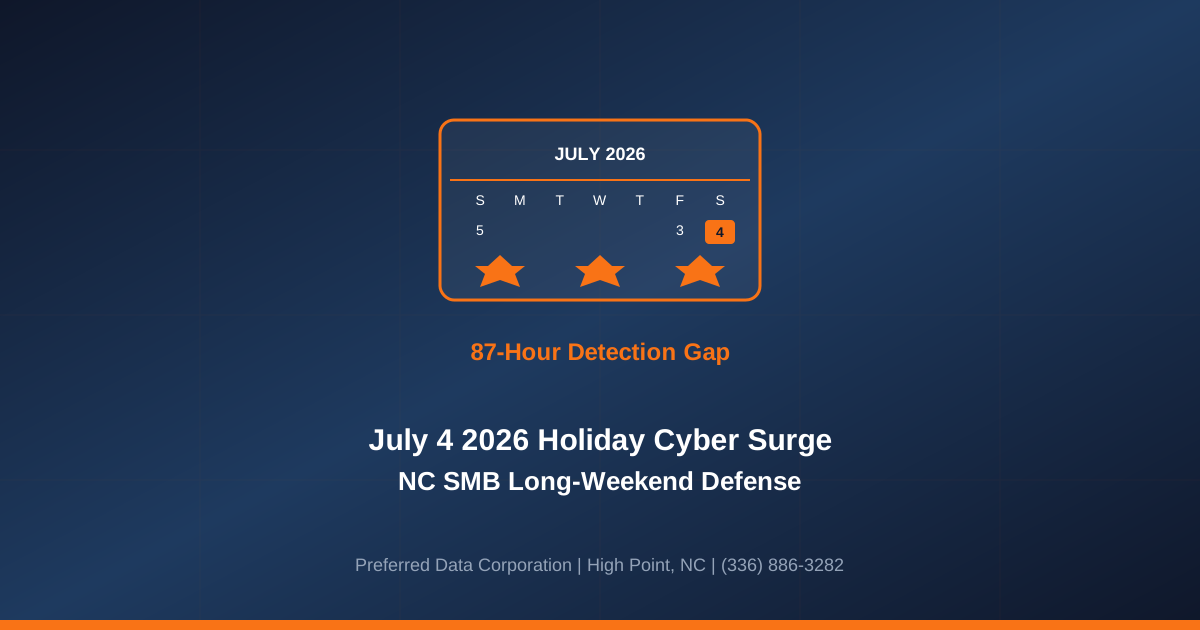
TL;DR: FBI and CISA joint advisories in 2021, 2022, 2023, and 2024 have all documented the same pattern: ransomware crews and initial-access brokers deliberately time major attacks for US federal holiday weekends when SMB IT staff are off, response times slow, and executives are unreachable. Holiday-weekend ransomware volume has trended 30-70 percent higher than baseline weekends across the past five years. With July 4, 2026 falling on a Saturday and delivering a Friday-through-Sunday long weekend for most NC SMBs, the next 72 hours require deliberate coverage planning: verified immutable backups, 24/7 monitored MFA, alerting on RMM installs, and a documented on-call escalation path.
Key takeaway: Attackers do not take July 4 off. Neither can your detection stack. The gap between a 15-minute containment and a 96-hour compromise is whether you have automated response and a real 24/7 SOC or a skeleton crew answering phones.
Is your NC business staffed and monitored for July 4-6, 2026? Contact Preferred Data Corporation for holiday-weekend SOC coverage. BBB A+ rated, on-site response within 200 miles of High Point. Call (336) 886-3282.
Why Do Ransomware Groups Time Attacks for Holiday Weekends?
Ransomware operators target holiday weekends because the operational math favors them: fewer defenders on duty, slower decision-making from off-duty leadership, and longer dwell time before containment. Every FBI / CISA joint advisory on holiday cyber threats from 2021 through 2024 documents the same pattern — Colonial Pipeline hit on Mother's Day weekend 2021, JBS Foods on Memorial Day 2021, Kaseya on July 4 weekend 2021, and dozens of SMB attacks in the years since have followed the same rhythm.
Three structural factors drive holiday targeting:
- Detection-to-containment gap widens. SMBs that operate 8-5 IT coverage have effectively zero response capability from 5 PM Friday to 8 AM Tuesday over a 3-day holiday weekend — an 87-hour window.
- Decision authority delays. Ransom negotiation, insurance carrier engagement, and legal counsel all typically require executive sign-off. Executives on vacation add hours to every decision.
- Backup restore paths break. Backup infrastructure sits idle over long weekends, meaning even organizations with immutable backups may not discover restore failures until they are already committed to a recovery path.
For NC SMBs — Piedmont Triad manufacturers running weekend production, Charlotte professional-services firms with skeleton coverage, Greensboro healthcare providers on holiday staffing — July 4 weekend is peak attacker opportunity.
Key takeaway: The 87-hour holiday-weekend detection gap turns a manageable Friday-afternoon incident into a catastrophic Tuesday-morning discovery. Containment speed matters more than any other single control.
What Does the Data Show About Holiday-Weekend Attack Patterns?
The pattern has been consistent across five years of public reporting. FBI IC3 statistics, CISA joint advisories, and threat-intelligence vendor data all show elevated attack volume around major US holidays.
Notable holiday-weekend patterns:
- Kaseya VSA attack, July 4 weekend 2021. REvil deployed ransomware through the Kaseya supply chain on the Friday afternoon before July 4, hitting 1,500+ downstream SMBs.
- Colonial Pipeline, May 7 2021 (Mother's Day weekend). DarkSide affiliate encrypted operational systems, triggering fuel shortages across the East Coast.
- JBS Foods, Memorial Day weekend 2021. REvil encrypted operations at the world's largest meat producer; $11M ransom paid.
- MOVEit / Cl0p, Memorial Day weekend 2023. Cl0p exploited MOVEit Transfer CVE-2023-34362 starting May 27; ultimately breaching 2,700+ organizations.
- Change Healthcare, February 2024 President's Day weekend. ALPHV / BlackCat began the intrusion the Friday before President's Day.
- CDK Global, June 2024 (mid-summer). BlackSuit encrypted the primary DMS for 15,000+ US auto dealerships.
- Snowflake / UNC5537, Memorial Day weekend 2024. Credential-based attacks against multi-tenant cloud infrastructure.
The 2026 pattern to date already shows the same rhythm — Memorial Day weekend (May 25-27, 2026) saw a notable spike in FortiGate credential-based intrusions, and multiple ransomware disclosures on June 30, 2026 (Qilin, DragonForce, RansomHouse, BlackNevas, Anubis) suggest crews clearing their backlog before shifting to Independence Day operations.
| Holiday Weekend | Notable Incident | Business Impact |
|---|---|---|
| Mother's Day 2021 | Colonial Pipeline | East Coast fuel disruption |
| Memorial Day 2021 | JBS Foods | Global meat supply shock |
| July 4 2021 | Kaseya VSA | 1,500+ SMB victims |
| Memorial Day 2023 | MOVEit / Cl0p | 2,700+ organizations breached |
| Presidents Day 2024 | Change Healthcare | Multi-month healthcare disruption |
| June 2024 | CDK Global | 15,000+ auto dealerships |
| Memorial Day 2024 | Snowflake / UNC5537 | Multi-tenant cloud compromises |
What Should NC SMBs Do in the 72 Hours Before July 4 2026?
The pre-holiday hardening checklist runs from Wednesday morning through Friday close of business. Every item is executable in hours, not days, and none require new spending.
Wednesday-Thursday priorities:
- Verify backups. Run a live restore test of at least one critical system. Confirm immutable backups are actually immutable (S3 Object Lock, WORM, Veeam Hardened Repository). Take a snapshot of production data Wednesday night.
- Patch edge devices. Confirm Kemp LoadMaster (see CVE-2026-8037), FortiGate, Citrix, SonicWall, and any other internet-facing appliances are on current firmware. A weekend patch is a weekend outage plus a weekend forensics engagement.
- Rotate high-value credentials. Domain admin, cloud console root, backup admin, EDR / MDR console admin. All should be on phishing-resistant MFA (passkeys / FIDO2).
- Turn on MFA everywhere it isn't already. Email, VPN, RMM, cloud console. This is a Thursday-afternoon project for any account still on password-only.
Friday priorities:
- Lock down RMM. Disable RMM install permissions for anyone not on the approved change-management list. Alert on any new RMM install through Tuesday.
- Enable strict egress filtering. Block file-transfer to newly registered domains, Tor exit nodes, and known bulletproof-hosting providers for the long weekend.
- Verify on-call escalation. Confirm the on-call rotation. Every person on the list should know their role, the escalation path, the SOC hotline, the counsel hotline, and the insurance carrier hotline.
- Suspend deploys. No Friday-afternoon changes. No weekend deploys unless a documented emergency.
Saturday-Monday priorities (holiday period):
- 24/7 SOC coverage active. Managed SOC provider running with automated containment authority.
- Response team on-call and reachable. Documented reachability windows. Phone numbers verified.
- Daily briefing. 15-minute morning check from on-call lead: any alerts, any suspicious activity, any patch releases from vendors.
Explore Preferred Data's cybersecurity services
How Do NC SMBs Actually Get 24/7 Coverage Without Hiring 5 Analysts?
Internal 24/7 SOC coverage requires a minimum of 5-6 full-time analysts to cover round-the-clock shifts, which is $500K-$750K annually in salary alone — infeasible for most NC SMBs. Managed detection and response (MDR) providers deliver equivalent or better coverage for a fraction of the cost by pooling analyst hours across many clients.
What MDR delivers for an NC SMB:
- 24/7 monitoring of endpoints, servers, cloud, email, and network telemetry.
- Automated containment for high-confidence alerts. Isolates compromised endpoints in seconds without waiting for human approval.
- Human analyst triage for medium-confidence alerts. Reduces false-positive fatigue.
- Incident response initiation for confirmed incidents. Playbook execution, communication support, forensics coordination.
- Monthly reporting to executive leadership. Trends, incidents, remediation tracking.
For a Piedmont Triad manufacturer or a Charlotte professional-services firm, MDR is the single highest-ROI investment against holiday-weekend risk. The math is not close.
Need MDR coverage for the July 4 weekend? Call Preferred Data Corporation at (336) 886-3282 or schedule a consultation.
What Post-Holiday Actions Should Be Taken July 7-11?
Whether or not an incident occurs, the post-holiday week is the highest-value time to hunt for indicators of compromise, review logs, and close any gaps identified during coverage.
Post-holiday hunt checklist:
- Review sign-in logs for the entire holiday period. Any impossible-travel, any brute-force pattern, any unusual location, any device-code phish signature.
- Review email quarantine for the holiday period. Attackers time phishing waves for the return from vacation, when triage is rushed.
- Review RMM audit logs for any install or execution outside change-management windows.
- Verify backups again. Confirm no backup jobs were silently disabled or modified over the holiday.
- Confirm edge device patch status. Any critical CVE published during the holiday should be patched in the first week back.
- Debrief the on-call team. Any decisions delayed by executive absence? Any gaps in playbooks? Any tooling limitations discovered?
Post-holiday hunt is also the time to plan the September / October cadence. Q3 2026 attack volume typically continues to climb through Labor Day and into the September fiscal-quarter close.
Learn about Preferred Data's managed IT services
How Does Preferred Data Deliver Holiday-Weekend Coverage for NC SMBs?
Preferred Data Corporation provides 24/7 managed detection and response, automated containment, on-call incident response, and holiday-weekend hardening services for NC manufacturers, construction firms, healthcare providers, professional-services offices, and financial institutions. With 37+ years of North Carolina IT expertise and an average client retention of 20+ years, we structure holiday coverage as an integrated service, not a one-time bolt-on.
Our July 4 2026 coverage package includes pre-holiday hardening review Wednesday-Friday, 24/7 SOC monitoring with automated containment through the holiday period, post-holiday hunt Tuesday-Thursday, and after-action review with the client leadership team.
For businesses within 200 miles of High Point, we deliver on-site response when the situation demands hands on keyboards.
Review our cybersecurity checklist
Frequently Asked Questions
How much extra risk does the July 4 weekend actually add?
FBI / CISA data across 2021-2024 shows a 30-70 percent increase in ransomware volume around major US holidays versus baseline weekends, with the July 4 weekend historically among the most active. The Kaseya VSA attack on July 4 2021 alone hit 1,500+ SMB downstream victims.
My IT vendor says they will "monitor tickets" over the weekend. Is that enough?
No. Ticket monitoring is not 24/7 SOC coverage. Real coverage requires active telemetry ingestion, automated correlation, human analyst triage, and pre-authorized containment authority. Ask your vendor for their MDR product name, their response time SLA, and their automated containment scope.
What if we get hit on July 4 weekend?
Call (336) 886-3282 immediately. Our on-call incident responders start containment guidance within minutes, regardless of holiday. For clients within 200 miles of High Point, an engineer can be on-site within hours.
Is disconnecting from the internet a legitimate holiday defense?
For some verticals with no operational internet dependence, yes. For most modern SMBs, no — cloud email, cloud ERP, cloud file share, and remote access are business-critical even on holidays. Segmentation and monitoring are more practical than air-gapping.
Should we suspend RMM tools over the holiday?
Consider it for the highest-risk RMM (any RMM with production credential access). At minimum, alert on every RMM install / execution outside change-management, and require MFA on every RMM login.
Can Preferred Data set up MDR coverage before July 4?
Yes, for onboarding started this week. Our standard MDR onboarding is 7-14 days depending on environment size. Call (336) 886-3282 to discuss expedited holiday coverage.