
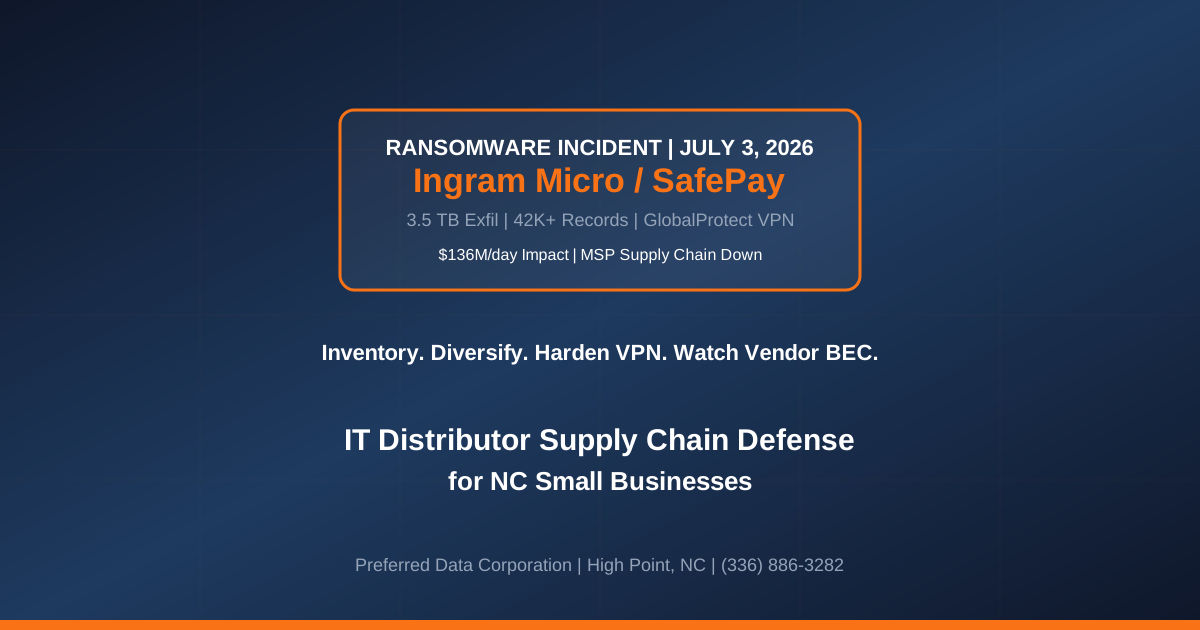
TL;DR: On July 3, 2026 — 24 hours before the Fourth of July long weekend — SafePay ransomware crippled Ingram Micro, one of the world's largest IT distributors and the backbone of hardware, software licensing, and cloud provisioning for tens of thousands of MSPs and resellers. The attackers exploited misconfigured GlobalProtect VPN infrastructure, moved laterally undetected for weeks, exfiltrated an estimated 3.5 TB of financial, legal, and intellectual property data, and disrupted digital commerce, order processing, and cloud license provisioning for several days. Analyst estimates put the revenue impact at $136 million per day, and 42,000+ employee and applicant records were later confirmed exposed. Every NC SMB — even those with no direct Ingram Micro relationship — has fourth-party exposure through their MSP, hardware reseller, or cloud license broker. This is your 2026 vendor-risk wake-up call.
Key takeaway: When a distributor at Ingram Micro's scale goes dark for four days over a holiday weekend, MSPs cannot fulfill hardware orders, cloud licenses cannot be provisioned or renewed, and downstream customers — you — lose the ability to onboard new employees, expand capacity, or recover from an unrelated outage. Vendor concentration is a business continuity risk, not just a procurement optimization.
Do you know which vendors could take your business down this weekend? Contact Preferred Data Corporation for a same-week vendor-risk audit and business continuity review. BBB A+ rated. On-site within 200 miles of High Point. Call (336) 886-3282.
What Happened to Ingram Micro Between July 2 and July 4, 2026?
Ingram Micro suffered a global outage of its digital commerce, order processing, and cloud license provisioning platforms starting the morning of July 3, 2026 and ultimately confirmed a SafePay ransomware attack. Reporting from Dark Reading, CSO Online, Cybersecurity Dive, and BleepingComputer places the initial intrusion window between July 2 and July 3, 2026, with attackers active inside the environment for several weeks before deploying the ransomware payload.
Three technical facts define the incident and every one of them matters for NC SMB defense planning:
- Initial access vector: misconfigured GlobalProtect VPN. Reports indicate SafePay entered through inadequately protected GlobalProtect infrastructure, then moved laterally through the network. A single VPN gateway with insufficient MFA and monitoring became the pivot point for a global outage.
- Dwell time measured in weeks. SafePay was inside the environment "for several weeks" before ransomware detonation. This matches the 7-14 day dwell times that Sophos CTU has reported for Anubis and other 2026 RaaS operators — attackers now assume they will not be detected in a normal 90-day retention window.
- 3.5 TB exfiltrated. SafePay claimed to have stolen 3.5 TB of financial, legal, and intellectual property data — later leaks confirmed 42,000+ employee and applicant records including names, contact details, dates of birth, and government-issued identification numbers.
Ingram Micro publicly confirmed the ransomware nature of the attack within days, engaged incident response, and restored global operations the following week. The public and financial impact — analyst estimates around $136 million per day in revenue disruption — landed in the middle of a US federal holiday.
Key takeaway: The attackers did not choose July 3 by accident. Holiday weekends are peak ransomware windows because IT staffing is skeletal, detection dwell time doubles, and executives are hard to reach. If your MSP or your business runs on skeleton crew this weekend, you are running the same risk profile as Ingram Micro.
Why Is an Ingram Micro Outage Every NC SMB's Problem?
Even if you do not have a direct account with Ingram Micro, your MSP, hardware reseller, or cloud license broker almost certainly does. Ingram Micro is one of the three largest IT distributors in the world (alongside TD SYNNEX and D&H Distributing), and their platform sits between vendors like Microsoft, Cisco, Dell, HP, Lenovo, Fortinet, and hundreds of others and the MSP or reseller who invoices you.
Four concrete downstream impacts every NC SMB should model:
- New employee onboarding stalls. If your MSP orders laptops, monitors, and licensing through Ingram Micro, an outage delays every new hire's Day 1 kit. In the Piedmont Triad manufacturing and construction sectors — where seasonal hiring surges in Q3 — this compounds quickly.
- Cloud license renewals fail silently. Microsoft 365, Adobe Creative Cloud, Fortinet subscriptions, and countless other cloud licenses are provisioned through distributor portals. An outage means license renewals miss the deadline, users lose access mid-day, and IT scrambles for workarounds.
- Business email compromise via vendor spoofing. Attackers know Ingram Micro invoices are legitimate; they use the outage as social-engineering cover to send fake "order status," "shipment tracking," or "invoice correction" emails to MSPs and their customers. Post-breach, expect a wave of Ingram-Micro-themed BEC.
- Data exposure of your PII inside a supplier's systems. If your MSP submitted your company's billing records, purchase orders, or contact directory into Ingram Micro's systems, it is inside the 3.5 TB exfiltration.
The Verizon 2026 DBIR reported that third-party breaches now account for 48% of confirmed breaches, up from 15% in 2023. Fourth-party breaches — breaches at your vendor's vendor — are the fastest-growing category. Ingram Micro is a fourth-party for most NC SMBs.
How Did SafePay Get In Through GlobalProtect?
Publicly available reporting attributes the initial access to misconfigured or inadequately protected Palo Alto Networks GlobalProtect VPN infrastructure. GlobalProtect itself is a well-regarded enterprise VPN gateway; the failure was in configuration and monitoring, not in the product. That distinction is critical for NC SMBs whose MSPs deploy the same or similar VPN stacks.
The likely playbook, based on reporting and SafePay's known tradecraft:
- Credential harvest. SafePay is a Windows-focused RaaS that often obtains initial credentials through infostealer logs, phishing, or credential-stuffing against exposed VPN gateways.
- Legacy authentication or weak MFA. VPN gateways that permit SMS OTP or lack conditional-access enforcement give attackers a foothold on any credential that survives password rotation cadences.
- Post-VPN pivot to domain admin. Once inside the VPN, attackers exploit Kerberoasting, print-nightmare-class flaws, or misconfigured trusts to reach domain admin — which is where they stage the ransomware payload and exfiltration channel.
- Long, quiet reconnaissance. SafePay typically dwells for weeks, mapping backups, identity, and payment systems before firing the encrypter.
| Control | Compensates For | Time to Deploy |
|---|---|---|
| Phishing-resistant MFA (FIDO2/passkeys) on VPN | Credential-stuffing, MFA fatigue, SMS interception | 2-4 weeks |
| Conditional access on VPN (device, geography, risk score) | Compromised credentials from third-party breaches | 1-2 weeks |
| VPN gateway EDR + log ingestion into SOC | Long-dwell reconnaissance | 1 week |
| Immutable, offsite, tested backups | Encrypter payload | 2-4 weeks |
| Just-in-time domain admin (LAPS, PIM) | Kerberoasting and lateral movement | 4-8 weeks |
Explore Preferred Data's cybersecurity services
What Should NC SMBs Do This Weekend?
The pre-holiday hardening playbook is short, executable in a single maintenance window, and does not require new spending. Execute it before your business closes for the Fourth of July weekend.
Immediate (next 24 hours):
- Inventory your dependence on Ingram Micro. Ask your MSP: which orders, licenses, and provisioning workflows route through Ingram Micro? Which have not yet completed?
- Snapshot cloud license expiration dates. Any Microsoft 365, Adobe, Fortinet, or other cloud subscription renewing between July 3 and July 14 is at elevated risk of failing to renew. Manually extend or contact the vendor directly.
- Warn users about vendor-themed phishing. Every email that references Ingram Micro, order status, tracking numbers, invoice corrections, or "urgent action required" during this window is a phishing candidate.
- Enforce phishing-resistant MFA on VPN and admin accounts. If you have not moved from SMS OTP to FIDO2/passkeys on your VPN gateway, do it now.
- Verify your backups are immutable and tested. Restore a non-production file today. If you cannot restore in 30 minutes, you are not ready for a weekend incident.
This week:
- Fourth-party inventory. Ask your MSP for their supplier list. Which distributors, cloud license brokers, and support-tool vendors sit between them and you?
- Business continuity plan for a two-week distributor outage. If Ingram Micro were dark for 14 days, what breaks? Who calls whom? What is your alternate vendor?
- Vendor-risk contract review. Do your MSP contracts require breach notification within 24 hours? Do they require MFA on VPN and privileged access? Do they carry cyber insurance with vendor liability coverage?
Learn about Preferred Data's managed IT services
What Are the Warning Signs of Vendor-Themed BEC?
Post-breach vendor spoofing is a documented pattern after every major distributor or vendor incident. Attackers know your users are conditioned to trust emails about shipping, invoices, and license activations. Watch for these specific indicators through mid-July 2026.
High-confidence indicators of vendor-themed BEC:
- Look-alike domains.
ingrammicro-support[.]com,ingram-micro[.]net,ingrammicroorder[.]com, homoglyph attacks (Cyrillic characters replacing Latin), or subdomain abuse (ingrammicro.support-team[.]com). - Urgency without context. "Your order status has changed — verify now" or "Your license will expire in 24 hours — click to renew" with a shortened URL.
- Attachment-based lures. SVG attachments (a 2026 phishing surge), OneNote/HTML files, or password-protected ZIPs claiming to be "invoice corrections."
- Reply-to mismatch. Sender appears to be your MSP but reply-to routes to an external free-mail account.
- Wire transfer instruction changes. Attackers use vendor outages as social-engineering cover to redirect legitimate outgoing payments.
Lower-confidence but worth reviewing:
- Unusual login geographies against Microsoft 365 or Google Workspace.
- New OAuth applications registered against tenant with mail-read permissions.
- Newly registered forwarding rules on executive mailboxes.
If any of these indicators appear, treat as a live incident: contain the affected mailbox, preserve headers, notify your MSP, and consider whether the compromise pre-dates the Ingram Micro incident.
If you spot vendor-themed BEC, call Preferred Data at (336) 886-3282 for expedited investigation and containment.
How Does This Fit the 2026 Ransomware Pattern?
The Ingram Micro attack fits a consistent 2026 pattern: RaaS operators targeting the connective tissue of the IT industry — distributors, MSPs, RMM tools, and identity providers — because a single successful intrusion cascades to hundreds or thousands of downstream victims. This is the same pattern that produced the July 2021 Kaseya VSA attack (1,500+ MSP customers), the June 2023 MOVEit / Cl0p campaign (2,700+ victims), the June 2025 SimpleHelp CVE-2026-48558 KEV addition, and the June 2026 Verizon DBIR finding that third-party breaches account for 48% of confirmed breaches.
Three connected 2026 trends every NC SMB should track:
- Distributor and MSP attacks are the highest-ROI targets for RaaS. A single successful intrusion at a distributor gives the attacker leverage over thousands of downstream MSPs and hundreds of thousands of SMB customers.
- VPN gateways are still a top initial-access vector. Palo Alto GlobalProtect, Cisco AnyConnect, Fortinet FortiClient, and Ivanti Connect Secure have all appeared in KEV entries in 2025-2026 either as vulnerable products or as exploited misconfigurations.
- Holiday windows are exploitation windows. SafePay chose July 3, matching the pattern of Kaseya (July 4, 2021), Colonial Pipeline (Mother's Day 2021), MOVEit (Memorial Day 2023), and Change Healthcare (Presidents Day 2024).
For NC manufacturers, construction firms, healthcare providers, and professional-services offices in the Piedmont Triad, Charlotte, Raleigh, and Greensboro, the lesson is not "avoid distributors." It is "assume your distributors will be breached — plan the alternate."
Read Preferred Data's vendor risk management guide
How Does Preferred Data Deliver Vendor-Risk Defense for NC SMBs?
Preferred Data Corporation delivers vendor-risk assessment, business continuity planning, MSP oversight, phishing-resistant MFA rollout, VPN gateway hardening, and 24/7 managed detection and response for NC manufacturers, construction firms, healthcare providers, professional-services offices, and financial institutions. With 37+ years of North Carolina IT expertise and an average client retention of 20+ years, our vendor-risk process integrates with your existing procurement, insurance, and identity controls.
Our post-Ingram-Micro emergency response package includes fourth-party inventory across your MSP and reseller relationships, cloud license renewal validation through July 14, vendor-themed BEC awareness and email gateway tuning, VPN gateway MFA hardening, incident response tabletop scoped to the "your distributor is dark" scenario, and 24/7 SOC coverage through the July 4 weekend.
For businesses within 200 miles of High Point, we deliver on-site response when the situation demands hands-on-keyboard forensics and remediation.
Review our cybersecurity checklist
Frequently Asked Questions
When did the Ingram Micro ransomware attack happen?
Reporting from Dark Reading, CSO Online, and BleepingComputer places the initial intrusion between July 2 and July 3, 2026, with the outage of digital commerce, order processing, and cloud license provisioning starting July 3, 2026 — 24 hours before the Fourth of July long weekend. Ingram Micro confirmed the ransomware nature of the attack within days and restored global operations the following week.
What ransomware group was responsible?
SafePay, a Windows-focused RaaS operator, claimed responsibility on their dark web leak site and stated they had exfiltrated 3.5 TB of data. Media reporting attributed the attack to SafePay before the group publicly claimed it.
How did the attackers get in?
Public reporting attributes initial access to misconfigured or inadequately protected Palo Alto Networks GlobalProtect VPN infrastructure. The product itself is enterprise-grade — the failure was in configuration, MFA enforcement, and monitoring. Attackers then moved laterally undetected for several weeks before deploying the ransomware payload.
How much data was stolen?
SafePay claimed 3.5 TB of data was exfiltrated. Later disclosures confirmed 42,000+ employee and job applicant records including names, contact details, dates of birth, and government-issued identification numbers. Reports also indicate financial, legal, and intellectual property data was stolen.
My business does not have a direct Ingram Micro account. Am I affected?
Almost certainly, yes — indirectly. If your MSP, hardware reseller, or cloud license broker sources from Ingram Micro, your business's contact information, purchase history, and possibly PII may sit inside their systems, and your onboarding, license renewals, or hardware orders may be delayed. This is called fourth-party risk.
How do I know if my MSP was affected by the outage?
Ask directly. Specifically: "Do you source hardware, cloud licenses, or software through Ingram Micro? Which of our orders or renewals were in-flight between July 2 and July 14, 2026? What is your alternate distributor plan?" A prepared MSP will answer without hesitation.
Should we switch distributors?
Not automatically. Every major distributor (Ingram Micro, TD SYNNEX, D&H Distributing) faces the same risk profile. The right response is to require breach-notification SLAs, MFA on all vendor-facing VPNs and admin accounts, cyber insurance with vendor liability coverage, and a documented plan for a 14-day distributor outage.
Can Preferred Data audit our vendor risk this week?
Yes. Our vendor-risk assessment is a 3-5 day engagement for a typical NC SMB and delivers a fourth-party inventory, a distributor-outage tabletop, and a prioritized remediation roadmap. Call (336) 886-3282 to start the engagement.