
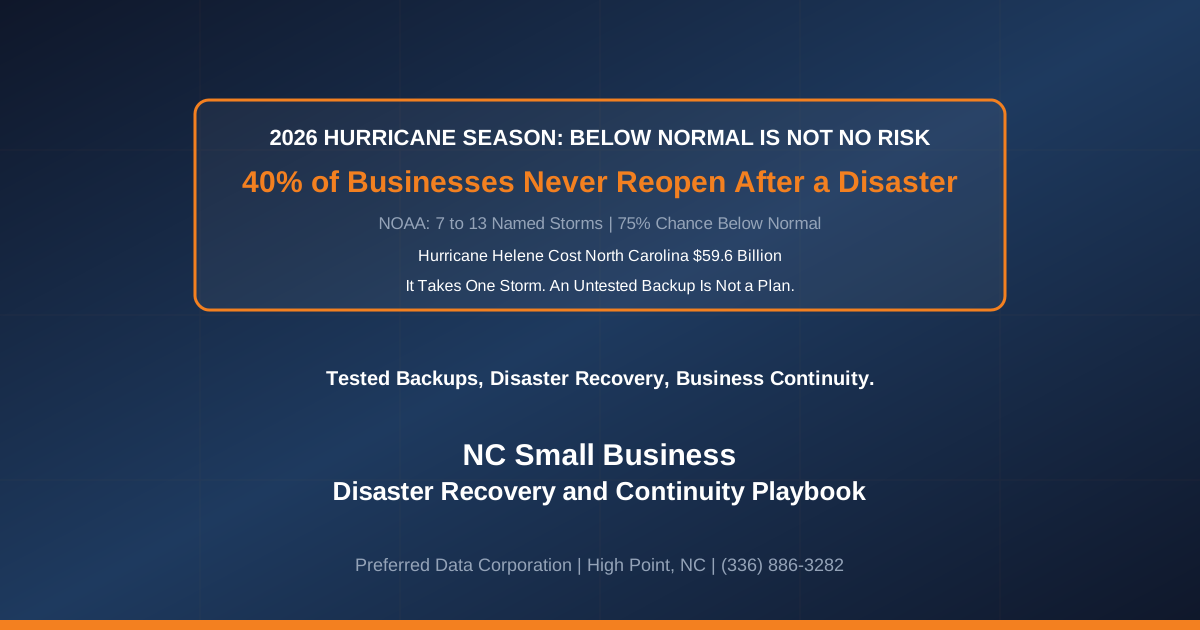
TL;DR: NOAA's August 2026 update calls for a below-normal Atlantic hurricane season, 7 to 13 named storms and a 75% chance of below-normal activity, per the NOAA hurricane outlook. That is not permission to relax. FEMA reports that roughly 40% of businesses never reopen after a disaster and another 25% fail within a year, per the Insurance Information Institute, and Hurricane Helene caused $59.6 billion in damage in North Carolina, per the NC Office of State Budget and Management. The difference between a business that survives and one that does not is a tested backup and a documented disaster recovery plan.
Key takeaway: A quiet forecast lowers the odds of a storm, not the cost of being caught without a recovery plan when one arrives. It takes exactly one storm to close a business, and the businesses that reopen are the ones that prepared before the season started.
Not sure your backups would actually restore after a flood, outage, or ransomware hit? Contact Preferred Data Corporation at (336) 886-3282 for a business continuity and disaster recovery review. BBB A+ rated, serving High Point, Greensboro, Winston-Salem, Charlotte, Raleigh, and the Piedmont Triad since 1987.
What is NOAA predicting for the 2026 hurricane season?
NOAA's August 2026 updated outlook forecasts a below-normal Atlantic hurricane season, with 7 to 13 named storms, 2 to 6 hurricanes, and 0 to 2 major hurricanes, per the NOAA news release. NOAA puts the odds at 75% for a below-normal season, 20% for near-normal, and just 5% for above-normal, with El Nino conditions increasing wind shear and tempering storm development.
The numbers behind the 2026 outlook:
- A 75% chance of below normal. NOAA assigns only a 5% chance of an above-normal season, the calmest odds in several years, driven largely by El Nino wind shear that disrupts storm formation.
- Still up to 13 named storms possible. Even the low end of the forecast includes multiple named storms, and the Atlantic hurricane season runs a full six months, from June 1 to November 30.
- A range, not a guarantee. The forecast describes seasonal activity, not where or whether a storm makes landfall, so a "quiet" season can still deliver one destructive, business-ending event.
For a North Carolina business owner, the takeaway is not the total count. It is that the season is long, active storms remain possible, and the forecast says nothing about which storm finds your building.
Does a below-normal season mean my business is safe?
No. A below-normal forecast lowers the probability of storms overall, but it does nothing to reduce the damage a single storm can cause, and the historical record shows that low-activity seasons still produce catastrophic landfalls. The FEMA-cited failure rate is stark: about 40% of businesses do not reopen after a disaster and another 25% close within one year, per the Insurance Information Institute.
Why "below normal" is not the same as "low risk":
- It only takes one storm. Seasonal totals are irrelevant to a business that loses its data and systems to the single storm that reaches it. The risk that matters is your exposure, not the basin-wide count.
- The failure math is unforgiving. With roughly 40% never reopening and 25% more failing within a year, up to 65% of unprepared businesses do not survive a serious disaster, per FEMA data.
- North Carolina is not just a coastal risk. Even inland regions like the Piedmont Triad face remnant storms, inland flooding, and extended power and connectivity loss, and Hurricane Helene proved that the mountains, hundreds of miles from the coast, can take the worst of it.
Key takeaway: Preparedness is not a bet on the forecast. It is insurance against the one storm, cyberattack, or hardware failure that the forecast cannot predict. The businesses that reopen are the ones that could restore their data no matter what caused the loss.
Want to know whether your business could recover from a total loss tomorrow? Call Preferred Data at (336) 886-3282 or explore our Data Protection and Backup and Cloud Solutions services.
What did Hurricane Helene cost North Carolina businesses?
Hurricane Helene hit North Carolina on September 27, 2024, and caused the largest disaster in the state's history. The NC Office of State Budget and Management put total damage and recovery needs at $59.6 billion, more than three times Hurricane Florence's $17 billion in 2018. For individual businesses in Western North Carolina, the losses were often existential.
The scale of the damage in the numbers:
- $59.6 billion in total impact. Helene became North Carolina's costliest disaster on record, far exceeding Florence's $17 billion, per NC OSBM.
- A median loss of $95,000 per business. A regional survey of WNC businesses found a median loss of $95,000 and an average loss of $322,000, equal to more than six years of typical annual profit for a small business in the region, per Blue Ridge Public Radio and Mountain BizWorks.
- A recovery measured in years, not weeks. About a year and a half later, roughly 32% of surveyed businesses were still operating below break-even, and about half still had revenue below pre-Helene levels, per the Mountain BizWorks impact report.
Helene is the cautionary example every North Carolina owner should keep in mind. It struck an inland region many assumed was safe, it destroyed physical premises and the data inside them, and the businesses that recovered fastest were the ones whose records and systems were replicated somewhere the flood could not reach.
What is the difference between backup and disaster recovery?
A backup is a copy of your data. Disaster recovery is a documented, tested plan for getting your entire business operational again, with defined targets for how fast you recover and how much data you can afford to lose. Many businesses have the first and mistake it for the second, which is why an untested backup is one of the most dangerous assumptions in small business IT.
Two definitions worth quoting:
- RTO (recovery time objective) is the maximum acceptable time your systems can be down before the business is seriously harmed. It answers "how long can we be offline?"
- RPO (recovery point objective) is the maximum acceptable amount of data, measured in time, that you can afford to lose. It answers "how much recent work can we accept losing?"
A modern, right-sized approach follows the 3-2-1 rule: 3 copies of your data, on 2 different types of media, with at least 1 copy stored off-site or in the cloud. That off-site copy is what survives when a flood or fire takes the building, and the tested restore is what proves the copy actually works.
Backup alone versus a tested DR and BC plan
| Factor | Backup alone | Tested DR and BC plan |
|---|---|---|
| What it protects | Copies of files | The whole business getting back online |
| Off-site or cloud copy | Often missing | Required (3-2-1 rule) |
| Recovery targets | Undefined | Defined RTO and RPO |
| Tested restores | Rarely or never | Regular, documented tests |
| Covers physical disaster | Sometimes | Yes, storm, fire, flood |
| Covers cyber disaster | Sometimes | Yes, ransomware and breach |
| Redundant connectivity | No | Planned failover |
| Confidence you can recover | Assumed | Proven |
Key takeaway: An untested backup is not a recovery plan. You do not have a backup until you have restored from it, and you do not have a disaster recovery plan until you have defined how fast you must recover and rehearsed doing it.
Ready to turn your backups into a plan you can actually trust? Call (336) 886-3282 or learn about our Managed IT services.
How should an NC small business build a business continuity plan?
Start by identifying the systems and data your business cannot operate without, set recovery targets for each, and then build tested backups, off-site replication, and redundant connectivity around those priorities. A good business continuity plan covers both cyber and physical disasters, because ransomware and a hurricane can each take you offline, and it is written down and rehearsed rather than assumed.
A practical business continuity checklist for a North Carolina small business:
- Inventory critical systems and data. List the applications, files, and records that must be available to keep operating, because you cannot protect what you have not identified.
- Set your RTO and RPO. Decide how long you can be down and how much data you can afford to lose for each critical system, and let those targets drive the plan.
- Implement the 3-2-1 rule. Keep 3 copies of your data on 2 media types with 1 copy off-site or in the cloud, so a single physical event cannot destroy every copy.
- Replicate off-site or to the cloud. Ensure at least one current copy lives outside your building, hundreds of miles away if possible, exactly the failure Helene exposed.
- Test your restores on a schedule. Regularly restore from backup and confirm the data is complete and usable, because an untested backup is a guess, not a plan.
- Plan redundant connectivity. Arrange failover internet or mobile connectivity so a downed line does not mean a downed business.
- Cover cyber and physical threats. Extend the same rigor to ransomware and breaches, since a cyber disaster can be as business-ending as a storm.
- Document roles and rehearse. Write down who does what during an outage, keep the plan accessible off-site, and review it before every hurricane season.
Done once and reviewed each year, this turns a vague hope that "we have backups" into a specific, tested capability to reopen after the worst day your business will face.
How does Preferred Data help NC businesses prepare?
Preferred Data Corporation acts as the local technology partner that designs, implements, and tests right-sized data protection so a North Carolina business can survive a disaster and reopen. Through our Data Protection and Backup, Cloud Solutions, Managed IT, and Cybersecurity services, we build 3-2-1 backups with off-site and cloud replication, define your RTO and RPO, test restores so your backups are proven rather than assumed, and cover both cyber and physical disasters. Serving North Carolina businesses and manufacturers since 1987, that is 39 years of local experience, we bring practical resilience, not theory.
Because we are local, on-site within 200 miles of High Point and serving the Piedmont Triad, Charlotte, and Raleigh, we can sit with your team, map what your business cannot lose, and stay accountable for the plan through every hurricane season and beyond.
Get a business continuity and disaster recovery review. Contact Preferred Data Corporation at (336) 886-3282. We deliver Data Protection and Backup, Cloud Solutions, and Managed IT for small businesses and manufacturers across High Point, Greensboro, Charlotte, and Raleigh. Serving the region since 1987, BBB A+ rated.
Frequently Asked Questions
Is a below-normal hurricane season safe for my business?
No. NOAA's 2026 outlook gives a 75% chance of a below-normal season with 7 to 13 named storms, but that only lowers the overall odds, not the damage from any single storm, per the NOAA news release. FEMA reports roughly 40% of businesses never reopen after a disaster and another 25% fail within a year, so one storm is enough to close an unprepared business.
What did Hurricane Helene cost North Carolina?
Hurricane Helene hit North Carolina on September 27, 2024, and caused $59.6 billion in damage and recovery needs, the state's largest disaster ever and more than triple Hurricane Florence's $17 billion, per the NC Office of State Budget and Management. A regional survey found Western NC businesses lost a median of $95,000 and an average of $322,000 each.
What is the 3-2-1 backup rule?
The 3-2-1 rule means keeping 3 copies of your data, on 2 different types of media, with at least 1 copy stored off-site or in the cloud. The off-site copy is what survives when a flood, fire, or storm destroys your building, and it is the specific gap that left many Western North Carolina businesses unable to recover after Helene.
What is the difference between RTO and RPO?
RTO (recovery time objective) is the maximum time your systems can be down before the business is seriously harmed, answering "how long can we be offline?" RPO (recovery point objective) is the maximum amount of data, measured in time, you can afford to lose, answering "how much recent work can we accept losing?" Both targets should be defined for each critical system.
Why is a tested backup so important?
An untested backup is not a recovery plan, because you do not truly have a backup until you have restored from it and confirmed the data is complete and usable. Regular, documented test restores catch corruption, missing files, and configuration gaps before a disaster does, which is the difference between reopening and joining the roughly 40% of businesses that never reopen.
Does the Piedmont Triad need hurricane preparation?
Yes. While the Piedmont Triad is inland and less exposed than the coast or mountains, it still faces remnant storms, inland flooding, and extended power and connectivity loss. Hurricane Helene proved that inland North Carolina, hundreds of miles from the coast, can suffer catastrophic damage, so every NC business should have tested backups and a disaster recovery plan.
Related Resources
- NOAA maintains prediction for below-normal Atlantic hurricane season
- When disaster strikes: preparation, response, and recovery - Insurance Information Institute
- Hurricane Helene damage and needs assessment - NC OSBM
- Regional survey finds WNC businesses lost an average of $322,000 during Helene - BPR
- WNC Strong Helene Business Recovery Fund impact report - Mountain BizWorks
- Preferred Data Backup and Data Protection Services
- Preferred Data Cloud Solutions
- Preferred Data Managed IT Services