
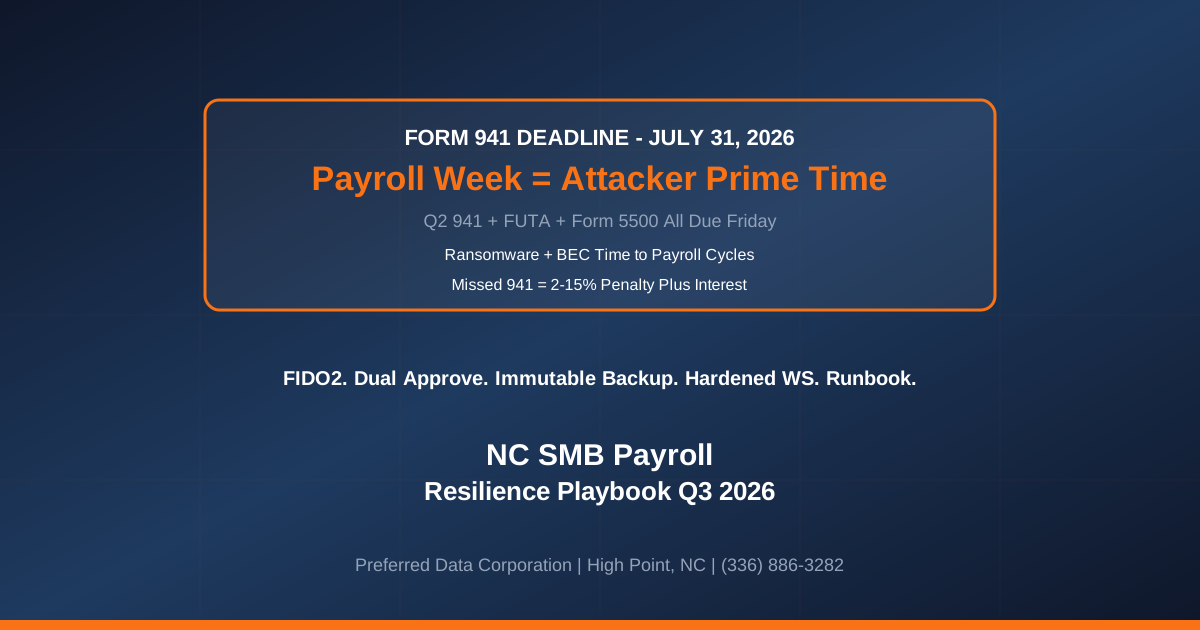
TL;DR: Friday, July 31, 2026 is a hard IRS deadline for NC small businesses. Employers must file Q2 Form 941 (or confirm the extension window if deposits were on time) and remit Q2 FUTA payments if the accumulated liability exceeds $500, per the NerdWallet 2026 business tax deadline calendar and Boulay Group 2026 tax calendar. The same week is one of the most active payroll-attack windows of the year: ransomware actors and BEC operators time their intrusions around known payroll-close cycles because payroll pressure raises the odds of a fast ransom payment or an approved fraudulent wire. For NC small businesses — Piedmont Triad manufacturers with in-house payroll, Triangle professional services on cloud payroll SaaS, Charlotte-metro construction firms with certified-payroll obligations — the July 31 deadline is a live test of whether the payroll system, the payroll workstation, and the payroll administrator's account can survive an incident on July 30 or 31 without missing the filing.
Key takeaway: Payroll resilience is not the same as payroll accuracy. A payroll system that produces correct paychecks 99% of the time can still miss the July 31 941 filing if the payroll workstation is ransomware-encrypted on July 29, the payroll SaaS provider has a regional outage on July 30, or the payroll administrator's account is compromised via MFA fatigue on July 31. NC SMBs should treat the July 31 filing week as an annual live-fire test of payroll BCDR posture, MFA on payroll admin accounts, and BEC controls on direct-deposit changes.
Need a two-week payroll resilience assessment before the July 31 filing? Contact Preferred Data Corporation at (336) 886-3282. BBB A+ rated, serving High Point, Greensboro, Winston-Salem, Charlotte, Raleigh, and the Piedmont Triad since 1987.
What Exactly Is Due on July 31, 2026?
Three specific IRS obligations converge on July 31, 2026, per NerdWallet's small business tax deadline reference and the IRS's Q2 employment tax guidance.
- Form 941 for Q2 2026 - employers report Social Security and Medicare taxes plus income tax withholding for April, May, and June. Filers who deposited all associated taxes in full and on time may file Form 941 by August 10, 2026, per the IRS Instructions for Form 941, but the underlying deposits are still due.
- FUTA Q2 2026 deposit — employers deposit federal unemployment tax if the accumulated liability exceeded $500 through the end of Q2. FUTA quarterly deposit dates are April 30, July 31, November 2 (2026), and February 1, 2027.
- Form 5500 (calendar-year retirement plans) — the standard July 31 deadline for calendar-year 401(k) and other qualified retirement plans, absent an extension via Form 5558.
The mandatory-deposit thresholds, $2,500/quarter for Form 941 accumulated taxes and $500/quarter for FUTA, mean that essentially every NC SMB with W-2 employees has a July 31 obligation of some kind. The extension to file (to August 10) is not an extension to deposit; the deposits are due on the deposit-frequency schedule (monthly or semi-weekly) and independent of the filing deadline.
Why Do Attackers Target the Payroll Week?
Three reasons the last week of a payroll quarter is disproportionately dangerous.
- Time pressure. A payroll administrator with a Friday deadline is more likely to click through a suspicious email, approve a suspicious direct-deposit change, or wire funds without secondary verification. Attackers know this and time BEC and phishing campaigns to hit Tuesday-Thursday of the deadline week.
- Payment authorization concentration. The finance user who has payroll authorization typically also has wire-transfer authorization. Compromising that user in the payroll week lets the attacker pivot from a fake direct-deposit change into a full wire fraud in hours.
- Backup-window disruption. Payroll SaaS platforms often run their heaviest data-movement operations in the last week of the quarter (transactional volumes, employee data updates, tax-filing exports). Any incident during this window has a worse blast radius than a mid-quarter incident.
The 2024-2026 wave of ransomware attacks against small business managed service providers frequently detonated on Thursday or Friday of month-end and quarter-end weeks precisely to maximize this leverage.
What Are the Five Highest-Impact NC SMB Payroll Resilience Moves for Q3?
A payroll resilience playbook, in decreasing order of universal applicability.
- Phishing-resistant MFA on every payroll admin and payroll approver account. No push notification, no SMS — passkey or FIDO2 hardware key. Per PDC's MFA fatigue playbook, 22% of MFA bypasses come from push fatigue and finance/payroll roles are the primary target. YubiKey deployment for 2-5 payroll users is a $80-$300 investment.
- Dual-approval control on direct-deposit changes and new-vendor payment adds. Any change to an employee's direct-deposit bank account or the addition of a new payroll-vendor payee requires two named humans to confirm — one of them out-of-band by phone. This single control blocks the highest-frequency payroll-BEC pattern.
- Tested backup and immutable copy of the payroll data set. Payroll registers, employee master data, tax-filing exports, and prior-quarter Form 941s should exist in an immutable backup (Purview, Barracuda, Rubrik, or MSP-managed equivalent) with a documented restore RTO under 4 hours. Test the restore this quarter.
- Segregated payroll workstation with hardened profile. Payroll administrators should not run payroll from the same workstation used for general web browsing, personal email, or non-work applications. A dedicated hardened workstation (or virtual desktop) with EDR, application allow-listing, and no local admin rights cuts the ransomware blast radius on the payroll data path.
- Written payroll incident-response runbook covering "we cannot file 941 on July 31." The runbook lists (a) who contacts the CPA and IRS, (b) which prior-quarter records are needed to reconstruct if data is lost, (c) how to request Form 4868/8809 extension or reasonable-cause abatement, and (d) how to communicate to employees whose deposits may be delayed. Most NC SMBs do not have this runbook.
Executed together, the five moves reduce the probability of a missed-deadline or payroll-fraud incident by an order of magnitude for a typical 20-150 seat NC SMB.
Payroll System Attack Surfaces: Where Does the Risk Actually Live?
The following comparison shows the six most-attacked payroll surfaces and the corresponding NC SMB control.
| Attack Surface | Attack Type | Right Control | Priority |
|---|---|---|---|
| Payroll admin credentials | MFA fatigue, credential theft | FIDO2 or passkey, no push | Immediate |
| Direct-deposit change workflow | BEC, insider fraud | Dual approval + out-of-band phone verify | Immediate |
| Payroll workstation | Ransomware, infostealer | Hardened profile, EDR, no local admin | 30 days |
| Payroll data backup | Ransomware encryption of backup | Immutable copy, tested restore | 60 days |
| Payroll SaaS provider outage | Regional cloud incident | Documented manual-workaround runbook | 90 days |
| Payroll audit trail integrity | Insider modification, forensic gap | Tamper-evident logging, separation of duties | 90 days |
For most NC SMBs, the payroll-admin credential surface is the single largest exposure — but the direct-deposit-change control is the highest-frequency attack, and the runbook gap is the biggest reason a missed-deadline scenario becomes a compounding failure rather than a contained incident.
What About Payroll SaaS Providers — Are They a Single Point of Failure?
Yes, and NC SMBs should plan for that. When your payroll SaaS is down on July 30, you are not filing 941 on July 31 without a manual workaround.
Three preparations that make payroll SaaS outages survivable.
- Export a weekly local copy of the current payroll register, employee master, and YTD 941 subtotals. Kept in your immutable backup archive. Sufficient to reconstruct with your CPA if the SaaS export is unavailable at the filing deadline.
- Know the vendor's escalation path. The SMB-tier support desk at ADP or Paychex will not resolve a filing-deadline outage in real time. Have the account-manager phone number and the IRS reasonable-cause template ready.
- Understand your Section 3505 exposure. If your payroll SaaS is a "payroll service" under IRC Section 3505, they carry some third-party responsibility for the filing, but the employer remains ultimately liable. A missed 941 filing that the SaaS caused is still your penalty in the first instance.
For manufacturers running Sage 300 CRE payroll or Foundation Software payroll (common in NC construction), the on-prem architecture removes the SaaS-outage risk but adds the payroll-workstation ransomware risk on the specific machine hosting the module — which brings the resilience question back to backup and workstation hardening.
Which NC SMB Verticals Face Concentrated Payroll-Week Risk?
Four segments have concentrated exposure and belong at the front of the Q3 payroll resilience review.
- Piedmont Triad manufacturers with 30-200 hourly employees. Highest transactional payroll volume per pay period, most exposure to shift-differential calculations and overtime accuracy, and typically running Sage 100/300 or Foundation Software payroll on-prem — meaning the payroll workstation is the single point of failure.
- NC construction and specialty trades with certified-payroll obligations. Prevailing-wage jobs (federal, state, and municipal) require accurate certified payroll every week, and a ransomware event during a certified-payroll deadline week compounds project-management liability with tax liability.
- Medical, dental, and behavioral-health practices with mixed W-2 clinician and 1099 contractor pay. Complex payroll workflow, tight cash-flow tolerance, and typically small in-house payroll capacity.
- NC restaurants, hospitality, and food-service with high employee-turnover payroll and heavy tipped-wage reporting. Highest frequency of direct-deposit changes (i.e., highest BEC attack surface) and tightest deadline pressure.
For all four, the Q3 payroll-resilience assessment is a 2-3 week engagement that pays for itself the first time a missed-deadline scenario is avoided.
Ready for a two-week payroll resilience assessment for your NC business? Contact Preferred Data Corporation at (336) 886-3282. Serving High Point, Greensboro, Winston-Salem, Charlotte, Raleigh, and the Piedmont Triad since 1987.
Frequently Asked Questions
What is due on July 31, 2026 for a typical NC small business?
Form 941 for Q2 2026 (April-June) and the Q2 FUTA deposit if accumulated liability exceeded $500, per the NerdWallet 2026 business tax calendar. Depositors who paid all Q2 employment taxes in full and on time have an extended filing deadline of August 10, 2026 for Form 941 itself, but the underlying deposits (monthly or semi-weekly per your assigned schedule) are due on their own calendar. Calendar-year retirement plans also have a July 31 Form 5500 deadline absent Form 5558 extension.
What is the penalty for missing a July 31 deposit or filing?
Late-deposit penalties scale with days late: 2% (1-5 days), 5% (6-15 days), 10% (16+ days), and 15% (10+ days after IRS notice). Late-filing penalty is 5% of unpaid tax per month up to 25%. For a typical NC SMB with $30,000-$80,000 in Q2 payroll tax liability, a 30-day delay can generate $1,500-$8,000 in penalties before interest. Reasonable-cause abatement is available in genuine incident cases with proper documentation.
Is ransomware really more common in payroll weeks?
We have not found a reliable measure of that. What payroll weeks change is the pressure: at month-end and quarter-end, a rushed approval of a fraudulent wire or a distracted click on a phishing email costs more, and an outage that stops payroll is harder to wait out.
Do I need a separate workstation just for payroll?
For SMBs with 30+ employees on a single-payroll-administrator model, yes. A dedicated hardened workstation (or a locked-down virtual desktop) with EDR, application allow-listing, no local admin rights, and no non-work applications reduces ransomware blast radius on the payroll data path by an order of magnitude. Cost is one workstation refresh cycle (~$1,200-$2,400 hardware, plus ~$800-$1,500 in setup and IT time), amortized over 4-6 years.
What is dual-approval on direct-deposit changes and why does it matter?
Dual-approval requires two named humans to confirm any change to an employee's direct-deposit bank account, with at least one confirmation done out-of-band (phone call to a known number, not email or in-app message). The control blocks the highest-frequency payroll BEC pattern: attacker compromises an employee's email, sends a "please update my direct deposit" email to payroll, and diverts one or more pay cycles to a controlled account. Dual approval closes that path with essentially zero productivity cost.
Can PDC handle payroll processing itself?
No — PDC is your technology partner. Payroll processing and tax filing are handled by your CPA, your in-house payroll administrator, or your payroll service (ADP, Paychex, QuickBooks, Gusto). PDC's role is to make the payroll system resilient, secure, and available on filing day: MFA hardening, workstation hardening, backup and restore, incident response runbook, and BCDR posture for the payroll data path.
Related Resources
- NerdWallet 2026 business tax deadline calendar
- Boulay Group 2026 IRS tax deadline calendar
- IRS Employment Taxes overview
- Preferred Data Managed IT Services
- Preferred Data Cybersecurity Services
- Preferred Data Data Protection & Backup
- Related: MFA Fatigue 22% BEC Bypass — NC SMB Authentication Upgrade
- Related: 2026 SMB Breach Economics — NC Small Business Survival Budget