
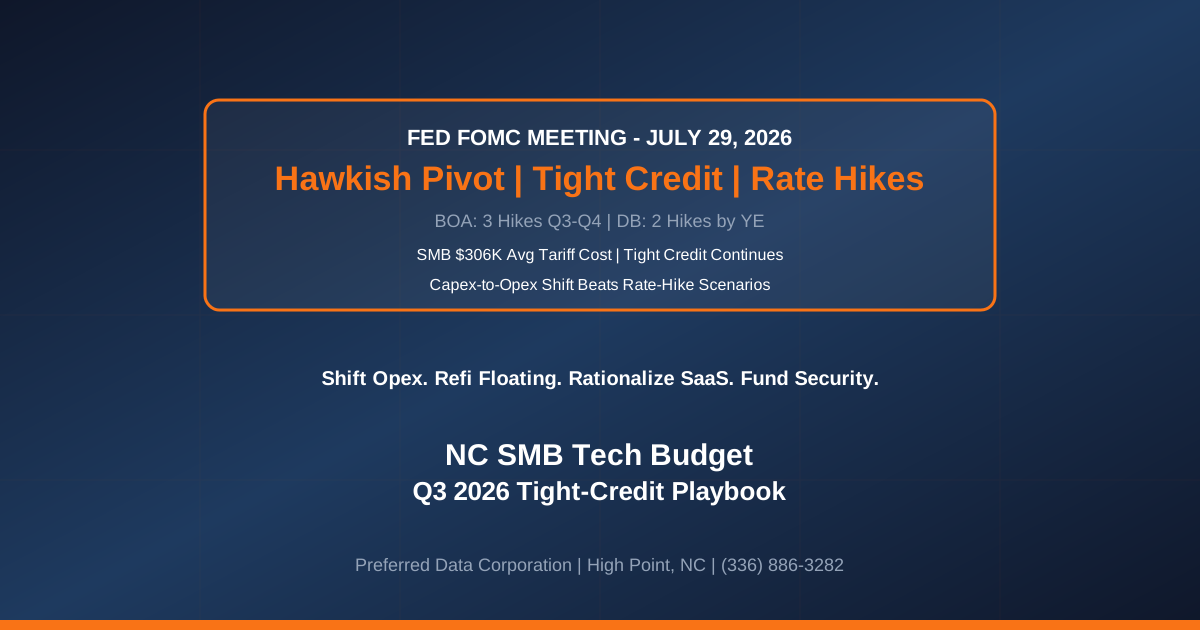
TL;DR: The Federal Reserve's next FOMC meeting is Tuesday, July 29, 2026, and market expectations have swung hard from anticipated rate cuts to bracing for multiple rate hikes through year-end. Bank of America projects three 25-basis-point increases at the September, October, and December FOMC meetings; Deutsche Bank projects two hikes before year-end. The Fed's July 2026 Monetary Policy Report explicitly notes that "small businesses and households continued to face relatively tight credit conditions," compounding earlier findings that tariff-affected SMBs are already less likely to expect employment or revenue growth in 2026. For NC SMBs — Piedmont Triad manufacturers, Triangle professional services, Charlotte metro distributors — the 90-day operational question is not "should we invest in technology?" but "which technology spend gets us the highest fixed-cost predictability against the widest range of interest-rate outcomes?"
Key takeaway: The macro environment for the rest of 2026 is likely tight-credit-plus-hawkish-Fed. NC SMBs should shift the technology mix toward fixed-monthly-cost operating expense (managed IT, managed security, SaaS with reasonable contract terms) and away from large-lump-sum capex (hardware refreshes financed at floating rates, in-house build-outs, on-prem infrastructure). Every capex decision this quarter should stress-test against a scenario where the Fed hikes 50-75 bps through year-end and the SMB working-capital line reprices upward.
Need a two-week IT cost-optimization and capex-to-opex conversion analysis? Contact Preferred Data Corporation at (336) 886-3282 for a right-sized 2026-2027 IT budget review. BBB A+ rated, serving High Point, Greensboro, Winston-Salem, Charlotte, Raleigh, and the Piedmont Triad since 1987.
What Is the Fed Likely to Signal at the July 29 FOMC Meeting?
Three data points frame the July 29 meeting expectations.
- Rate-decision baseline. Per Intellectia's Fed tracker, consensus is for the Fed to hold rates steady at July 29 but for Chair Kevin Warsh (who took the seat in the 2026 leadership transition) to signal a hawkish pivot in the accompanying statement. The June meeting held rates, and the June minutes documented rising internal debate about the timing of the next move.
- Bank forecasts. Bank of America projects three 25-basis-point rate hikes in September, October, and December 2026. Deutsche Bank projects two hikes before year-end. This is a full reversal from the "multiple cuts through 2026" narrative that dominated Q4 2025 and Q1 2026.
- Underlying macro. The July 2026 Monetary Policy Report cites persistent inflation, resilient labor markets, and supply-chain disruptions (tariff-related and otherwise) that have eroded the Fed's willingness to sustain the previously-projected easing path.
The operational takeaway is that any NC SMB with (a) a floating-rate working-capital line, (b) equipment financing on floating terms, or (c) capex plans that assume a lower-rate 2027 refinance is entering a materially harder financing environment than they planned for six months ago.
Why Are Small Businesses Uniquely Squeezed Right Now?
Small businesses are hit harder than large enterprises by both sides of the current macro squeeze — tight credit and tariff pass-through — for three structural reasons.
- Credit access. The Fed's own Monetary Policy Report notes that "small businesses and households continued to face relatively tight credit conditions." Large enterprises can tap public debt markets and syndicated bank lines at compressed spreads; SMBs rely on regional-bank lines that reprice quickly and often face non-price rationing (shrinking credit availability, tighter covenants).
- Tariff absorption capacity. Per Liberty Street Economics' July 2026 analysis, most small businesses in the New York Fed survey said they responded to tariff cost increases by passing the cost to customers. Small businesses reporting tariff-related challenges were less likely to expect either increased revenues or employment in 2026, even controlling for firm characteristics. The Center for American Progress' Q2 2026 study found roughly $306K in average annual tariff costs per SMB importer, with 39% cost absorption.
- Fixed-cost overhead ratio. SMBs have higher fixed-cost-to-revenue ratios than large enterprises. Every technology dollar spent on rigid overhead compounds the SMB's operating leverage against them in a tightening environment.
The convergence of these three effects is what the Reason coverage of the Fed's SMB survey called "greater pessimism about generating employment and revenues in 2026."
How Should NC SMBs Restructure Their Technology Spend Under Tight Credit?
Five moves to make in the next 90 days, in decreasing order of universal applicability.
- Shift the technology mix toward opex, away from capex. Every hardware, on-prem infrastructure, and in-house-build decision should be tested against an equivalent managed-service or SaaS alternative. A $60K on-prem server refresh financed at 8.5% costs meaningfully more in a rising-rate environment than $2K/month of equivalent managed-service capacity. See the Managed IT vs In-House Build cost comparison below.
- Renegotiate any floating-rate technology financing before Q4. Equipment leases, hardware financing lines, and SaaS financing on floating-rate terms should be pulled forward for renegotiation or refinance before the September FOMC meeting. Locked-in fixed rates today are cheaper than they will be in Q1 2027 under the current forecast.
- Prioritize cybersecurity spend that reduces insurance premiums. 2026 cyber-insurance underwriting rewards specific controls — 96% MFA mandate, 88% EDR mandate, 24/7 MDR — with material premium reductions. The right sequencing turns a "sunk cost" security spend into a documented insurance savings that partially self-funds.
- Rationalize SaaS spend against actual usage. Most NC SMBs are paying for 20-40% more SaaS seats and tiers than they actively use. A quarterly usage-based rightsizing typically frees 10-20% of the SaaS budget line, which is enough to fund the incremental managed-security spend from #3.
- Postpone discretionary capex; accelerate high-ROI security capex. In a rising-rate environment, discretionary hardware refresh (workstation cycles, printer fleets, wire-drop expansions) should be pushed 6-12 months if functional. But high-ROI security capex (immutable backup, EDR licenses, MFA hardware keys) should be pulled forward because the cost of a ransomware event compounds against the SMB's already-tightening balance sheet.
Managed IT vs In-House Build: The 2026 Tight-Credit Math
The following comparison shows the total cost of ownership for a typical NC SMB (50 seats, 4 servers, 3 SaaS integrations) over 3 years under a rising-rate environment.
| Cost Component | In-House Build | Managed IT (PDC-style) |
|---|---|---|
| Year-1 hardware capex | $60,000 (financed at 8.5%) | $0 |
| 3-year interest on hardware line | ~$8,100 | $0 |
| 1 FTE IT admin (salary + burden) | $95,000/yr × 3 = $285,000 | $0 |
| 24/7 SOC/MDR coverage | $30,000/yr × 3 = $90,000 | Included |
| Software licensing + refresh | $22,000/yr × 3 = $66,000 | Passthrough |
| Managed IT retainer (50 seats) | N/A | ~$8,500/mo × 36 = $306,000 |
| Cybersecurity insurance premium | Higher (uncertified) | Lower (certified controls) |
| 3-year total (excluding software) | ~$509,000 | ~$306,000 + software |
The math is not just cost — it is also cost predictability. The managed retainer is a fixed monthly opex line that survives rate hikes, credit-line reprices, and a scenario where the SMB has to defer capex. The in-house build is a series of variable capex commitments layered on top of a floating-rate credit line.
What NC SMB Verticals Are Most Exposed to the Tight-Credit + Tariff Squeeze?
Four NC SMB segments face concentrated exposure and should be first in line for a Q3 IT-budget rework.
- Piedmont Triad manufacturers and distributors. Tariff-exposed on inputs (steel, furniture components, textiles, electronics, packaging), operating leverage against fixed overhead, and typically running on-prem ERP with hardware refresh cycles that get expensive under rising rates. Also the segment most likely to have Oracle EBS or on-prem SharePoint deployments that need the CVE work covered elsewhere in this month's blog cadence.
- Charlotte-area distributors and light manufacturing. Same tariff and hardware exposure as the Triad, plus higher-touch customer-service technology stacks that need consistent uptime; less-forgiving margin structure.
- Triangle professional services (law, engineering, consulting). Lower physical-goods tariff exposure but higher SaaS spend per employee (typically $200-$500/user/month across all applications) and thus higher SaaS-rationalization upside.
- Rural and mid-market healthcare, dental, and behavioral-health practices. Tight margins under Medicaid/insurance reimbursement pressure, HIPAA/OCR compliance overhead (per HHS OCR's 2026 risk-management enforcement expansion), and typically small internal IT teams. Managed IT + managed security is often the only path to full compliance.
What Does a "Fed Hike Scenario" IT Budget Look Like in Practice?
A three-tier scenario plan for a 50-seat NC SMB with typical technology exposure.
- Base case (Fed holds, one hike late 2026). Standard IT budget with quarterly review. Deploy the priority security spend (MFA, EDR, immutable backup); rationalize SaaS on a quarterly cadence; refresh hardware on normal cycle. Assume 8-10% year-over-year technology cost growth.
- Hawkish case (Fed hikes 50-75 bps through Q4). Shift the mix: freeze discretionary capex, accelerate the managed-IT / managed-security conversion, refinance any floating-rate technology debt, rationalize SaaS more aggressively (targeting 15-20% cost reduction), and push non-essential SaaS renewals into 2027 with better negotiating position. Assume 3-5% year-over-year cost growth after mix shift.
- Downside case (Fed hikes 100+ bps + tariff escalation). Freeze all non-security discretionary spend, execute a full capex-to-opex conversion, negotiate 12-18 month SaaS renewals at flat pricing, and use the managed-IT retainer as the fixed anchor. Insurance-driven security spend remains as the only category that grows (because it self-funds through premium reduction).
The right posture is not to bet on any single scenario but to structure the technology mix so that the SMB has upside optionality if rates ease and downside protection if they don't.
Ready for a two-week IT cost-optimization and capex-to-opex conversion analysis for your NC business? Contact Preferred Data Corporation at (336) 886-3282. BBB A+ rated, serving the Piedmont Triad since 1987.
Frequently Asked Questions
What is the Federal Reserve expected to do on July 29, 2026?
Consensus expectation is a hold at July 29 with a hawkish signal in the statement and Chair Warsh press-conference. Bank of America projects three 25-basis-point hikes at the September, October, and December FOMC meetings; Deutsche Bank projects two hikes by year-end. The consensus is a full reversal of the "multiple cuts through 2026" narrative that prevailed in early 2026.
How much does an average NC SMB pay in tariffs?
Per Center for American Progress research cited in our Section 122 aftermath post, the average annual tariff cost per SMB importer is approximately $306,000, with 39% absorption (i.e., 61% passed to customers). The July 24, 2026 Section 122 expiration provides temporary relief, but Section 232 pharma/medical device investigations and Section 301 investigations are staged to bring replacement tariffs into effect in Q3-Q4 2026.
What is the fastest way to convert IT capex to opex?
The three highest-impact conversions are: (1) hardware-as-a-service (leasing hardware refresh cycles instead of financing), (2) managed IT retainer replacing internal IT overhead (typically converts $150K-$300K/year of loaded FTE cost into a fixed monthly retainer), (3) managed cybersecurity (SOC/MDR/EDR bundled into a per-seat monthly line item instead of separate hardware, license, and staffing capex). PDC's assessments typically identify $60K-$180K/year of achievable cost conversion for a 50-seat SMB.
Are cybersecurity investments still worth it in a tight-credit environment?
Yes — arguably more so. Cybersecurity spend is one of the few technology categories where the ROI includes a documented insurance premium reduction (typically 15-40% for organizations that meet the 96% MFA mandate baseline). Combined with the fact that 60% of small businesses close within six months of a major ransomware event, the risk-adjusted ROI on defensive investment is materially higher in a tight-credit environment than in an easy-credit one.
Should I lock in fixed-rate financing on technology capex now?
Generally yes if you have capex commitments already in the pipeline. Locking in current rates before the September FOMC meeting is a hedge against BOA's projected 75-basis-point year-end tightening. But before locking in financing, run the alternative analysis: does the capex commitment need to happen at all, or can the same functional need be met with an opex managed-service equivalent? PDC's cost-optimization analyses often reveal that the "obvious" hardware capex has a cheaper opex alternative.
How does the tariff environment interact with the Fed rate environment?
They compound. Rising rates increase the cost of the working-capital line that NC SMB importers use to hold pre-paid inventory or to bridge tariff-cost pass-through timing. The July 24 Section 122 expiration provides temporary relief, but the Section 232 pharma/medical device investigation reports (due July 31 and September 29) and expected Section 301 successor tariffs stage replacement duties into Q3-Q4 2026 — likely coinciding with the Fed's projected September and October hikes.
Related Resources
- Federal Reserve Monetary Policy Report July 2026 summary
- Effect of Tariffs on U.S. Small Businesses — Liberty Street Economics
- Preferred Data Managed IT Services
- Preferred Data Cybersecurity Services
- Preferred Data M&A Advisory
- Related: Section 122 Tariff Expired July 24 — NC SMB Landed-Cost Reset
- Related: Cyber Insurance 96% MFA Mandate — NC SMB Q4 Renewal Playbook