
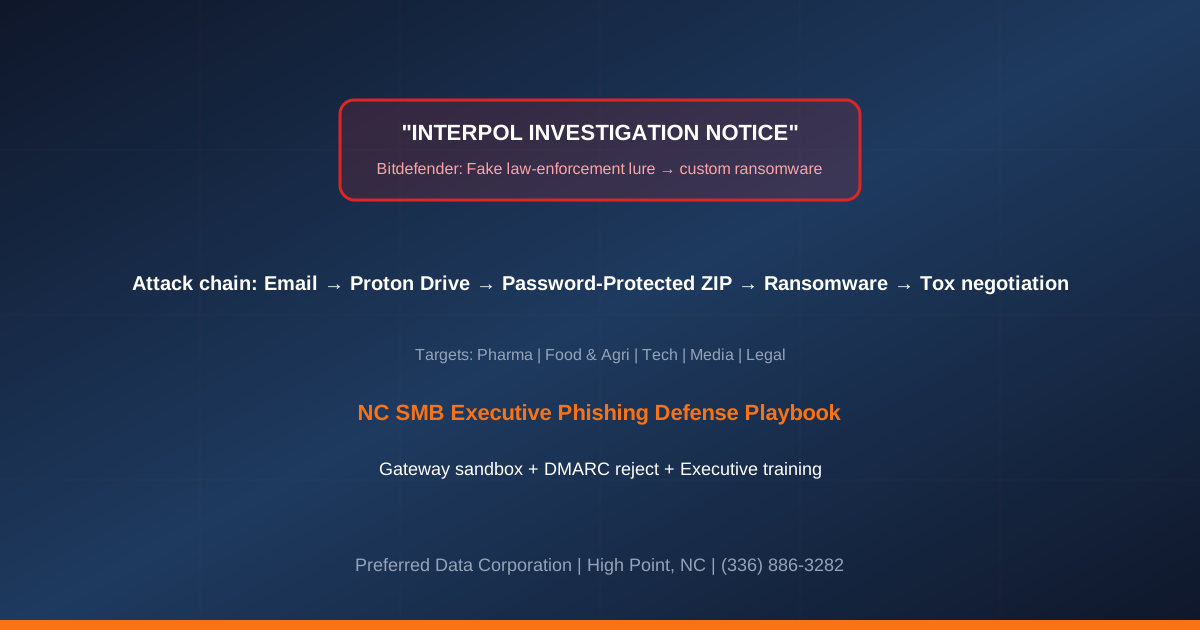
TL;DR: Bitdefender Antispam researchers disclosed a global phishing campaign in July 2026 that impersonates Interpol to deliver a custom ransomware payload to small and medium-sized businesses across pharmaceuticals, food and agriculture, technology, media, and legal services. The lure email claims the recipient's company is under investigation and directs them to a Proton Drive link containing a password-protected archive with the "evidence." The archive extracts to a ransomware executable disguised as a video file that encrypts local systems and directs victims to negotiate via the Tox peer-to-peer messenger. For NC SMBs, this is a high-priority email defense and executive-training event that requires immediate action on gateway policies, sandboxed archive extraction, and impersonation-fraud user training.
Key takeaway: Attackers evolved past "your account will be suspended" phishing years ago. In 2026, the credible lure is "you are under criminal investigation." The right defense is not just an email filter — it is training your executives and finance team to recognize authority-based fraud before they click.
Does your email gateway block password-protected archives from unknown senders? Contact Preferred Data Corporation for a same-week email security posture review. BBB A+ rated. On-site within 200 miles of High Point. Call (336) 886-3282.
What Is the Fake Interpol Ransomware Campaign?
The fake Interpol ransomware campaign is a phishing-to-ransomware operation first documented publicly by Bitdefender Antispam researchers in July 2026. It impersonates the International Criminal Police Organization (Interpol) to convince SMB decision-makers that their company is the subject of a criminal investigation, then delivers a custom ransomware payload via a password-protected archive.
Attack chain:
- Phishing email arrives at an SMB executive, finance leader, or general company mailbox with subject lines resembling "URGENT: Interpol Investigation Notice" or "Case Reference: [random alphanumeric] - Response Required."
- Email body alleges the recipient's organization is implicated in "activities involving accounts, systems, or services associated with your organization" and demands cooperation.
- Proton Drive link in the email points to a password-protected ZIP or RAR archive.
- Password provided in the email body (a common technique to bypass email gateway archive scanning).
- Archive extracts to a malicious executable disguised as a video file (e.g.,
evidence.mp4.exeorcase_video.wmv.exe— extension abuse relies on Windows' default "hide file extensions" behavior). - Ransomware payload encrypts local files and deposits a ransom note directing the victim to negotiate via Tox peer-to-peer messenger.
Attack characteristics:
- Custom ransomware, not a known family. The payload is not tied to a known ransomware-as-a-service group like LockBit or Akira, making signature-based detection harder.
- Multi-sector targeting. Victim sectors include pharmaceuticals, food and agriculture, technology, media, and legal services across the US, Europe, Asia, and the Middle East.
- Authority-based social engineering. The lure exploits fear of law enforcement action, urgency, and reputational damage — a psychology-driven vector that bypasses "does this look phishy" heuristics.
- Tox negotiation. Tox is a decentralized peer-to-peer messenger that leaves fewer forensic artifacts than email or Signal, complicating attribution.
Key takeaway: Interpol will never email your company directly. Interpol works through national law enforcement — in the US, that is the FBI, DEA, ICE, or your state Attorney General. Any email claiming to be Interpol is fraud, full stop.
Which NC SMB Industries Are Most at Risk?
Bitdefender's initial disclosure identifies pharmaceuticals, food and agriculture, technology, media, and legal services as the primary target sectors. Every one of those sectors has a strong NC presence:
- Pharmaceuticals and life sciences. Research Triangle Park (Raleigh-Durham-Chapel Hill) is one of the largest life-sciences clusters in the US. Charlotte, Greensboro, and Winston-Salem all host pharmaceutical manufacturing and distribution.
- Food and agriculture. North Carolina is the second-largest poultry producer in the US, with major food processing and agri-tech operations across the Piedmont, Sandhills, and eastern coastal plain.
- Technology. The Piedmont Triad, Charlotte, and Research Triangle host thousands of tech-adjacent SMBs — SaaS, embedded systems, IoT, industrial technology.
- Media and communications. Regional media companies, PR firms, marketing agencies, and video production studios across every metro area.
- Legal services. Every county in North Carolina has law firms handling contracts, real estate, litigation, family law, and estate work — every one of them attractive to attackers because law firms hold sensitive client data.
Beyond the named target sectors, the campaign structure suggests the attackers will pivot to new verticals as detection rises. Construction, healthcare, financial services, and professional services are all natural next targets given the same authority-based psychology.
What Makes This Campaign Effective (and How Do We Break the Kill Chain)?
The fake Interpol campaign works because it combines three social engineering primitives:
- Authority. Recipients are conditioned to comply with law enforcement.
- Urgency. "Response required within 48 hours" or "immediate action" language shortcuts deliberation.
- Fear. "Your company is under investigation" triggers threat response, not critical evaluation.
The kill-chain break points for an NC SMB:
Email gateway (delivery prevention).
- Block emails from external senders claiming to be from law enforcement domains that fail DMARC / DKIM / SPF.
- Sandbox all password-protected archives from external senders. Modern email security gateways (Microsoft Defender for Office 365, Proofpoint, Mimecast, Abnormal) support this.
- Rewrite external URLs through a URL-defense proxy that detonates the link in a sandbox before allowing the user to reach it.
- Flag emails with mixed language patterns — the fake Interpol emails often contain machine-translation artifacts, non-English capitalization, and inconsistent formatting.
Endpoint (execution prevention).
- Show file extensions by default. Group Policy:
HideFileExt = 0. - Application allowlisting. Deny execution of unsigned executables from Downloads, Desktop, and temp directories.
- Behavioral EDR. Block execution of unsigned binaries with encryption behavior signatures.
- Backup with immutability. Test restore quarterly.
Identity (post-compromise containment).
- Phishing-resistant MFA. FIDO2 / passkeys for executives, finance, and admins.
- Conditional access policies that require compliant device for M365 access.
- Continuous access evaluation. Revoke tokens on high-risk sign-in.
Human (recognition and reporting).
- Executive-lure training. Quarterly simulated phishing that includes authority-based lures (law enforcement, government, regulatory).
- Report-a-phish button in Outlook / Gmail that routes to security operations.
- "When in doubt, call the sender through a channel you already trust." No email link, no phone number in the suspicious email.
| Kill-Chain Stage | Control | Detection Difficulty |
|---|---|---|
| Delivery | Email gateway sandboxing | Low — modern gateways catch |
| Delivery | DMARC / DKIM / SPF enforcement | Low |
| User interaction | Executive training | Medium — repeat training needed |
| User interaction | URL-defense URL rewriting | Low |
| Execution | Application allowlisting | Medium — requires deployment work |
| Execution | Behavioral EDR | Medium — depends on EDR quality |
| Impact | Immutable backup | Low — requires validated restore |
What Should NC SMBs Do This Week to Harden Against This Campaign?
The fake Interpol campaign is opportunistic and volume-driven. A tight July 2026 hardening cycle across email, endpoint, and training will dramatically reduce SMB exposure.
Wednesday-Thursday priorities (email gateway):
- Confirm password-protected archive sandboxing is enabled and active. Test with a known-good sample.
- Confirm DMARC is at
p=rejectfor your domain. If still atp=noneorp=quarantine, escalate to reject. - Enable URL rewriting / safe links for all external URLs. Microsoft Safe Links, Proofpoint URL Defense, Mimecast URL Protect.
- Add impersonation-protection policies for law enforcement domains (interpol.int, fbi.gov, dea.gov, dhs.gov). Flag any external sender using these strings in the display name.
Thursday-Friday priorities (endpoint and user):
- Push Group Policy to show file extensions on every managed endpoint (
HideFileExt = 0). - Push a fleet-wide security notice to all staff describing the fake Interpol lure with screenshots (not clickable) and a report-a-phish shortcut.
- Send a targeted note to finance, legal, HR, and executives with specific guidance on authority-based lures and how to verify legitimate law enforcement contact.
- Confirm EDR posture on every executive endpoint.
Friday priorities (backup and IR):
- Verify immutable backups for critical systems.
- Test restore on at least one critical file share and one email mailbox.
- Confirm on-call escalation for the July 4 weekend.
Explore Preferred Data's cybersecurity services
How Should NC SMB Executives Actually Respond to Authority-Based Fraud?
The most durable defense is a decision protocol every executive follows for any authority-based communication.
The 3-check protocol for any law enforcement, regulator, or government communication:
- Independent channel verification. Do not use any contact information contained in the suspicious email. Look up the agency's official phone number through a search engine or an existing legal contact, and call to verify.
- Legal counsel loop-in. Real law enforcement communications with SMBs are almost always routed through counsel. Involve your outside counsel or general counsel immediately for any investigation notice.
- No data, no clicks, no calls to their number. Do not send any information, do not open any attachment, do not click any link, and do not call the number in the email — until step 1 and step 2 are complete.
Additional protocol items for NC SMB executives:
- Legitimate US federal law enforcement contact for a business is not typically initiated by email. The FBI, DEA, ICE, and others use in-person visits, formal subpoenas, or contact through counsel. Interpol works through national law enforcement — Interpol will not email a US SMB directly.
- Cross-border investigation notices via email are essentially always fraud. Real cross-border investigations go through the DOJ Office of International Affairs, not through Interpol email to your company inbox.
- Password-protected archives are a red flag. Legitimate government communications do not send evidence in a password-protected ZIP.
For NC manufacturers subject to CMMC, DFARS, or ITAR, and NC healthcare providers subject to HIPAA, executive-lure training must include compliance-adjacent scenarios (fake OCR breach notice, fake OFAC sanction notice, fake DoD contract violation notice).
Key takeaway: The best defense against authority-based fraud is a documented protocol that every executive follows before any response. That protocol should be tested with quarterly simulated phishing that includes law enforcement lures.
What Do NC SMBs Do If a User Already Clicked?
If a user opened the archive and extracted the payload, treat it as a live incident. The response window is measured in hours.
Immediate containment (within 1 hour):
- Isolate the affected endpoint from the network. Physical unplug is faster than any policy push.
- Disable the user's identity. Force sign-out from every session. Disable the account in Entra ID / Active Directory.
- Rotate the user's credentials. All passwords and MFA seeds.
- Notify security operations. Engage MDR / SOC.
Investigation (within 4 hours):
- Preserve the endpoint for forensics. Do not wipe or re-image until forensics has a memory and disk snapshot.
- Identify the payload. Hash the malicious executable, check VirusTotal, engage IR provider for reverse engineering if needed.
- Assess encryption scope. Which files, which network shares, which cloud sync targets.
- Assess exfiltration scope. Review outbound network traffic from the endpoint for the past 72 hours.
Recovery (within 24-72 hours):
- Restore from immutable backup for encrypted data.
- Rebuild the endpoint from a clean image.
- Re-provision the user account with new credentials and refreshed MFA.
- Notify counsel and cyber insurance carrier.
- Notify regulators if required (HIPAA breach, state breach-notification laws, DFARS incident reporting for CMMC-scoped systems).
Do NOT pay the ransom. In the fake Interpol campaign specifically, the payload is a custom ransomware with no established decryption reputation. Payment is more likely to fund the next wave than to recover files. Restore from backup and engage law enforcement — real law enforcement — through the FBI IC3 (ic3.gov).
Call Preferred Data at (336) 886-3282 for expedited incident response.
How Does Preferred Data Deliver Email and Executive Defense for NC SMBs?
Preferred Data Corporation provides email security posture assessment, DMARC / DKIM / SPF hardening, executive-lure phishing simulation, security-awareness training, and 24/7 managed detection and response for NC manufacturers, construction firms, healthcare providers, professional-services offices, and financial institutions. With 37+ years of North Carolina IT expertise and an average client retention of 20+ years, we build email and identity defense as a layered posture rather than a single tool.
Our fake Interpol campaign response package includes email gateway policy review, password-protected archive sandbox verification, DMARC posture assessment, executive-lure targeted training, endpoint file-extension enforcement, immutable backup validation, and 24/7 monitored SOC coverage through the July 4 weekend.
For businesses within 200 miles of High Point, we deliver on-site training workshops for executive and finance teams.
Review our cybersecurity checklist
Frequently Asked Questions
Does Interpol actually email small businesses?
No. Interpol is an international coordination body for national law enforcement — it does not communicate directly with private companies. In the US, federal law enforcement (FBI, DEA, ICE) contacts businesses in person, through counsel, or via formal subpoena — not via unsolicited email demanding a response.
What is the ransom demand for the fake Interpol payload?
The Bitdefender report indicates the attackers direct victims to negotiate via Tox peer-to-peer messenger. Ransom amounts vary. NC SMBs should not pay — restore from immutable backup and report to FBI IC3.
How do I recognize a fake Interpol phishing email?
Common indicators: sender domain not interpol.int (or claims to be Interpol but comes from a webmail domain), Proton Drive or Mega link to a password-protected archive, password provided in the email body, machine-translation artifacts, urgency language, and threat of criminal consequence for non-response.
Should we train our whole staff or just executives?
Both. Executives and finance staff are the primary targets, but any employee with access to sensitive data or the ability to authorize actions can be lured. Quarterly training for all staff, monthly executive-specific training for the top 20-50 people.
What is Tox and why does the ransomware use it?
Tox is a decentralized peer-to-peer messenger that provides end-to-end encryption without a central server. Attackers use it because it leaves fewer forensic artifacts than email, Telegram, or Signal, and it is harder to disrupt through takedown requests.
Can Preferred Data assess our email posture this week?
Yes. Our email posture assessment is a 5-day engagement for a typical SMB — DMARC / DKIM / SPF audit, gateway policy review, sandbox validation, executive-lure test, and remediation plan. Call (336) 886-3282.
Does our cyber insurance require executive phishing training?
Most 2026 cyber insurance policies require documented security awareness training as a condition of coverage. Increasingly, they specifically require executive-lure training and DMARC at p=reject. Review your policy renewal questionnaire.