
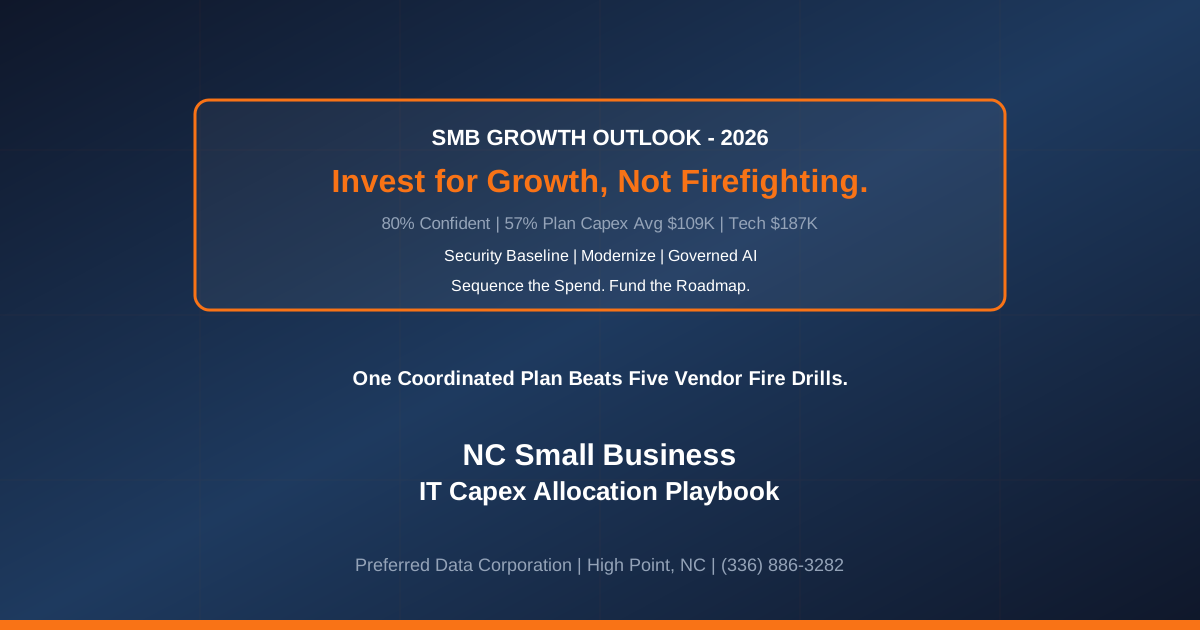
TL;DR: Small business owners are investing for growth despite the headlines. A Comerica Bank survey found 80% of small business owners confident in their future success and 79% expecting sales growth, averaging a projected 7.9% increase, while 57% plan 2026 capital spending averaging $109,000, and technology firms average $187,000. The question for NC small businesses is not whether to invest in technology in 2026, it is how to spend that money on growth instead of on emergencies.
Key takeaway: 2026 is a year of both opportunity and forced modernization. The same businesses planning growth capex are also being pushed off legacy systems by vendor changes. The winners will fund a deliberate roadmap, security, modernization, and governed AI, rather than reacting to each vendor deadline as a surprise bill.
Planning your 2026 technology investments? Contact Preferred Data Corporation at (336) 886-3282 for a technology roadmap and IT investment review. BBB A+ rated, serving High Point, Greensboro, Winston-Salem, Charlotte, Raleigh, and the Piedmont Triad since 1987.
Are small businesses really investing in 2026?
Yes, and the confidence is broad-based. Despite tariff and inflation pressure, small business owners are optimistic and are backing that optimism with real capital budgets, which makes 2026 a genuine growth-and-investment year rather than a defensive one.
The Comerica survey found:
- 80% of owners are confident in their future success, and 79% expect sales growth averaging a projected 7.9%.
- 57% plan capital expenditures in 2026, averaging $109,000, with technology firms averaging $187,000.
- The Comerica Small Business Index registered 55.5 in the fourth quarter of 2025, still indicating squarely optimistic sentiment.
The pressure is real too: 42% reported negative effects from tariffs. But the headline is that NC small businesses are not hunkering down, they are budgeting to grow, and technology is where a lot of that capital will go.
Why does 2026 IT spending get wasted so easily?
IT budgets get burned when they are spent reactively, one vendor deadline and one emergency at a time, instead of against a plan. 2026 is unusually full of forced changes, and each one, handled in isolation, becomes an unplanned expense that crowds out growth investment.
Consider what is landing on NC small businesses at once this year:
- Broadcom's VMware pricing can double or triple virtualization costs, pushing a migration decision.
- Microsoft 365 and Google Workspace both raised prices and bundled mandatory AI.
- Windows 10 Extended Security Updates escalate, and on-premises Exchange Server hits its final security-update deadline in October 2026.
- QuickBooks Desktop is being retired while its price rises.
Handled one panic at a time, these become five separate fire drills. Handled as a roadmap, they become one coordinated modernization that also advances your growth goals. The difference is planning, which is exactly what a virtual CIO relationship provides.
Want your forced-change list turned into one coordinated plan? Call Preferred Data at (336) 886-3282 or explore our Managed IT Services.
How should an NC small business allocate its 2026 IT budget?
A durable way to allocate IT capital is across three buckets: a security and continuity baseline, modernization of aging systems, and governed AI and growth enablement. Fund them in that order, because growth technology built on an insecure, out-of-date foundation does not last.
| Investment bucket | What it covers | Why it matters in 2026 |
|---|---|---|
| Security and continuity baseline | MFA, EDR, backups, tested recovery, patching | 96% of ransomware victims are SMBs; insurers now require it |
| Modernization | Server, email, virtualization, accounting migrations | Vendor deadlines force these anyway; plan them |
| Governed AI and growth | AI adoption with policy, cloud, automation | Capture productivity you are already paying for |
Key takeaway: Spend on the baseline first, because a single ransomware incident or an unpatched-server breach can erase a year of growth investment. Then modernize on your schedule, and layer governed AI on top of a foundation that can actually support it.
The businesses that get the most from a $109,000 or larger technology budget are not the ones that buy the most tools; they are the ones that sequence the spend so each investment protects and enables the next.
What is the highest-return technology investment for 2026?
For most NC small businesses, the highest-return move is a strategic IT relationship that turns scattered spending into a plan, because the biggest losses come from unplanned downtime, breaches, and duplicated tools, not from underspending. Getting the sequence right is worth more than any single product.
- Close the security gaps first. The Verizon DBIR reports 31% of breaches now start with an unpatched vulnerability; fixing that is cheaper than any incident.
- Modernize the forced items on a roadmap. Sequence the VMware, Exchange, Windows, and accounting decisions so they share planning and budget cycles.
- Adopt AI with governance. You are already paying for bundled AI; a light policy plus enablement turns that cost into measured productivity.
- Measure outcomes, not activity. Track downtime avoided, hours saved, and risk reduced, and let those numbers drive next year's budget.
This is the core of what a managed IT partner and virtual CIO deliver for firms across the Piedmont Triad: a roadmap that fits your growth goals, your budget, and your industry, whether you are a manufacturer, a professional-services firm, or a distributor.
Ready to invest for growth instead of firefighting? Contact Preferred Data Corporation at (336) 886-3282. Serving the Piedmont Triad since 1987, BBB A+ rated.
Frequently Asked Questions
Are small businesses actually planning to spend more on technology in 2026?
Yes. The Comerica survey found 80% of owners confident in their success, 79% expecting sales growth, and 57% planning capital expenditures averaging $109,000, with technology firms averaging $187,000. Small businesses are investing for growth, and technology is a major destination for that capital.
How much should a small business spend on IT?
There is no single percentage that fits every business, because the right number depends on your risk profile, compliance requirements, and growth plans. A more useful approach is to allocate across three buckets, security and continuity first, modernization second, and governed AI and growth third, then size each to your specific situation.
What should be my top IT priority in 2026?
Close your security and continuity gaps first: multi-factor authentication, endpoint detection and response, tested backups, and current patching. Because 96% of ransomware victims are small businesses and a single incident can wipe out a year of growth investment, the baseline is the highest-return spend before anything else.
Why are so many technology deadlines hitting in 2026?
Several vendors converged on 2026: Broadcom's VMware pricing, Microsoft 365 and Google Workspace increases with bundled AI, Windows 10 Extended Security Updates, the final on-premises Exchange security-update deadline, and the QuickBooks Desktop wind-down. Planned together as a roadmap, they become one coordinated modernization instead of five separate emergencies.
What is a virtual CIO and do I need one?
A virtual CIO is a strategic IT advisor who builds and maintains your technology roadmap, budget, and priorities without the cost of a full-time executive. Small businesses making meaningful 2026 investments benefit most, because the vCIO ensures the spending is sequenced for security, modernization, and growth rather than reacting to each vendor deadline.
Can Preferred Data help build our 2026 technology roadmap?
Yes. We provide managed IT and virtual CIO services that turn scattered technology spending into a sequenced plan aligned to your growth goals, for businesses across High Point, Greensboro, Charlotte, Raleigh, and the greater Piedmont Triad.