
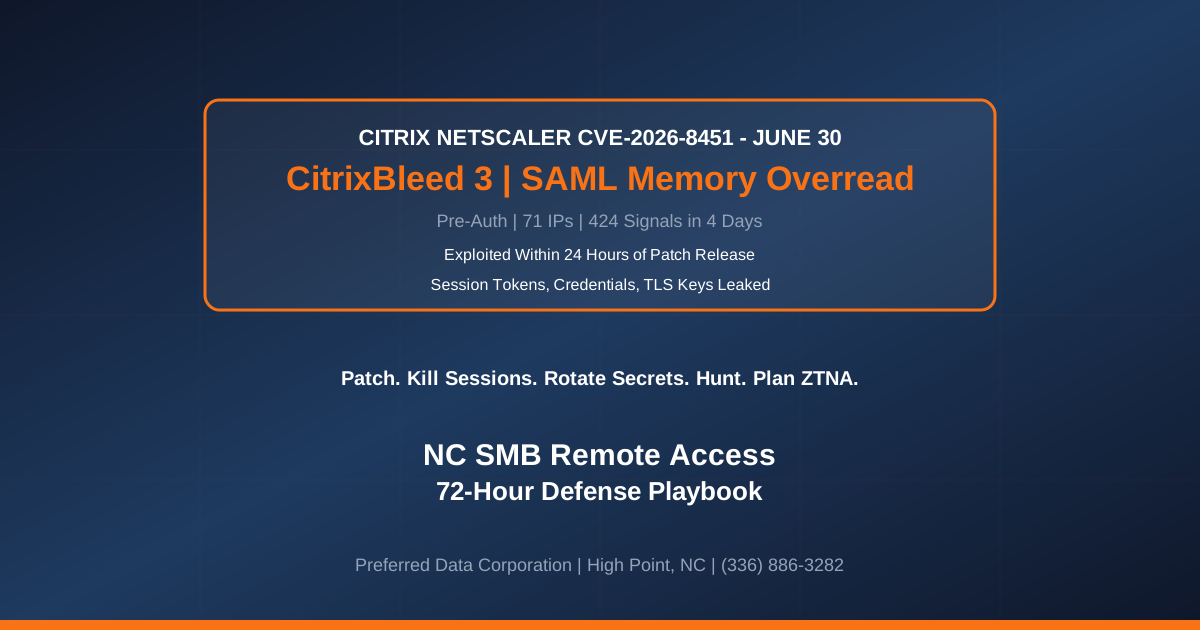
TL;DR: CVE-2026-8451, dubbed "CitrixBleed" by researchers, is a pre-authentication SAML memory overread in Citrix NetScaler ADC and NetScaler Gateway appliances configured as SAML identity providers. Citrix published fixes on June 30, 2026 as part of a six-CVE bulletin. Detection rules landed on July 1, and CrowdSec observed the first in-the-wild exploitation attempts on July 2, logging 71 unique malicious IP addresses and 424 exploitation signals in the first four days, with a peak of 127 attempts in a single day. The vulnerability lives in the appliance's XML parser at the /saml/login endpoint and leaks fragments of appliance memory that can include authentication session tokens, cleartext credentials, and SSL/TLS private keys. For any NC SMB that fronts remote access, VPN, virtual desktops, or SaaS SSO through a NetScaler appliance, this is a 72-hour patch-plus-rotate emergency, not a routine advisory.
Key takeaway: Every NetScaler ADC or Gateway that has ever been configured as a SAML identity provider on a vulnerable firmware release should be considered credential-and-session compromised until proven otherwise. Patch to the fixed firmware, terminate all active sessions, rotate all secrets exposed to the appliance (including admin passwords, RADIUS/LDAP service accounts, and SSL private keys), and hunt for post-exploitation activity. This is the same operational pattern that turned the original 2023 CitrixBleed into a mass-ransomware event.
Need an emergency NetScaler assessment and 90-day ZTNA migration plan? Contact Preferred Data Corporation at (336) 886-3282 for a two-week edge-appliance security review. BBB A+ rated, serving High Point, Greensboro, Winston-Salem, Charlotte, Raleigh, and the Piedmont Triad since 1987.
What Exactly Is CVE-2026-8451 and Why Does the "CitrixBleed" Name Matter?
CVE-2026-8451 is an out-of-bounds read (memory overread) vulnerability in the NetScaler appliance's XML parser for SAML authentication requests. When the appliance is configured as a SAML identity provider (IdP), an unauthenticated remote attacker can send a crafted request to the /saml/login endpoint and receive back fragments of the appliance's process memory — the same class of flaw as the original 2023 CitrixBleed (CVE-2023-4966) that triggered mass ransomware activity across Boeing, Comcast, DP World, and hundreds of other victims.
- Attack vector. Pre-authentication. The attacker does not need credentials, does not need to phish a user, and does not need to exploit a chain — a single well-formed HTTP request to
/saml/loginis enough. - Leaked data classes. Per watchTowr Labs' technical analysis, exposed memory can include SAML session tokens, cleartext credentials from recent authentications, SSL/TLS certificate private keys, and other secrets held in the appliance's memory at the time of the request.
- Exploitability. Detection sensor networks recorded 71 unique attacking IPs and 424 exploitation signals in the first four days. The exploit was in the wild within 24 hours of the patch bulletin.
The reason the "CitrixBleed" naming matters is threat-actor targeting behavior. The 2023 CitrixBleed pattern shows the sequence: (1) mass exploitation to harvest session tokens, (2) session hijack to bypass MFA, (3) internal reconnaissance, (4) domain admin, (5) ransomware. Every hour a vulnerable appliance stays online is an hour that an attacker with a valid stolen session token can walk into your network as an authenticated user.
Who Is Affected and What Are the Fixed Firmware Versions?
CVE-2026-8451 affects NetScaler ADC and NetScaler Gateway appliances only when configured as a SAML identity provider (IdP) — the "Authentication, Authorization, and Auditing" SAML IdP feature. Appliances used purely for load balancing, WAF, or ICA/HDX proxying to XenApp/XenDesktop without SAML IdP are not directly exposed to this specific CVE, but should still be patched because the June 30 bulletin covered six total CVEs including HTTP/2 Bomb (CVE-2026-49975) and other high-severity issues.
Fixed firmware releases (verify against your build):
- NetScaler ADC and Gateway 14.1-56.72 and later
- NetScaler ADC and Gateway 13.1-59.10 and later
- NetScaler ADC 13.1-FIPS/NDcPP 13.1-37.241 and later
- NetScaler ADC 12.1-FIPS/NDcPP 12.1-55.323 and later
Older 12.1 and 13.0 non-FIPS releases are past end-of-maintenance; if you are on those, migrate the appliance to a supported release and patch, in that order.
Who in NC Is Most Likely Running a Vulnerable NetScaler?
NetScaler deployments in the NC SMB tier concentrate in four use cases. Any operator in these segments should audit for the SAML IdP feature this week.
- Regional healthcare, medical practices, and dental groups using NetScaler Gateway for clinician remote access to EMR/EHR systems and virtual desktops. SAML IdP is commonly enabled to broker SSO into Epic MyChart, Athenahealth, Nextech, and specialty systems.
- Manufacturers and industrial operators that inherited NetScaler as part of a Citrix XenApp/XenDesktop deployment used for shop-floor terminal access, engineering CAD/PLM remoting, or shared-workstation kiosks. SAML IdP often federates into Microsoft 365, Autodesk, and PTC.
- Professional services firms (law, accounting, engineering, consulting) using NetScaler Gateway for attorney/consultant remote access with SAML SSO into iManage, NetDocuments, Clio, or Thomson Reuters products.
- Municipal, county, and community-college IT operations across the Triad, Triangle, and Charlotte regions that standardized on NetScaler in the 2015-2020 window and never fully replaced it with a modern ZTNA platform.
If your organization matches any of these profiles and your last NetScaler firmware upgrade predates June 30, 2026, treat this as an active-exploitation situation.
How Does CVE-2026-8451 Compare to Other 2024-2026 Edge-Appliance Compromises?
CitrixBleed 3 is the newest entry in a two-year run of mass edge-appliance exploitation. The comparison shows why the class of attack — pre-auth remote takeover of the appliance that fronts your remote access — is now the modal ransomware entry vector.
| Vulnerability | Product | Type | Disclosed | Time to Exploit | Notable Victim Pattern |
|---|---|---|---|---|---|
| CVE-2023-4966 (CitrixBleed 1) | NetScaler ADC/Gateway | Session token leak | Oct 2023 | ~1 week | Boeing, Comcast, DP World, hundreds of ransomware victims |
| CVE-2024-3400 | Palo Alto GlobalProtect | Pre-auth RCE | Apr 2024 | Days | Ivanti-style mass exploitation |
| CVE-2025-5777 (Citrix Bleed 2) | NetScaler ADC/Gateway | Memory disclosure | Jun 2025 | Days | Anubis ransomware campaign (91+ SMB victims) |
| CVE-2026-15409/15410 | SonicWall SMA1000 | Unauth SSRF + code inject | Jul 2026 | Days | Federal-deadline KEV |
| CVE-2026-8451 (CitrixBleed 3) | NetScaler ADC/Gateway | SAML memory overread | Jun 30, 2026 | ~48 hours | 71 IPs, 424 signals in 4 days |
The trend line is unambiguous: the appliance in front of your remote access is now the highest-blast-radius asset on your network. Every 6-12 months, a new pre-authentication RCE or memory-disclosure flaw drops on Citrix, Fortinet, SonicWall, Palo Alto, Ivanti, or Cisco appliances, and the exploit-to-mass-abuse window is compressing from months in 2023 to days in 2026.
What Should NC SMB NetScaler Operators Do in the Next 72 Hours?
Six workstreams, run in parallel where possible.
- Inventory and patch. Confirm every NetScaler ADC and Gateway appliance version, whether standalone or in HA pair. Deploy the fixed firmware (14.1-56.72, 13.1-59.10, or the FIPS/NDcPP fixes) tonight or tomorrow. Do not wait for a change-window ticket to route — this is emergency-cadence work.
- Terminate all active sessions. Execute
kill icaconnection -allandkill aaa session -allon each appliance immediately after patch. Force re-authentication for every user of every application fronted by the appliance. - Rotate every secret the appliance held. Admin passwords, RADIUS/LDAP service accounts, SSL/TLS certificate private keys, SAML signing keys, RSA SecurID/FIDO2 backend secrets, and any other credential the appliance's memory could have held. Assume all are compromised.
- Hunt for post-exploitation. Pull 30 days of appliance access logs and downstream authentication logs from Microsoft Entra ID, Okta, ADFS, or your IdP-of-record. Look for: (a) authentication from IP ranges you don't recognize; (b) sessions established without a preceding MFA challenge; (c) new OAuth or app-consent grants on federated SaaS.
- Notify affected users, cyber insurance carrier, and downstream partners. North Carolina Identity Theft Protection Act (N.C.G.S. § 75-65) treats compromised authentication credentials as a reportable breach if paired with personally identifying information. Assume you owe notification and prepare the packet.
- Plan the ZTNA migration. If this is the third time in 24 months you've had to emergency-patch a NetScaler appliance, that is the signal to move remote access onto a modern Zero Trust Network Access (ZTNA) platform (Cloudflare Access, Zscaler ZPA, Tailscale, Twingate, Netskope). The appliance-in-front-of-network model is aging out.
What Are the Cyber Insurance and NC ITPA Consequences of a NetScaler Compromise?
Two intersections matter for NC SMBs.
- NC Identity Theft Protection Act notification. N.C.G.S. § 75-65 requires notification "without unreasonable delay" when personal information of NC residents is breached. A NetScaler memory leak that exposes authentication session tokens paired with usernames/emails/employee IDs meets the threshold. The NC AG's office also requires notification for breaches affecting more than 1,000 residents.
- Cyber insurance evidence requirement. The 2026 renewal cycle typically requires attestation on: (a) documented patch cadence with SLA on critical CVEs (72 hours is now the underwriter floor), (b) EDR on all endpoints including admin workstations, (c) MFA on every remote-access application, and (d) 24/7 monitoring. A NetScaler compromise attributable to an unpatched CVE-2026-8451 becomes a pattern-of-neglect factor in loss adjustment.
The forward-looking mitigation is a defense-in-depth combination: patch the appliance, add phishing-resistant MFA (FIDO2/passkeys) on every downstream application so that a stolen session token alone is insufficient, and gate high-value application access with device-posture checks so that an attacker with valid session cookies but no managed device is still blocked.
Ready for a two-week NetScaler compromise assessment and a right-sized ZTNA migration plan for your NC business? Contact Preferred Data Corporation at (336) 886-3282 or request an assessment online. Serving the Piedmont Triad since 1987, BBB A+ rated.
Frequently Asked Questions
Is my NetScaler affected if I only use it for load balancing, not SAML SSO?
CVE-2026-8451 specifically exploits the SAML identity-provider (IdP) feature, so a NetScaler used only for load balancing, WAF, or basic ICA proxying without SAML IdP is not directly exposed to this specific CVE. However, the same June 30 bulletin patched five other CVEs including CVE-2026-49975 (HTTP/2 Bomb) and other memory-safety issues that affect broader configurations. Patch anyway — every NetScaler on a pre-June-30 firmware release should be updated.
If I patch tonight, do I still need to rotate secrets?
Yes. The vulnerability leaks fragments of appliance memory to attackers, and if you were on a vulnerable firmware release for any window during which internet-facing exploitation was underway (July 2 through your patch date), you cannot prove that memory containing your secrets was not read. The safe default is to assume compromise for any secret that could have been in the appliance's memory: admin passwords, RADIUS/LDAP service accounts, SSL private keys, SAML signing keys, and RSA/FIDO backend secrets.
What's the difference between CitrixBleed 1, 2, and 3?
CitrixBleed 1 (CVE-2023-4966) leaked session tokens from a session-buffer overrun in October 2023 and triggered widespread ransomware activity. CitrixBleed 2 (CVE-2025-5777, disclosed June 2025) was a distinct memory-disclosure flaw that gave rise to the Anubis campaign against 91+ SMBs. CitrixBleed 3 (CVE-2026-8451, disclosed June 30, 2026) is a SAML-IdP-specific memory overread. All three are pre-authentication memory-disclosure flaws on NetScaler; the exploitation pattern is nearly identical.
Should we migrate off NetScaler entirely?
Not necessarily. NetScaler remains a capable ADC and gateway, and Citrix ships timely patches. The right question is whether your remote-access architecture should still depend on an appliance-in-front-of-network model. If your NC SMB is on the third patch-plus-rotate cycle in 24 months, the operational cost of these cycles typically exceeds the incremental cost of moving to a modern ZTNA platform. PDC helps clients build a 90-to-180-day migration plan when the math tips.
Does MFA prevent CitrixBleed-style attacks?
Not fully. The 2023 CitrixBleed pattern showed that attackers stealing valid session tokens bypass MFA because they present the appliance's own session cookie, which represents a previously MFA-authenticated session. The defenses that do work are: (a) short session lifetimes (1-2 hours max), (b) FIDO2/passkey step-up on high-value applications so re-authentication is required, and (c) device-posture checks that require managed-device attestation on top of the session cookie.
What NC-specific notification obligations trigger if we get hit?
The NC Identity Theft Protection Act (N.C.G.S. § 75-65) requires notice to affected NC residents and, for breaches over 1,000 residents, notice to the NC Attorney General's Consumer Protection Division. Contract-based obligations under HIPAA (for medical practices), GLBA (for financial services), and MSA/DPA terms with SaaS vendors typically shorten those timelines to 24-72 hours. Cyber-insurance carriers usually require notice within the first 24-48 hours of discovery.
Related Resources
- Citrix NetScaler CVE-2026-8451 technical analysis — watchTowr Labs
- CVE-2026-8451 in-the-wild exploitation telemetry — CrowdSec
- Preferred Data Cybersecurity Services
- Preferred Data Managed IT Services
- Preferred Data Network Infrastructure
- Related: SonicWall SMA1000 Zero-Days — NC SMB Emergency Patch Plan
- Related: Anubis + Citrix Bleed 2 + RMM Abuse — NC SMB Remote Access Defense