
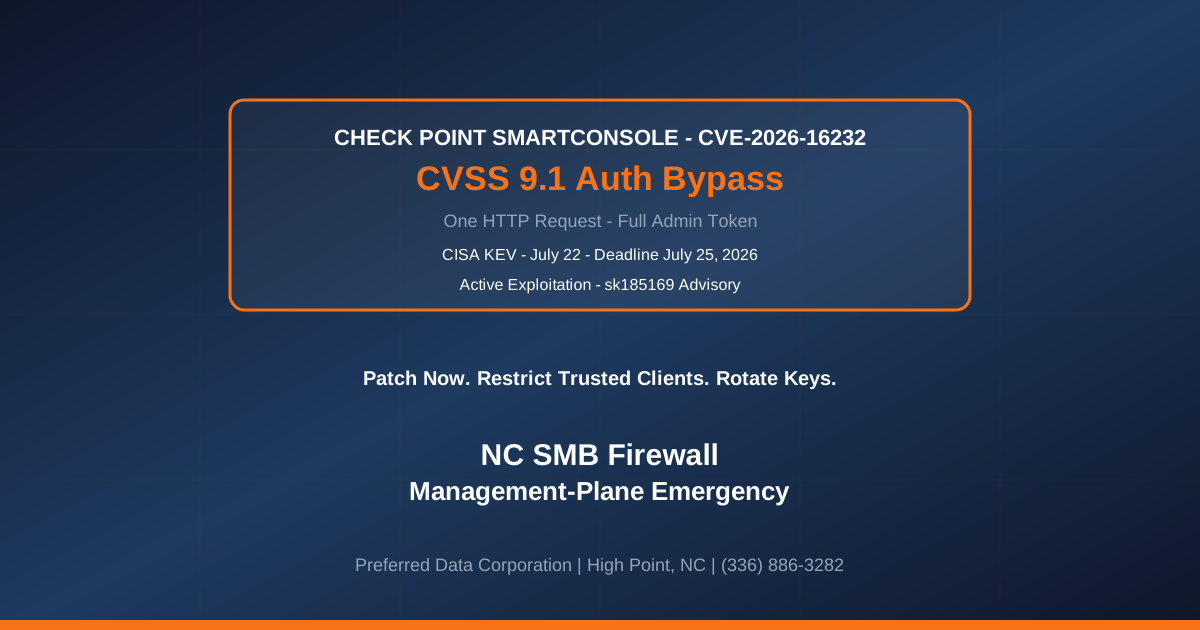
TL;DR: Check Point disclosed CVE-2026-16232 on July 22, 2026 (CVSS 9.1, CWE-287), an unauthenticated remote authentication bypass in SmartConsole and the Check Point Management API that lets an attacker with network reach to a Management Server obtain a valid application login token and act as a full administrator. CISA added it to the Known Exploited Vulnerabilities catalog the same day with a three-day federal remediation deadline of July 25, 2026, and Check Point has confirmed active exploitation in the wild. Every North Carolina business that inherited a Check Point stack from a prior IT provider or upgraded from SonicWall or Fortinet should treat this as a 72-hour emergency.
Key takeaway: A firewall's security policy is only as trustworthy as the management plane that stores it. CVE-2026-16232 lets an unauthenticated attacker rewrite that policy from a single HTTP request. Patching Check Point R80, R81, or R82 per sk185169 and restricting Trusted Clients on the Management Server are not optional this week; both need to be done before Friday.
Is your Check Point Management Server reachable from an untrusted network? Contact Preferred Data Corporation at (336) 886-3282 for an emergency firewall management-plane audit. Serving High Point, Greensboro, Winston-Salem, Charlotte, Raleigh, and the Piedmont Triad since 1987.
What is CVE-2026-16232 and why is it a 72-hour emergency for NC SMBs?
CVE-2026-16232 is a CVSS 9.1 improper-authentication flaw (CWE-287) in Check Point SmartConsole and the Check Point Management API stack that allows an unauthenticated remote attacker to obtain a valid application login token and log in with full administrative privileges to the Check Point Security Management Server or Multi-Domain Management Server. Once authenticated, the attacker can add or modify access rules, disable log forwarding, publish policy to every firewall managed by that server, and exfiltrate configuration data. Check Point published advisory sk185169 on July 22, 2026 confirming active exploitation.
The urgency is not academic. CISA added CVE-2026-16232 to the Known Exploited Vulnerabilities catalog on July 22, 2026 with a federal civilian remediation deadline of July 25, 2026, a three-day window that CISA only assigns to vulnerabilities it considers actively dangerous. The Hacker News and BleepingComputer both reported the disclosure the same day, and Rapid7's emergency threat response advisory recommends treating this vulnerability as if the appliance is already compromised until proven otherwise. For any North Carolina small or mid-market business running Check Point on a management server reachable from any WAN interface or from a flat internal network, "already compromised" is a defensible working assumption.
Who in North Carolina is actually exposed?
Any organization in North Carolina running a Check Point Security Management Server, Multi-Domain Management Server, or standalone firewall management stack on the R80, R81, or R82 branches is potentially exposed, and the practical risk is far higher than most owners realize because default deployments do not restrict which client IPs can reach the management API. Help Net Security and Cybersecurity News both confirmed that remote exploitation only requires network access to the Management Server IP in environments that do not lock down Trusted Clients.
Check Point is one of the top three commercial firewall vendors present in mid-market North Carolina businesses, alongside Fortinet and Palo Alto Networks. It concentrates in three predictable pockets:
- Manufacturers in the Piedmont Triad (High Point, Greensboro, Winston-Salem, Thomasville, Lexington) that inherited a Check Point cluster from a national MSP when a plant was acquired or when a previous IT firm standardized on it years ago
- Community banks, credit unions, and CPA firms in Charlotte, Raleigh, Durham, and the Research Triangle that adopted Check Point for its detailed audit and log retention
- Defense contractors and healthcare practices across Fayetteville, Jacksonville, and eastern North Carolina that were steered onto Check Point by a compliance auditor
Any of those organizations that put a Management Server on a segment reachable from a WAN interface, a VPN concentrator's inside interface, or a flat corporate LAN without explicit Trusted Clients rules is exposed. Check Point publicly described only a "small number" of customers as confirmed exploited, but the practical reality per Rapid7 is that most SMBs lack the SIEM instrumentation to detect an authentication bypass on the management plane at all, so the observed count is a floor, not a ceiling.
How does the exploit chain compromise a firewall in a single request?
The technical premise per Rapid7 and Check Point's own advisory is that the authentication routine used by the Management API can be induced to return a valid application login token to an unauthenticated caller under specific request conditions. That token is then presentable to any subsequent Management API call as a bearer credential, and the API grants full administrative capability because the token is treated as a legitimately issued session.
From there the attack is not "root the box" in the classic sense, it is worse. The attacker becomes an authenticated administrator inside the tool that already has legitimate reason to push policy to every downstream firewall the server manages. They can add an "any/any" rule at the top of the policy, disable log forwarding to the SIEM, publish policy globally, and leave the appliance operating system untouched. According to The Hacker News and BleepingComputer, that is precisely the pattern observed during the pre-disclosure exploitation window. A single HTTP request is all it takes if the Management Server is reachable.
The blast radius is the entire security architecture, not just the firewall. Once the policy engine is under attacker control, segmentation between the corporate LAN and OT plant floor cannot be trusted, VPN access rules cannot be trusted, IPS and threat prevention posture cannot be trusted, and outbound egress filtering cannot be trusted. That is why CISA moved so quickly.
What is Check Point's fix and how do I apply it safely?
Check Point's fix is a Jumbo Hotfix or targeted hotfix take on the affected R80, R81, and R82 versions of the Security Management, Multi-Domain Management, and firewall management stacks, plus updated SmartConsole client builds. sk185169 enumerates the exact takes per version and confirms that installing the fix on the Management Server is sufficient to close the authentication bypass; the managed gateways themselves do not need to be reinstalled.
Applied correctly, the patch itself is not disruptive to production traffic, because production traffic does not depend on the management server. The gateways continue to enforce the last-published policy while the management stack is patched. The realistic sequence for a North Carolina SMB is:
- Take a full snapshot of the Management Server (VMware, Hyper-V, or Check Point native)
- Install the vendor hotfix per sk185169 during a maintenance window (typical 30 to 60 minutes)
- Restrict Trusted Clients on the Management Server to only the specific management jump host or administrator subnets
- Rotate every local Management Server administrator credential and any Management API keys issued to third parties or automations
- Review policy revisions and audit logs for the past 60 days for unfamiliar changes or new administrator accounts
Any Check Point deployment where steps 3, 4, and 5 have not been done should be treated as high-risk until they are.
What is the 72-hour NC SMB emergency response playbook?
Given the CISA July 25 deadline, the practical order of operations for a North Carolina business between disclosure and end of week is:
- Hour 0 to 2: Confirm exposure. Identify every Check Point Management Server, Multi-Domain Server, and standalone management stack on the network. Note the code branch, current build, and current Jumbo Hotfix take.
- Hour 2 to 6: Restrict management-plane reachability. If the management interface is on a WAN-adjacent VLAN or a flat corporate LAN, immediately narrow access with an ACL, a jump host, or a Trusted Clients allowlist. This is the highest-value control you can apply before the patch lands.
- Hour 6 to 24: Install the vendor fix. Snapshot the appliance, apply the JHF per sk185169, verify SmartConsole reconnects, and confirm a test policy install succeeds.
- Hour 24 to 48: Hunt. Pull SmartLog and the Management Server audit log for administrator logins, policy revisions, disabled log-forwarding rules, and rule changes over the last 60 days. Flag logins outside business hours, unfamiliar client IPs, and new administrator accounts.
- Hour 48 to 72: Rotate and report. Reset every local Management Server administrator credential, rotate Management API keys, re-enroll two-factor devices, and notify customers, cyber insurance carriers, and regulators as required.
If your organization does not have the internal muscle to execute this by Friday, call now. Preferred Data Corporation is on-site within 200 miles of High Point, covering the Piedmont Triad, Charlotte, Raleigh, Winston-Salem, Wilmington, and Fayetteville.
Do not wait for the CISA deadline to pass before treating this as an emergency. Contact Preferred Data Corporation at (336) 886-3282 for an emergency Check Point management-plane assessment. Based at 1208 Eastchester Drive, Suite 131, High Point, NC 27265, BBB A+ rated with a 20-plus-year average client tenure and 100-plus active clients across North Carolina.
What Trusted Clients hardening should be in place regardless?
The Check Point advisory notes that remote exploitation of CVE-2026-16232 requires network reach to the Management Server IP in environments that do not restrict Trusted Clients, which is a polite way of saying the default configuration is exploitable. Trusted Clients is Check Point's management-plane allowlist; when configured, only IPs on the list can even reach the Management API. Every deployment should have it defined regardless of any single CVE.
| Configuration | Trusted Clients | Management Interface | Admin MFA | Blast Radius of CVE-2026-16232 |
|---|---|---|---|---|
| Default (worst) | Any | On corporate LAN | Local password only | Full firewall compromise on one HTTP request |
| SMB-safe (baseline) | Named admin subnets | Isolated management VLAN | TOTP or hardware key | Contained; still requires patch |
| Defense-in-depth (target) | Named jump host IPs only | Out-of-band management network | Hardware key plus IP allowlist | Attack surface reduced to jump host |
The middle row is the minimum any 25 to 250 seat organization in the Piedmont Triad or Charlotte metro should be running today. The bottom row is what a community bank, defense contractor, or manufacturer with CMMC obligations should already have in place.
What is the 2024 to 2026 pattern of firewall CVEs and what does it tell us?
CVE-2026-16232 does not exist in isolation. Every major commercial firewall and edge-appliance vendor has shipped one or more critical unauthenticated CVEs in the past 24 months, and every one has been exploited in the wild before most SMBs finished patching.
| Year | Vendor and Product | CVE | CVSS | Vector |
|---|---|---|---|---|
| 2024 | Ivanti Connect Secure | CVE-2024-21887 + CVE-2023-46805 | 9.1 | Auth bypass plus command injection |
| 2024 | Palo Alto Networks PAN-OS GlobalProtect | CVE-2024-3400 | 10.0 | Command injection, unauth RCE |
| 2024 | Fortinet FortiManager | CVE-2024-47575 (FortiJump) | 9.8 | Missing auth on management API |
| 2025 | SonicWall SMA 100 | CVE-2025-32819 | 8.8 | Auth bypass in management interface |
| 2025 | Cisco ASA and FTD | CVE-2025-20333 + CVE-2025-20362 | 9.9 | Chained unauth RCE, KEV listed |
| 2026 | Check Point SmartConsole | CVE-2026-16232 | 9.1 | Unauth token issuance on management API |
Each of those CVEs is documented in the CISA KEV catalog. The pattern is unambiguous: the highest-severity vulnerabilities in commercial firewalls are consistently on the management plane, not the data plane, and vendor diversity has not saved anyone. The right response for a North Carolina SMB is not "switch vendors during an incident" but "isolate the management plane so that a single-vendor CVE never costs you the entire security architecture." That is a design decision, not a purchase decision.
Frequently Asked Questions
We are not sure if we run Check Point. How do we tell?
Ask your IT provider what firewall vendor manages your inter-VLAN and internet-edge traffic and request the model and code version in writing. If the answer references "Quantum," "Maestro," "Smart-1," "SmartConsole," "Multi-Domain Server," or "R80/R81/R82," it is Check Point. If you have no in-house IT and no current MSP relationship, Preferred Data Corporation can perform a 30-minute topology review at (336) 886-3282.
Our Check Point is behind a jump host. Are we safe?
Safer, not safe. A jump host limits which IPs can reach the Management Server API and dramatically reduces exposure, but it does not eliminate the CVE. If the jump host itself is compromised or a legitimate administrator's workstation is compromised, the attacker still has a valid path to the management plane. Patch per sk185169, restrict Trusted Clients to the jump host IPs only, and require hardware-key MFA on the jump host.
We patched last month. Do we need to patch again?
Yes. CVE-2026-16232 was disclosed July 22, 2026, so any patch installed before that date does not include the fix. Verify the specific Jumbo Hotfix or hotfix take listed in sk185169 is present on the Management Server; a general "we run current versions" is not evidence in an incident response conversation or a cyber insurance claim.
Do we need to rotate credentials and API keys after patching?
Yes. If the Management Server was reachable from any untrusted network at any point since disclosure, assume a valid application login token could have been issued to an attacker. Rotate all local admin credentials on the Management Server, revoke and reissue any Management API keys, and re-enroll TOTP or hardware-key MFA devices. Do this even if your audit logs look clean, because a competent attacker's first action is to disable logging.
What indicators of compromise should we look for in the logs?
Review SmartLog and the Management Server audit log for administrator logins from unfamiliar client IPs (especially outside your admin subnets and outside normal business hours), unexpected policy revisions or rule additions, disabled or modified log-forwarding rules, and new administrator accounts. Per Rapid7's emergency threat response advisory, plan for at least a 60-day lookback.
We are considering switching to a different firewall vendor. Is now the time?
No. The 2024 to 2026 CVE table above shows that every major firewall vendor has shipped a critical management-plane CVE in the past two years; switching vendors during an active incident just moves the risk to a stack your team knows less well. Patch, harden the management plane, and if the strategic decision to change vendors is worth making, plan that migration on its own timeline with a proper design review, not under fire.
Does cyber insurance cover management-plane compromise?
Most modern cyber insurance policies do cover firewall compromise, but coverage depends on whether reasonable security controls were in place at the time of the incident. A carrier is far less likely to pay a claim on a Check Point compromise where Trusted Clients was left at default and the patch was applied more than 72 hours after CISA KEV listing. Document your patch, hardening, and log-review actions in writing; that record is the evidence your broker will need at claim time.
We are a defense contractor. Does this trigger CMMC or DFARS 7012 incident reporting?
If your Check Point manages any network segment that stores, processes, or transits Controlled Unclassified Information (CUI), and you have evidence or a reasonable suspicion of compromise, DFARS 252.204-7012 requires reporting to the Department of Defense via DIBNet within 72 hours of discovery. CMMC assessments also expect a documented incident response for KEV-listed vulnerabilities affecting in-scope systems. When in doubt, treat this as a reportable event and consult your C3PAO or third-party assessor.