
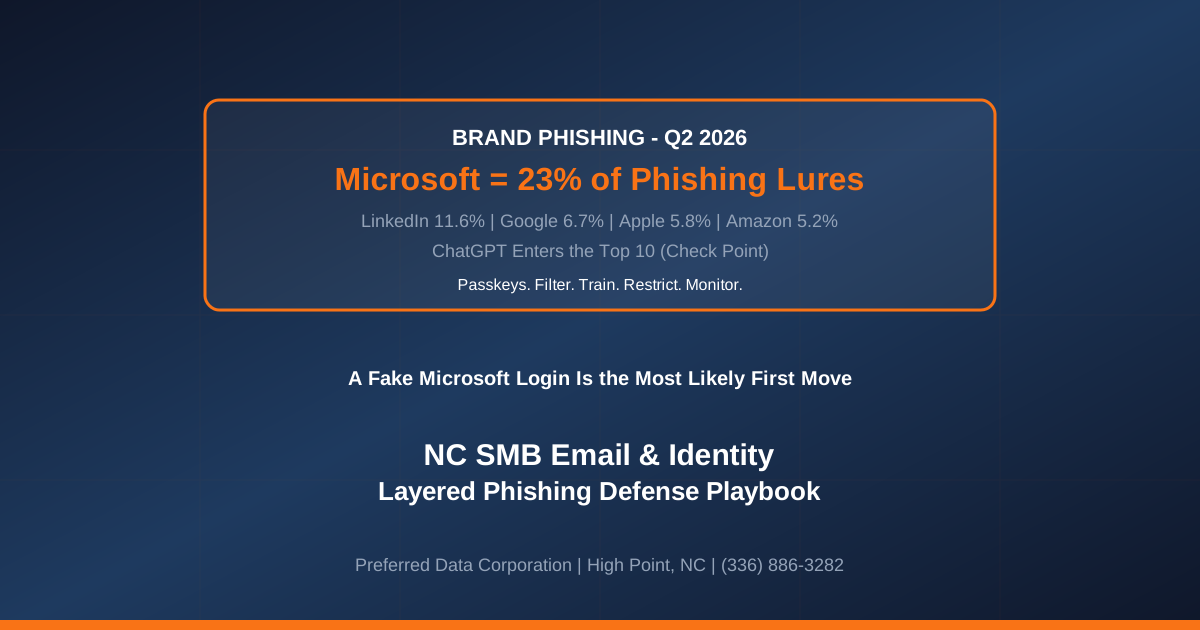
TL;DR: Check Point's Q2 2026 Brand Phishing Report names Microsoft the single most impersonated brand at 23% of all brand-phishing attempts, nearly double the next brand, followed by LinkedIn at 11.6%, Google at 6.7%, Apple at 5.8%, and Amazon at 5.2%, with the top five accounting for more than half of all activity. For the first time, ChatGPT entered the ten most-impersonated brands, and Technology remained the most-impersonated sector. For North Carolina small businesses, the takeaway is direct: the brands your employees log into every day, above all Microsoft 365, are the exact lures attackers use to steal credentials, and a fake Microsoft login page is the most likely first move against your business.
Key takeaway: Phishing has concentrated on the identity brands that gate your business, and Microsoft leads by a wide margin because a stolen Microsoft 365 credential unlocks email, files, Teams, and often single sign-on to everything else. Defending against this is not one product; it is a layered stack, phishing-resistant MFA so a stolen password is not enough, email filtering to cut the volume, security awareness training so people recognize the lure, and monitoring to catch the account takeover fast. The newest wrinkle, ChatGPT joining the top ten, means the AI tools your staff are newly adopting are now phishing bait too.
Worried a fake Microsoft login could hand over your whole tenant? Contact Preferred Data Corporation at (336) 886-3282 for an email-security and identity-defense assessment. BBB A+ rated, serving High Point, Greensboro, Winston-Salem, Charlotte, Raleigh, and the Piedmont Triad since 1987.
Which brands do attackers impersonate most in 2026?
Microsoft dominates brand-impersonation phishing by a wide margin, because compromising a Microsoft account yields the broadest access. Per Check Point's Q2 2026 report, the ranking is:
- Microsoft, 23% of all brand-phishing attempts, nearly double the second-place brand.
- LinkedIn, 11.6%, exploiting professional-networking trust and recruiter lures.
- Google, 6.7%, targeting Workspace and consumer Google accounts.
- Apple, 5.8%, and Amazon, 5.2%, rounding out a top five that together make up more than half of all brand-phishing activity.
Two structural facts sit behind the ranking. First, Technology is the most-impersonated sector, followed by Social Networks and Banking, because tech brands are the login gateways to everything else. Second, ChatGPT appeared in the top ten for the first time, tracking the surge in SMB AI adoption, attackers follow the tools people newly trust.
Why is Microsoft impersonated almost twice as often as any other brand?
Microsoft leads because a single stolen Microsoft 365 credential is the highest-leverage prize in a small business, unlocking communication, data, and often the keys to every other system. The value concentration is what drives the volume.
- One credential, many doors. A compromised Microsoft 365 account gives an attacker Outlook email, SharePoint and OneDrive files, and Teams, and where Microsoft is the identity provider for single sign-on, it hands over the connected SaaS estate too.
- Universal familiarity. Nearly every business employee sees Microsoft login prompts constantly, so a well-crafted fake blends into normal behavior in a way a niche brand never could.
- The pivot to business email compromise. Once inside a real mailbox, attackers read the conversation history and launch business email compromise, invoice fraud, and wire redirection from a trusted internal address, which is where the large financial losses happen.
This is why an email that looks like a Microsoft password-expiration or file-share notice is not a nuisance; it is the opening move of the most common attack path against NC small businesses.
How do modern brand-phishing attacks actually work?
Modern phishing has evolved well past the typo-ridden email, using AI-polished lures, credential-harvesting pages that defeat basic MFA, and multiple channels. Knowing the mechanics is what makes the defenses make sense.
| Technique | How it works | What defeats it |
|---|---|---|
| Fake brand login page | Pixel-perfect Microsoft/Google login harvests credentials | Phishing-resistant MFA; email filtering |
| AI-generated lures | Flawless grammar and tailored context raise click rates | Awareness training on intent, not typos |
| Adversary-in-the-middle | Proxy page also steals the MFA session token | Phishing-resistant (FIDO2/passkey) MFA |
| Quishing (QR codes) | QR in email or PDF bypasses URL scanning | Mobile caution; awareness; filtering |
| Multi-channel (email + SMS + voice) | Reinforces the lure across channels for legitimacy | Verification protocols; awareness |
The important detail: adversary-in-the-middle kits mean that ordinary one-time-code MFA can be bypassed, which is precisely why phishing-resistant MFA (passkeys and FIDO2 hardware keys) has moved from best practice to baseline.
What is the layered defense that actually stops brand phishing?
No single control stops phishing; a layered stack does, and each layer catches what the previous one misses. This is the core of PDC's managed cybersecurity email-defense program.
- Phishing-resistant MFA. Deploy passkeys or FIDO2 hardware keys so a stolen password, and even a stolen session attempt, does not grant access. This is the single most important control against Microsoft credential theft.
- Email filtering and authentication. Advanced email security to cut inbound volume, plus properly configured SPF, DKIM, and DMARC so attackers cannot easily spoof your own domain against your staff and customers.
- Security awareness training with simulation. Regular, realistic phishing simulations that teach staff to judge intent and context, since AI-written lures no longer have the tell-tale errors older training relied on.
- Least-privilege and conditional access. Limit what any one account can reach and enforce conditional-access policies (device, location, risk) so a compromised credential has a smaller blast radius.
- Monitoring and fast response. 24/7 detection to spot account-takeover behavior, impossible-travel logins, mailbox rule changes, mass downloads, and shut it down before it becomes wire fraud or a data leak.
Want this stack deployed and managed for your team? Call Preferred Data Corporation at (336) 886-3282 for an email-security and identity-defense assessment.
Why does managed email and identity defense beat DIY for NC SMBs?
Phishing defense fails in the gaps between tools, and a lean internal team rarely has the time to configure, tune, train, and monitor every layer consistently. A managed cybersecurity partner runs the whole stack as a system: phishing-resistant MFA rolled out correctly, DMARC actually enforced instead of set to "none," simulations run on a schedule, and 24/7 monitoring that catches the account takeover at 2 a.m. For NC small businesses, especially professional-services firms and manufacturers where a single compromised mailbox can reroute a real invoice, that operational consistency is the difference between a blocked attempt and a five-figure loss. PDC has defended NC businesses against exactly this class of attack, locally and hands-on, since 1987.
Frequently Asked Questions
What brand is impersonated most in phishing attacks in 2026?
Microsoft. Check Point's Q2 2026 Brand Phishing Report found Microsoft accounts for 23% of all brand-impersonation phishing attempts, nearly double the next brand, LinkedIn at 11.6%. Google, Apple, and Amazon round out a top five that together make up more than half of all brand-phishing activity.
Why is ChatGPT now a phishing target?
ChatGPT entered the ten most-impersonated brands for the first time in Q2 2026 because attackers follow the tools people newly trust and log into. As small businesses rapidly adopt AI tools, fake ChatGPT login and billing pages become a fresh way to harvest credentials, so AI tools now belong in your phishing-awareness training.
Does MFA stop brand-phishing attacks?
Ordinary one-time-code MFA helps but can be bypassed by adversary-in-the-middle phishing kits that steal the session token along with the password. Phishing-resistant MFA, passkeys and FIDO2 hardware keys, is what reliably defeats these attacks, because there is no code for the attacker to relay. Upgrading MFA type is the highest-impact single change most SMBs can make.
What is the most dangerous outcome of a Microsoft 365 phishing attack?
Business email compromise. Once an attacker controls a real mailbox, they read genuine conversations and send fraudulent invoices or wire-transfer requests from a trusted internal address, which is where the largest financial losses occur. A compromised Microsoft account can also expose files and, through single sign-on, connected SaaS applications.
How often should we run phishing simulations?
Regularly and continuously, not once a year. Because AI-generated lures now read flawlessly, staff need ongoing, realistic practice to build judgment about intent and context. A managed program runs simulations on a recurring schedule, targets training to those who need it, and tracks improvement over time.
How can Preferred Data help defend our email and identity?
PDC runs a layered email and identity defense as a managed system, phishing-resistant MFA, email filtering with SPF/DKIM/DMARC enforcement, recurring awareness simulations, conditional access, and 24/7 account-takeover monitoring. It closes the gaps a DIY setup leaves open. Call (336) 886-3282 for an assessment.
Related Resources
- Which Brands Are Impersonated Most? Q2 2026 Brand Phishing Report - Check Point
- ChatGPT joins the most impersonated brands in phishing - Help Net Security
- Preferred Data Cybersecurity Services
- Preferred Data Managed IT Services
- Preferred Data Professional Services Industry Solutions
- Related: Deepfake CFO Meeting Fraud - NC SMB Finance-Approval Defense
- Related: Cyber Insurance Evidence Packets: NC SMB Q4 Renewal Playbook