
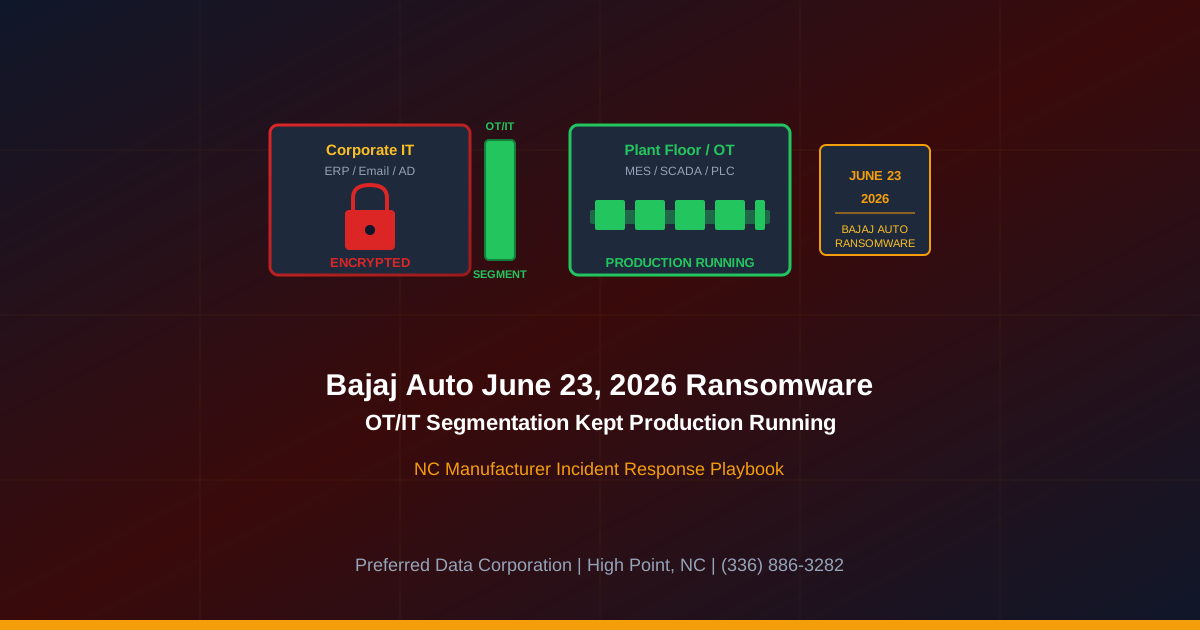
TL;DR: On June 23, 2026, Indian automaker Bajaj Auto disclosed a ransomware attack on its IT systems and on Bajaj Auto Technology Limited (BATL), the unit that handles its technology operations. The incident was reported to CERT-In under the Information Technology Act, 2000, comes nine months after the Jaguar Land Rover plant shutdown, and follows the World Leaks ransomware group's hit on Tata Electronics earlier this year. For NC manufacturers in the Piedmont Triad supplying automotive, aerospace, and industrial OEMs, this is the third high-profile automotive sector ransomware incident in twelve months — and a directly transferable risk model.
Key takeaway: Bajaj kept production running because its incident response separated OT (manufacturing) from IT (corporate) and was prepared to operate the plant on manual procedures while corporate systems were isolated. NC manufacturers that have not run a ransomware tabletop with their plant managers, ERP team, and shop-floor supervisors in the last six months are betting on luck.
Worried that your NC manufacturer cannot keep the line running through a ransomware incident? Preferred Data Corporation runs OT/IT segmentation, manufacturer-grade incident response, and ERP resilience for NC plants in High Point, Greensboro, Winston-Salem, Charlotte, and Raleigh. Call (336) 886-3282 or request a manufacturer cyber readiness review.
What actually happened to Bajaj Auto on June 23, 2026?
A ransomware actor breached Bajaj Auto's and BATL's corporate IT systems at approximately 08:00 a.m. IST, and the company's incident response team contained the impact while keeping manufacturing operations running. Per GB Hackers' incident summary, Business Today's analysis, and Storyboard18's follow-up coverage, the timeline was:
- 08:00 IST, June 23, 2026. Ransomware detected in Bajaj Auto and BATL IT systems.
- Within hours. Incident response team and external cyber-security experts engaged. Containment and mitigation protocols launched.
- Day of incident. CERT-In notification filed under the Information Technology Act, 2000.
- Within 24 hours. Manufacturing operations, sales, service, dealer support, and customer service continuing without disruption per public statements.
- Within days. Operations described as "normal" with continued probe.
Three reasons NC manufacturers should treat the Bajaj playbook as directly relevant:
- Automotive supply chain is a 2026 ransomware bullseye. Per the 2026 Verizon DBIR and BlackFog's State of Ransomware 2026 report, manufacturing remains the most-attacked sector by published ransomware victim counts. NC's manufacturing economy includes thousands of automotive, aerospace, and defense suppliers in PDC's service area.
- The cost of the attack you survive is not zero. Per Tata Motors / Jaguar Land Rover's September 2025 incident reporting, the JLR shutdown lasted weeks, halted UK and Slovakia production, and cost hundreds of millions in lost output. Bajaj's faster containment is the better outcome, but the IR cost still runs into millions in remediation, legal, regulatory, and customer-communication expense.
- Tata Electronics already happened in 2026. Per The Hacker News' and BreachSense's reporting, the World Leaks group claimed 600+ GB of Tata Electronics data, including Apple and Tesla component specifications. The same supply-chain disclosure risk applies to any NC supplier holding OEM customer drawings, BOMs, or production schedules.
Why does the Bajaj outcome matter more than the breach itself?
Because the outcome — manufacturing operations continuing while corporate IT was isolated — is the result of a documented OT/IT separation and an exercised incident-response playbook. Per NIST SP 800-82r3 (Guide to OT Security), the CISA Stop Ransomware Guide, and Microsoft's 2026 Digital Defense Report, the manufacturers that keep production running through ransomware share four characteristics:
- OT and IT are segmented at the network level. A compromise in corporate Active Directory does not propagate to MES, SCADA, or PLCs because the L3 and L2 boundaries are firewalled.
- The plant has a documented manual-operation playbook. Quality, inventory, and production scheduling can run on paper for 24-72 hours while corporate ERP is offline.
- The IR team has run a tabletop with plant management. Plant managers know whom to call, what to do, and what to keep running before the incident starts.
- Backups for MES, ERP, and design files are immutable and tested. A backup that has not been restored in 6 months is a hypothesis, not a control.
| IR readiness dimension | Bajaj-style outcome | Worst-case JLR-style outcome |
|---|---|---|
| OT / IT segmentation | Production continued | Production halted plant-wide |
| Tabletop exercise in last 6 months | Yes — IR ran on muscle memory | No — chaos in first 48 hours |
| Immutable backups tested | Restore in hours | Restore in weeks or never |
| CERT / FBI / state AG notification | Filed same day | Delayed; regulatory exposure |
| ERP and MES recovery | Days | Weeks |
| Customer / dealer communication | Same-day reassurance | Multi-week silence |
| Cyber insurance posture | Defensible — IR followed plan | Documented gaps; coverage disputes |
| Reputational hit | Limited | Lasting |
What does the Bajaj incident mean for NC manufacturers in practice?
It means that an NC manufacturer's survival of a 2026 ransomware incident is decided by decisions made before the incident: how the network is segmented, how often the IR team practices, how the backups are architected, and how the plant is set up to run on manual procedures while corporate IT is isolated. Per the SharkStriker June 2026 breach digest and Verizon DBIR 2026 manufacturing summary, the realistic NC manufacturer scenarios are:
- A Charlotte aerospace supplier loses ERP for two weeks. Without a tested IR plan, plant cannot ship to OEM. OEM penalty clauses trigger. Cash flow stops.
- A High Point furniture maker loses MES and design files. Customer-specific patterns and BOMs encrypted. CAD reissue takes weeks. New orders cannot be cut.
- A Greensboro automotive Tier-2 supplier loses email and quoting tools. New-business quoting halts. Sales pipeline freezes for the duration.
- A Winston-Salem chemicals manufacturer loses SCADA visibility for batch monitoring. Safety case forces production halt; lost margin per shift compounds.
Quotable definition: Manufacturing ransomware survival is the discipline of separating what an attacker can encrypt from what production needs to run. The technical pieces — OT/IT segmentation, immutable backups, MFA on remote access, tested IR plays — are not optional in 2026. They are the difference between Bajaj's outcome and JLR's.
Need someone to run a manufacturer-grade tabletop with your plant manager and ERP team next month? Call (336) 886-3282 or book a manufacturer cyber readiness review.
What should an NC manufacturer do in the next 90 days?
Run a five-step plan that takes the Bajaj playbook from observation to operational capability. The plan:
- OT / IT segmentation audit (days 1-30). Per NIST SP 800-82r3 and the Purdue Reference Architecture, audit existing firewall rules between corporate IT (Levels 4-5), DMZ (Level 3.5), MES / supervisory (Level 3), and control systems (Levels 0-2). Document explicit allow rules; deny by default.
- Immutable backup verification (days 1-30). Confirm that ERP, MES, file servers, and design repositories back up to immutable storage with offline copies. Per the CISA Stop Ransomware Guide, test restore quarterly with documented runbooks, not "we assume it works."
- MFA and privileged access hardening (days 1-45). Enforce MFA on every remote-access path: VPN, RDP, RMM, MES vendor remote support. Per the Verizon DBIR 2026, credential abuse is the leading initial-access vector for manufacturing ransomware. Privileged Access Management for plant administrators and ERP admins.
- Tabletop with plant management (days 30-60). Run a 4-hour tabletop with corporate IT, plant manager, ERP team, quality lead, and an executive. Walk through the first 72 hours of a ransomware incident — who calls whom, who notifies CISA / FBI / cyber insurance, who triggers manual production, who communicates with customers and dealers.
- Manufacturer-grade IR retainer (days 60-90). Establish a relationship with an IR firm familiar with OT environments before the incident, not during. Document the contact, the runbook, and the executive escalation path.
Key takeaway: Segmentation + immutable backups + MFA + tabletop + IR retainer = a Bajaj-style outcome. Any one of those five missing pushes the NC manufacturer toward the JLR-style outcome.
How does Preferred Data Corporation help NC manufacturers prepare?
PDC has been an NC manufacturer's IT and security partner since 1987. We bring four things to the post-Bajaj manufacturer readiness response:
- Managed cybersecurity services: MFA enforcement, EDR deployment, privileged access management, log management, manufacturer-grade IR playbooks and tabletop facilitation.
- Network infrastructure design and management: OT/IT segmentation per ISA/IEC 62443 and NIST SP 800-82r3, MES vendor remote-access hardening, DMZ design for plant-floor systems.
- Backup and disaster recovery services: Immutable backup architecture for ERP, MES, design files, and Active Directory, with documented and tested restore runbooks.
- Managed IT services: Day-to-day ERP, MES, and Active Directory administration, plant-floor PC fleet management, and manufacturer-tuned change control.
For NC manufacturers in High Point and the Piedmont Triad with furniture, hosiery, and textile production, Charlotte and Concord aerospace and automotive Tier-2 suppliers, Greensboro and Winston-Salem industrial OEMs, and Raleigh-Durham life-sciences manufacturers, the Bajaj lesson is a managed-program task that runs alongside daily operations, not a one-time project.
Ready to make sure your NC plant survives the next ransomware incident with production running? Call (336) 886-3282 or book a manufacturer cyber readiness review.
Frequently Asked Questions
Was Bajaj's manufacturing operation actually affected?
Per Bajaj Auto's public disclosures and Storyboard18's follow-up coverage, the company stated that manufacturing operations, sales, service, dealer support, and customer service continued without disruption. The incident was contained to corporate IT systems at Bajaj Auto and BATL.
Why does this matter for NC manufacturers specifically?
NC's economy depends on manufacturing. Per the NC Department of Commerce and Verizon's DBIR 2026 manufacturing summary, thousands of NC suppliers feed automotive, aerospace, defense, and industrial OEMs. The ransomware actors targeting Bajaj, Tata, and Jaguar Land Rover are equally interested in Tier-2 and Tier-3 suppliers because the cyber insurance, IR maturity, and OT segmentation are typically weaker.
How long does a manufacturer tabletop exercise take?
A meaningful tabletop runs three to four hours with corporate IT, plant manager, ERP lead, quality, and an executive sponsor. Per the CISA Tabletop Exercise Packages, facilitated exercises with pre-built scenarios accelerate value. PDC delivers manufacturer-tuned scenarios specifically for the Bajaj / JLR / Tata Electronics threat model.
Does cyber insurance pay if we have not run an IR tabletop?
Increasingly, no. Per the 2026 cyber insurance market reports, insurers ask renewal applicants whether IR plans are documented and tested. A "no" or undocumented "yes" can result in denied applications, higher premiums, or post-claim coverage disputes.
What is the difference between OT and IT in a manufacturer context?
IT is the corporate network — email, file servers, ERP, finance, HR. OT is the operational technology — MES, SCADA, PLCs, robotics, plant-floor sensors. Per NIST SP 800-82r3, the two domains have different uptime requirements, different patch tolerances, and different threat models. OT/IT segmentation lets corporate IT recover from a ransomware incident without halting production.
What backup architecture does PDC recommend for NC manufacturers?
A "3-2-1-1-0" pattern: 3 copies of data, 2 different media, 1 offsite, 1 immutable (object-lock or air-gapped), 0 errors in the last test restore. Per the Veeam 2026 Data Protection Trends Report and CISA backup guidance, this pattern survives the encrypt-then-extort pattern that defined manufacturing ransomware in 2025-2026.
Related Resources
- Managed Cybersecurity Services for NC Businesses - Manufacturer-grade IR, EDR, MFA, tabletop facilitation
- Network Infrastructure Design and Management - OT/IT segmentation per NIST SP 800-82r3 and ISA/IEC 62443
- Backup and Disaster Recovery Services - Immutable backup architecture for ERP, MES, and design files
- Managed IT Services for NC Businesses - Day-to-day ERP, MES, and plant-floor PC administration
- Tata Electronics World Leaks: NC Manufacturer Supplier Risk - Companion supplier-risk write-up
- The Gentlemen Ransomware 90% Affiliate Split: SMB Defense - Companion ransomware-economics write-up
- Contact Preferred Data Corporation - Manufacturer cyber readiness review