
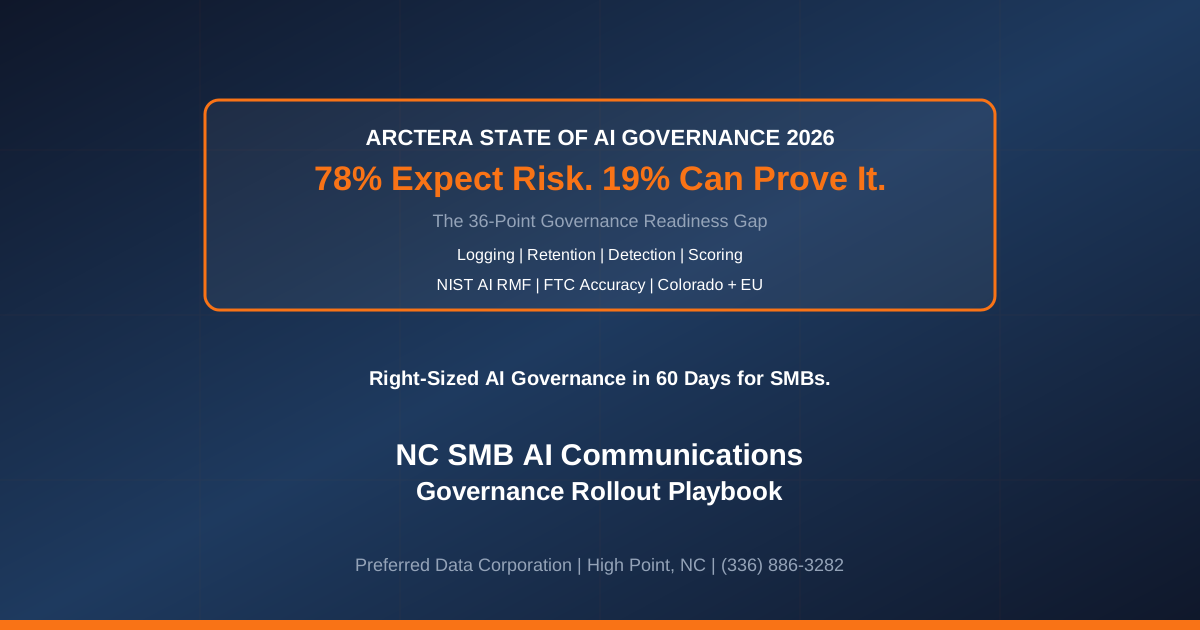
TL;DR: Arctera released its State of AI Governance 2026 report on July 21, 2026 surveying 500 compliance decision-makers in finance, healthcare, and energy in the Americas and EMEA. Headline: 78% expect AI-driven communications risk to rise in the next 12-24 months, but only 19% have the logging, retention, detection, and scoring controls needed to prove what happened. Even more revealing: 55% believe they have "core policies, training and review steps," but nowhere near the audit trail to defend those beliefs to a regulator. For NC small businesses that have been experimenting with ChatGPT, Copilot, Claude, and industry-specific AI tools, the July 21 report is a forcing event: the middle ground between "no AI" and "provable AI governance" is now the highest-risk posture.
Key takeaway: In 2026, "we have an AI policy" without logging + retention + detection + scoring is not a governance program, it is an aspiration. The gap between the 55% who feel prepared and the 19% who can actually prove it is where regulators, insurers, and plaintiffs' lawyers will operate.
Ready to close the AI-governance readiness gap without an enterprise-scale program? Contact Preferred Data Corporation at (336) 886-3282. BBB A+ rated, serving High Point, Greensboro, Winston-Salem, Charlotte, Raleigh, and the Piedmont Triad since 1987.
What Exactly Did the Arctera State of AI Governance 2026 Report Say?
The Arctera report, published July 21, 2026 and produced with Hanover Research, surveyed 500 compliance decision-makers across finance, healthcare, and energy/utilities in the Americas and EMEA. Three headline findings frame the SMB-relevance conversation.
- 78% of respondents at AI-using organizations expect AI-driven communications risk to increase over the next 12-24 months. Communications risk means all the things a regulator can subpoena: chat logs, emails, meeting transcripts, AI-generated summaries, AI-assisted marketing copy, AI-drafted contracts.
- 55% believe they have "core AI policies, training, and review steps." This is the "policy on paper" tier.
- Only 19% have the logging, retention, detection, and scoring controls needed to prove what happened. This is the "provable" tier — the tier a regulator, insurer, or plaintiff can accept as evidence.
The gap between the 55% "we have a policy" and the 19% "we can prove it" is the 36-percentage-point audit-and-evidence gap. In practical terms, a business with policy but no logging cannot answer the question "did our AI assistant say X to Y on Z date, and if so who reviewed it and what happened next" — which is the exact question a state attorney general, a plaintiff, an insurance adjuster, or an OCR auditor will ask in 2026.
Why Does an Enterprise-Focused Report Matter to a 40-Person NC SMB?
Because the AI-adoption pattern in Triad and Triangle small businesses is running six to twelve months ahead of any published governance framework, and because the same AI tools an enterprise uses are the AI tools an SMB uses. Two specific reasons the Arctera findings apply to a High Point manufacturer, a Charlotte medical group, or a Wilmington law firm.
- Regulatory expectations scale to the risk of the data, not the size of the business. HHS OCR's 2026 HIPAA enforcement expansion applies the same Security Rule Risk Management standard to a 5-provider practice as to a 500-provider system. NC ITPA is size-agnostic.
- AI liability is being built into enterprise vendor questionnaires, and NC SMBs sell into enterprise supply chains. A Piedmont Triad furniture supplier answering a Fortune-500 customer's 2026 questionnaire will now see AI-governance questions.
The 40-person NC SMB does not need an enterprise governance program; it needs a defensible, right-sized version. The Arctera report identifies exactly what "defensible" requires: logging + retention + detection + scoring.
What AI Tools Are NC SMBs Actually Using in July 2026?
An honest inventory of AI adoption in an NC 25-250-seat SMB in July 2026 typically finds seven categories of use, most of them without governance.
- Microsoft Copilot in Microsoft 365 for email drafting, Word/Excel/PowerPoint content generation, and meeting summaries. Widely licensed but rarely with a documented data-classification policy.
- ChatGPT, Claude, Gemini for marketing copy, technical writing, sales-email drafting, and internal Q&A. Frequently used through personal accounts, which never touch a corporate audit trail.
- Vertical AI tools (industry-specific): AI for construction estimating, AI for medical dictation, AI for legal contract review, AI for manufacturing quality inspection. Growing fast, thin on compliance documentation.
- AI features in existing SaaS (HubSpot AI, Salesforce Einstein, QuickBooks AI, ServiceNow Now Assist, Zoom AI Companion). Turned on by default, rarely audited.
- AI coding assistants (GitHub Copilot, Cursor, Windsurf, Claude Code) for internal automation and vibe-coded tools, per our July 24 write-up of the 434 AI-generated vulnerabilities study.
- Agentic AI browsers and MCP-connected agents that take actions on behalf of users, with documented prompt-injection risk.
- Chatbots and voice agents (front-of-website chat, IVR replacement, appointment-setting AI) that generate customer-facing communications at scale without human review.
An honest tally at most 50-person NC SMBs is 3-7 AI tools in active use, 1-2 documented, zero with the logging + retention + detection + scoring that Arctera identifies as the readiness bar.
What Are the Four Missing Controls Arctera Identifies?
The Arctera survey frames the readiness gap as four missing control categories. Each has a right-sized SMB implementation.
- Logging. Every AI-tool interaction that produces customer-facing content, regulated-data output, or automated action must produce a record that captures who asked what, what the model returned, and what happened next. SMB implementation: enable audit logs in every M365 Copilot license, capture ChatGPT/Claude Enterprise conversation history, and log agent-based actions to a central store.
- Retention. Records must survive long enough for regulatory, insurance, and litigation timelines — typically 6-7 years for financial and healthcare, 3-4 years for general commercial. SMB implementation: replicate AI logs to a cheap object-storage tier (Azure Blob, S3, Wasabi) with lifecycle policies matching the applicable data class.
- Detection. Ability to identify anomalous, high-risk, or policy-violating AI output. SMB implementation: rule-based alerts for regulated-data patterns (SSN, PHI, PII) in AI output plus periodic sampling by a human reviewer.
- Scoring. Ability to categorize AI output by risk (financial impact, regulatory exposure, reputational damage). SMB implementation: two-tier scoring (routine vs. sensitive) plus explicit review requirements for the sensitive tier.
Every one of the four controls is implementable in a 25-250 seat business inside 60 days by an IT team of one or a fractional managed IT partner. The technology is not exotic; the discipline of installing it is.
What Does a 60-Day NC SMB AI Governance Rollout Look Like?
A 60-day rollout is realistic and produces the documented evidence packet regulators, insurers, and enterprise customers will ask for. The plan anchors to NIST AI RMF as its framework spine and satisfies most 2026-vintage vendor-questionnaire questions.
- Days 1-7: Inventory. Enumerate every AI tool in active use across every department (marketing, sales, engineering, finance, HR, ops). Categorize by tier (T1 touches regulated data or customers; T2 touches internal ops; T3 is sandbox). Assign an owner to each tool.
- Days 8-14: Two-page policy. Write the AI Acceptable Use policy: approved tools, prohibited data classes (PHI, PII, CUI, source code under NDA), required review path for T1 and T2 use, incident-response contact.
- Days 15-21: Turn on logging. Enable audit logging in every T1/T2 tool. Configure retention to match the data class. Test that a log entry appears for a representative interaction and survives 30 days.
- Days 22-35: Detection + scoring. Add rule-based alerts for regulated-data patterns in AI output. Define the two-tier scoring model. Assign the human reviewer for the sensitive tier.
- Days 36-45: Training. Ninety-minute training for all employees using AI tools. One-hour deeper session for T1 users. Track completion.
- Days 46-54: Tabletop. Simulate a scenario ("a customer alleges our AI assistant gave them inaccurate medical/financial/legal information causing harm"). Walk the response: how do we know what the AI said, who reviewed it, and what did we tell the customer?
- Days 55-60: Evidence packet. Assemble the six-component packet — inventory, policy, logging configuration, retention proof, detection rules, tabletop after-action — into a single PDF for insurance and vendor-questionnaire response.
The 60-day plan is the difference between the 55% "we have a policy" tier and the 19% "we can prove it" tier from the Arctera report.
Ready to run the 60-day plan with a fractional AI governance partner? Contact Preferred Data Corporation at (336) 886-3282 or visit 1208 Eastchester Drive, Suite 131, High Point, NC 27265. PDC AI Transformation Advisory delivers the plan for NC manufacturers, contractors, medical practices, and professional services.
How Does the Arctera Report Intersect With FTC, State AI Laws, and the EU AI Act?
AI governance is not a single-regulator regime, and NC SMBs increasingly hit multiple regimes at once. Four intersections define the July-2026 compliance surface.
- FTC AI Accuracy Policy Statement (July 1, 2026). We covered the FTC's AI-washing enforcement in our July 13 post. The FTC's statement pulls Section 5 into AI output steering, meaning an NC SMB that markets its AI-assisted service without accuracy governance is exposed even without a data breach.
- Colorado AI Act (SB 24-205) and Illinois HB 3773. NC SMBs with customers or employees in Colorado or Illinois inherit those states' AI notification and impact-assessment obligations regardless of NC's own posture.
- EU AI Act. The August 2, 2026 general-purpose AI obligation is behind us, but NC SMBs selling into the EU (including through Amazon, Etsy, Shopify EU marketplaces) inherit downstream obligations.
- HIPAA / GLBA / SEC Regulation S-P. Any AI tool that touches PHI, financial-account data, or investment-advice communications inherits the corresponding regime's audit-trail requirements. The Arctera findings are the empirical evidence that most organizations do not have that audit trail today.
Where Does the Arctera Data Land Compared to Other 2026 AI Governance Signals?
The July 21 Arctera report is one data point in a larger 2026 signal set. Placed against three other public signals, the pattern is consistent: policy adoption is far ahead of provable governance.
| Signal Source | Finding | SMB Implication |
|---|---|---|
| Arctera State of AI Governance 2026 (Jul 21) | 78% expect risk rise, 19% have logging + retention + scoring | Policy without logging is not a program |
| SecureWorld SMB AI 2026 (mid-year) | SMBs split into "governance-first" vs. "stuck middle" | The stuck middle is where breach + audit surprises hit |
| NIST AI RMF adoption tracking | Framework mature; SMB adoption thin | NIST AI RMF is the safe framework to anchor to |
| FTC AI accuracy actions (13 since 2024) | Enforcement operational, not theoretical | AI marketing claims must survive substantiation test |
The common thread across all four is that the audit-and-evidence layer is where 2026 breaks. NC SMBs that install audit-and-evidence early are on the right side of the split.
Frequently Asked Questions
We are a 30-person business, not a regulated enterprise. Does any of this apply to us?
Yes. The applicability of AI governance is driven by the data your AI touches (PII, PHI, financial, confidential customer data), the state your customers live in, and whether you sell into any regulated supply chain. Almost every NC SMB is inside at least one of those triggers by mid-2026. The size of the program should scale to the size of the business, but the categories (logging, retention, detection, scoring) do not change.
We use ChatGPT / Claude through employees' personal accounts. Is that OK?
No, for two reasons: employee-personal-account use gives no employer audit trail (failing the logging + retention test in the Arctera framework), and it exposes company data to consumer terms of service that permit training on inputs. The correct posture is company-provisioned Enterprise accounts (ChatGPT Enterprise, Claude Enterprise, Copilot for M365) with logging enabled.
Do we need to disclose AI use to our customers?
Increasingly, yes, and specifically for customer-facing communications. The FTC's July 1, 2026 AI Accuracy Policy Statement plus the Colorado AI Act plus emerging state-level rules all push toward affirmative disclosure for consequential AI-generated communications. Best-practice is a website AI-use statement plus in-line disclosure where AI is materially involved in a customer-facing decision.
What is the cheapest defensible logging + retention stack for a 40-person NC SMB?
For a Microsoft-shop: Copilot audit logs to Purview Audit (already included), personal AI-tool use restricted to Enterprise accounts, and archive to Azure Blob or Wasabi. Typical cost: $500-1,500 per month for a 40-seat business. For a mixed-tool shop, add a lightweight capture tool like Otter for meetings and a policy that AI-generated customer communications route through Zendesk / HubSpot / Salesforce, both of which have audit logs.
Does using Microsoft Copilot count as "our AI governance"?
No. Copilot is a tool. Governance is the policy, the training, the logging, the retention, the detection, and the review process wrapped around Copilot (and every other tool). Buying Copilot without the wrapper leaves you in the "policy on paper" tier from the Arctera report, not in the "can prove it" tier.
What is the difference between AI incident response and cyber incident response?
Cyber IR handles unauthorized access to systems. AI IR handles unintended or harmful outputs from authorized AI use (a chatbot giving a customer wrong medical advice, an AI summarizer misstating a legal deadline, a marketing AI generating a discriminatory job posting). Most SMBs have a cyber IR plan; almost none have an AI IR plan.
How does AI governance factor into cyber insurance renewals?
In 2026, "AI-tool inventory and usage policy" is on many 2026 renewal questionnaires. In 2027, expect it to be required, following the same trajectory as MFA and EDR. Businesses that install the 60-day plan now are ahead of the underwriting curve.
How does the CMMC Phase 2 pause affect AI governance for NC defense subcontractors?
The July 13 CMMC Phase 2 pause did not pause DFARS 252.204-7012 CUI safeguarding, which still applies to any AI tool that touches CUI. The safe posture is to treat AI tools handling CUI as inside the CUI boundary and to require the same controls documented for the rest of the enclave.