
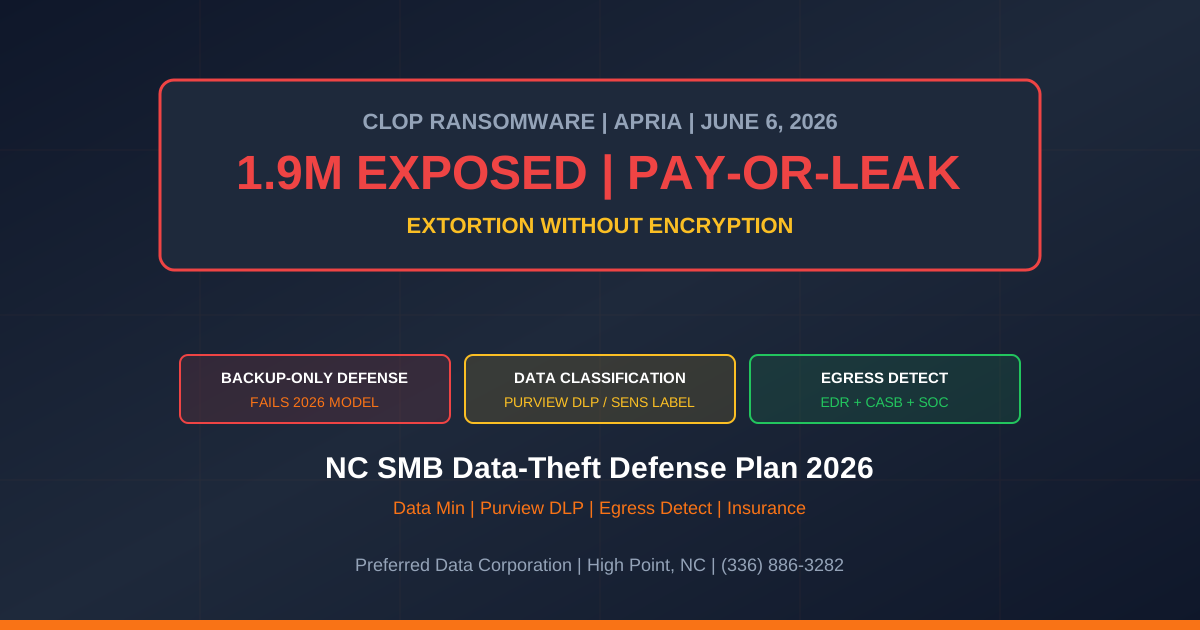
TL;DR: Per tech.co's 2026 data breach tracker, Apria Healthcare disclosed in June 2026 that the personal data of nearly 1.9 million customers may have been exposed in a data breach, with the Clop ransomware group claiming responsibility for the June 6, 2026 attack. The Apria event - combined with the May 2026 ShinyHunters extortion campaign against Charter Communications - confirms the 2026 shift away from encryption-only ransomware toward data-theft-and-extortion as the dominant model. NC SMBs that built a backup-only defense in 2024 are unprepared for the 2026 attacker model where the leverage is the leaked data, not the locked filesystem.
Key takeaway: A perfect backup recovery does not stop a data-theft extortion. The 2026 attacker model is "we already have your data; pay to keep it private." NC SMBs need exfiltration detection, data loss prevention (DLP), data minimization, and cyber-insurance language that covers extortion - not just backup integrity. The backup tier protects uptime; the DLP tier protects revenue and reputation.
Need a 2026 data-theft defense layered on top of an existing backup? Preferred Data Corporation runs managed cybersecurity, DLP, and exfiltration detection for NC small businesses since 1987. Call (336) 886-3282 or request a data-theft posture review.
What happened with the Apria Healthcare breach in June 2026?
Per tech.co, Apria Healthcare (a US healthcare company providing home healthcare equipment and services) informed almost 1.9 million customers in June 2026 that their personal data may have been exposed during a data breach. The Russian ransomware group Clop claimed responsibility for the June 6, 2026 attack. The disclosed data set includes:
- Customer personal information (names, addresses, dates of birth, Social Security numbers).
- Healthcare service records and medical equipment delivery details.
- Insurance and payment information.
The Clop group's claim is part of a broader 2026 pattern. Per Total Assure's 2026 reporting, Clop and other 2026-era extortion groups have moved from "encrypt and ransom" to "exfiltrate and extort" - faster, cheaper, and harder for victims to contain because there is no decryption key to recover.
Why is "data theft" replacing "encryption" as the dominant ransomware model in 2026?
Three reasons, well documented across Verizon's 2026 DBIR, BlackFog's 2026 State of Ransomware, and the VikingCloud 2026 Ransomware Trends:
| 2026 Reality | Why It Favors Data Theft Over Encryption |
|---|---|
| Backups are getting better | Immutable repositories defeat encryption-only attacks |
| Defenders are blocking encryption faster | EDR catches encryption at scale; exfiltration is quieter |
| Regulatory pressure on data | Leaked PII / PHI = SEC, HIPAA, state AG action |
| Cyber insurance covers backup recovery | But coverage gaps exist on extortion payouts |
| Brand and customer trust = bigger lever | Public leak = customer churn + regulator fines |
Per BlackFog's 2026 report, some ransomware groups have publicly stated they no longer bother with encryption when the exfiltration leverage alone produces a higher payout with less operational overhead.
Why is this dangerous for NC small businesses?
Because the backup-only defense most NC SMBs invested in during 2023 - 2024 does not stop the 2026 attacker model. Three concrete implications for an NC manufacturer, distributor, or small medical practice:
- A perfect restore does not unwind the leak. Even with a clean recovery in 4 hours, the attacker still has the customer list, the engineering drawings, the patient records, or the financial data. The extortion leverage is intact.
- NC AG and federal breach notification trigger faster. Per the NC Identity Theft Protection Act, exfiltration-based breaches trigger NC AG notification obligations and consumer notice within tight timelines.
- Customer attestation programs fail. Large NC retail customers, large distributors, and federal-prime customers running supplier cybersecurity questionnaires increasingly require data-loss-prevention evidence. A 2026 NC SMB without DLP cannot honestly answer the questionnaire.
Quotable definition: Data-theft extortion is the 2026 attacker model where the leverage comes from threatening to publish stolen data rather than from withholding a decryption key. An NC SMB defending against 2024-era encryption ransomware is fighting last year's war; the 2026 stack must add exfiltration detection, DLP, and data minimization to backup-tier defense.
What is the NC SMB data-theft defense stack for 2026?
A six-layer stack, per CISA's Cybersecurity Performance Goals 2.0, NIST Special Publication 800-171r3, and Microsoft Purview DLP guidance:
- Data minimization (the cheapest layer). Reduce the data set at risk. Purge customer records past retention, archive cold data to a separate tier, and stop storing what you do not need. Attackers cannot steal what you do not have.
- Data classification and sensitivity labels. Microsoft Purview sensitivity labels on M365, SharePoint, and OneDrive. Per Microsoft Purview documentation, classification is the prerequisite to DLP policy enforcement.
- Endpoint and cloud DLP. Microsoft Purview DLP (M365 E5 / Compliance Add-on), or equivalent. Per Microsoft's Endpoint DLP, policy-based blocks on copy-to-USB, upload-to-personal-cloud, and email-outside-organization.
- Egress monitoring. Firewall, CASB, or EDR-driven detection of high-volume outbound transfers, unusual cloud destinations, and after-hours data movement. Per Verizon 2026 DBIR, exfiltration detection lags initial access by weeks for most SMBs.
- Identity hardening (still required). FIDO2 / passkeys, conditional access, OAuth grant review. Per Microsoft Entra ID best practices, the identity layer is where most exfiltration paths start.
- Cyber insurance with extortion coverage. Per the 2026 SMB cyber-insurance underwriting guidance, confirm with the broker that the policy covers extortion-only events (no encryption required) and that the sub-limit matches the actual exposure.
What should an NC SMB do in the next 60 days?
A four-step plan to stand up the 2026 data-theft defense layer:
- Run a data inventory (week 1 - 2). Identify where customer PII, PHI, engineering IP, financial data, and customer lists actually live. M365, SharePoint, file servers, ERP, and SaaS tenants. The inventory is the document every later step depends on.
- Implement data classification and minimization (weeks 3 - 6). Microsoft Purview sensitivity labels on the top-priority data sets, retention policy enforcement, and a documented purge of data past retention.
- Deploy DLP and egress monitoring (weeks 6 - 10). Microsoft Purview DLP on M365 endpoints and SharePoint, plus EDR / firewall rules for outbound volume anomaly detection. The combination catches the exfiltration before the extortion.
- Update the incident runbook and cyber insurance (weeks 10 - 12). Add data-theft extortion scenarios to the tabletop, confirm cyber-insurance extortion sub-limits with the broker, and document the data-classification evidence for customer attestation questionnaires.
Key takeaway: The 2026 data-theft defense is a stack on top of the 2024 backup tier, not a replacement. NC SMBs that already have immutable backups must add DLP, data classification, and exfiltration detection to defend against the Clop / ShinyHunters-style extortion model. The backup tier protects uptime; the data tier protects the business itself.
How does Preferred Data Corporation help NC SMBs defend against 2026 data-theft extortion?
PDC has run managed IT and cybersecurity for NC small businesses since 1987 with 20+ year average client retention. We bring three things to the 2026 data-theft defense:
- Managed cybersecurity services: Managed Microsoft Defender for Business, M365 / Entra ID identity hardening, Microsoft Purview DLP deployment, EDR-driven egress anomaly detection, and 24/7 SOC monitoring through partnered providers.
- Managed IT services: Data inventory and classification rollout, retention policy enforcement, RMM-driven patching, and quarterly business reviews tied to customer attestation requirements.
- Backup and recovery + Cloud Solutions: Immutable backup tier preserved for the encryption-resilience story, plus cloud-native DLP and CASB integration for the SaaS data-theft story.
For NC manufacturers in High Point and the Piedmont Triad, NC distributors in Greensboro and Winston-Salem, and NC professional services firms and small medical practices in Charlotte and Raleigh, the June 6, 2026 Apria event is a free preview of what an NC SMB extortion event looks like - without encryption, without a decryption key, with a customer-list leak as the leverage. The work this quarter decides whether your 2026 attacker model is a backup recovery (cheap, fast) or a public extortion (expensive, slow, brand-damaging).
Need a 2026 data-theft defense layered on top of existing backup? Call (336) 886-3282 or book a data-theft posture review.
Frequently Asked Questions
What happened in the Apria Healthcare June 6, 2026 breach?
Per tech.co's 2026 data breach tracker, Apria Healthcare disclosed that the personal data of nearly 1.9 million customers may have been exposed in a data breach. The Clop ransomware group claimed responsibility for the June 6, 2026 attack, continuing its 2026 pattern of targeting healthcare and large-data-set organizations for exfiltration-and-extortion campaigns.
Why is data theft replacing encryption in 2026 ransomware?
Three reasons. Per BlackFog's 2026 State of Ransomware and Verizon's 2026 DBIR: defenders are blocking encryption attacks faster, immutable backups defeat encryption-only attacks, and the regulatory and reputational leverage from leaked data has grown. Some groups have publicly stated they no longer bother encrypting because exfiltration alone produces higher payouts.
Does an immutable backup defend against the 2026 data-theft model?
No. An immutable backup is the right defense for the encryption tier - it ensures the business can restore without paying. It does nothing about exfiltrated data. A 2026 NC SMB needs both: immutable backup for uptime resilience, and data classification + DLP + exfiltration detection for data-leak resilience.
What is Microsoft Purview DLP and is it appropriate for NC SMBs?
Microsoft Purview Data Loss Prevention is a policy-based engine that blocks or alerts on sensitive data movement across M365 endpoints, SharePoint, OneDrive, Teams, and Exchange. It is appropriate for NC SMBs that already use M365 with Business Premium, E3, or E5 / Compliance Add-on. PDC deploys Purview DLP for NC SMB clients as part of the managed cybersecurity stack.
Does cyber insurance cover extortion-only events?
It depends on the policy. Per the 2026 SMB cyber-insurance underwriting guidance, many 2023 - 2024 policies were written around encryption-based ransomware scenarios. NC SMBs renewing in 2026 should confirm with the broker that the policy explicitly covers extortion without encryption, includes a stated extortion sub-limit, and includes breach counsel for state and federal notification.
How fast can an NC SMB stand up a 2026 data-theft defense?
60 - 90 days for the core stack. Data inventory and classification take 4 - 6 weeks, DLP and egress monitoring deployment takes another 4 - 6 weeks, and updated incident runbook / insurance review closes out the program. Total monthly managed cost typically runs $5,000 - $14,000 for a 25 - 100 employee NC SMB - well below the $254K median 2026 SMB breach cost and the typical extortion demand range.
Related Resources
- Managed Cybersecurity Services for NC Businesses - DLP, identity, EDR, 24/7 SOC
- Managed IT Services for NC Businesses - Data inventory, classification, runbooks
- Backup and Recovery Services - Immutable repositories paired with DLP
- Cloud Solutions for NC SMBs - CASB, M365 hardening
- NYC Health + Hospitals 3-Month Dwell-Time Breach - Companion detection story
- Contact Preferred Data Corporation - Data-theft posture review