
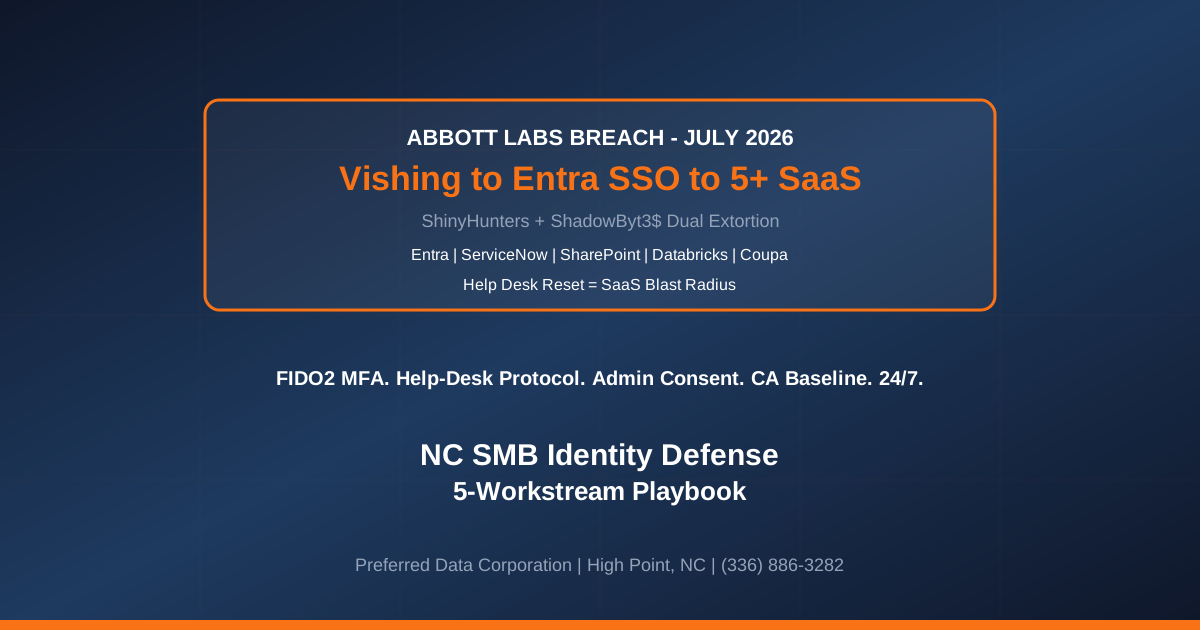
TL;DR: Abbott Laboratories is investigating two overlapping cyber incidents in July 2026, with the ShinyHunters extortion group claiming to have accessed data via a vishing (voice phishing) campaign targeting Abbott employees in mid-June, compromising a corporate Microsoft Entra ID single sign-on (SSO) account, and using it to exfiltrate data from Microsoft Entra, ServiceNow, SharePoint, Databricks, and Coupa. A second actor, ShadowByt3$, has separately claimed compromise of Abbott's Exact Sciences Cancer Diagnostics systems and LabCentral portal. The ShinyHunters extortion clock initially expired July 18 and was extended to July 21; as of July 20, the data has not been publicly leaked. The attack pattern — vishing → SSO → SaaS lateral exfiltration — is now the modal breach chain for identity-first organizations. For any NC SMB running Microsoft 365 with Entra ID SSO federating to five-plus SaaS platforms, this is your attack model.
Key takeaway: Every NC SMB running Microsoft 365 with Entra ID SSO now faces two structurally similar problems. First, the help desk is a first-class attack surface — attackers vish reset requests to reset MFA and take over accounts. Second, once inside a single privileged Entra account, SaaS federation is the exfiltration multiplier. Defense priorities: (1) phishing-resistant MFA (FIDO2/passkeys), (2) written help-desk verification protocol, (3) admin-consent workflow, (4) conditional-access baseline, (5) 24/7 identity monitoring.
Need a two-week identity security assessment and help-desk protocol build? Contact Preferred Data Corporation at (336) 886-3282 for a two-week identity readiness review. BBB A+ rated, serving High Point, Greensboro, Winston-Salem, Charlotte, Raleigh, and the Piedmont Triad since 1987.
What Exactly Happened at Abbott in July 2026?
Two overlapping incidents, one attack pattern, and a third-party breach echo — all disclosed in the third and fourth weeks of July 2026.
- ShinyHunters intrusion — vishing → Entra SSO → multi-SaaS exfil. Per ShinyHunters' own statement to BleepingComputer, the crew targeted several Abbott employees via voice-phishing calls in mid-June 2026, socially engineered an Entra ID SSO account takeover, and pivoted through that account to exfiltrate data from Microsoft Entra, ServiceNow, SharePoint, Databricks, and Coupa. Documents allegedly include internal contracts, customer information, and business records.
- ShadowByt3$ intrusion — Exact Sciences legacy systems and LabCentral portal. Per DataBreaches.Net's coverage, a second actor separately claims to have compromised legacy Exact Sciences systems in Abbott's Cancer Diagnostics business and the LabCentral portal.
- Extortion timeline. ShinyHunters initially set a July 18 leak deadline, extended it to July 21. As of July 20, no data has been publicly leaked, suggesting either active negotiation or extended pressure tactics.
Two separate actors hitting the same target in the same window is not coincidence — it is a signal that Abbott's exposure was known and traded across criminal marketplaces. The same pattern hit MGM Resorts, Caesars, and multiple healthcare organizations in the 2023-2025 vishing-first Scattered Spider / ShinyHunters wave.
Why Does the Vishing → Entra → Multi-SaaS Chain Matter Most for NC SMBs?
Because it is the exact model most modern NC SMBs deploy — and defend poorly.
The typical NC SMB in 2026 runs Microsoft 365 with Entra ID as the identity provider, federates single-sign-on into five to fifteen SaaS platforms (finance/ERP, CRM, HR/payroll, project management, expense/AP, ticketing, engineering tools, marketing automation, and industry-specific systems), and staffs a thin internal help desk — one to three people, or an outsourced-MSP help desk that handles a broad book of clients.
Every one of these design choices is defensible on its own. The composite attack surface is not. The Abbott pattern maps directly onto the SMB stack:
- Vishing pretext. Attacker calls the help desk, posing as an employee locked out of their account, and requests an MFA reset. Modern voice-clone AI (see Polygraf AI's July 2026 Meeting Guard launch) makes the pretext trivially convincing.
- MFA reset without callback verification. Help desk resets the MFA method — often to a new SMS number or app the attacker controls — and now the attacker owns the account.
- Entra SSO federation as blast-radius multiplier. Once inside Entra, the account inherits SSO into every federated SaaS app. Instead of one system compromised, ten are.
- SaaS-side data exfiltration. Attackers use legitimate SaaS APIs (Graph API for Microsoft, ServiceNow's REST API, Databricks workspace exports, Coupa's supplier and payment data endpoints) to bulk-exfiltrate. From the SaaS provider's perspective, it looks like normal usage from an authenticated user.
The Abbott attack differs from the Salesloft/Drift OAuth-token supply-chain breach and the July 16 ShinyHunters Salesforce OAuth abuse campaign in one important way: it does not depend on any SaaS-side integration flaw. The vulnerability is entirely inside the customer's identity plane. Every NC SMB owns 100% of this attack surface.
Which NC SMB Industries Are Most Exposed?
Five verticals concentrate the risk.
- Regional healthcare, medical practices, dental groups, and behavioral-health practices. SaaS-heavy stacks (Athenahealth, Nextech, Epic MyChart, DentalXchange, TheraNest), thin help desks, high PII/PHI stakes.
- Family-owned manufacturers and distributors in the Piedmont Triad. ERP-plus-SaaS combinations (Sage/Epicor/NetSuite + Salesforce + Coupa/Concur + engineering CAD/PLM) with federation into Entra.
- Law firms, CPA firms, and financial-services offices across Raleigh, Charlotte, and Greensboro. Client-data blast radius plus regulated confidentiality; iManage, NetDocuments, CCH Axcess, Practice CS, and industry systems federated into Entra.
- Engineering consultancies, architecture/AEC firms, and construction GC/subcontractors. Autodesk Construction Cloud, Procore, Bluebeam, Sage 300 CRE, Foundation Software, and Coupa/BillTrust federated into Entra.
- Nonprofits, community colleges, and municipal agencies. Small IT teams, high public accountability, Blackbaud/Raiser's Edge/NC-SecureGovt integrations federated into Entra.
If your NC SMB matches any of these profiles and has not documented a written help-desk verification protocol, the Abbott pattern is your organization's attack chain until proven otherwise.
How Does the Abbott Attack Chain Compare to the 2023-2026 Vishing → SaaS Wave?
The following comparison shows the maturation of the identity-first breach chain since MGM/Caesars in 2023.
| Incident | Year | Pretext | Identity Compromise | SaaS Blast Radius | Extortion Model |
|---|---|---|---|---|---|
| MGM Resorts | 2023 | Vishing IT help desk | Okta SSO admin | ~1 dozen SaaS apps | Ransomware + data theft |
| Caesars Entertainment | 2023 | Vishing IT help desk | Okta SSO admin | Broad enterprise SaaS | Ransom paid ($15M) |
| Scattered LAPSUS$ campaign | 2024-2025 | Vishing + MFA fatigue | Entra ID, Okta admin | Salesforce, ServiceNow, Snowflake | Data-theft-only extortion |
| Salesloft-Drift OAuth breach | 2025 | Third-party OAuth token abuse | N/A (OAuth) | ~1,000+ customer orgs | Data-theft extortion |
| ShinyHunters Salesforce campaign | 2026 (Jul) | Consent phishing (fake Data Loader) | Salesforce admin | 200+ tenants (Google, Chanel, Pandora) | Data-theft extortion |
| Abbott Labs | 2026 (Jul) | Vishing → Entra SSO | Entra ID user + admin | 5+ SaaS (Entra, ServiceNow, SP, Databricks, Coupa) | Dual extortion (ShinyHunters + ShadowByt3$) |
Three patterns are consolidating. First, vishing plus SSO is now the default attack chain for identity-first organizations. Second, the SaaS blast radius per compromise is growing as federation deepens. Third, dual-extortion (two independent actors) is a rising 2026 phenomenon that further compresses response timelines.
What Should NC SMBs Do This Week to Defend Against the Abbott Pattern?
Five parallel workstreams. Each has a two-to-four-week implementation timeline and is achievable inside a standard managed-IT retainer.
- Deploy phishing-resistant MFA (FIDO2 / passkeys) on all privileged accounts. SMS, push, and TOTP are all vulnerable to vishing-plus-MFA-fatigue. FIDO2 hardware keys and platform passkeys (Windows Hello, macOS Touch ID, iOS/Android passkeys) are the phishing-resistant baseline. Priority order: (a) global admins, (b) privileged role holders, (c) executives, (d) finance/AP, (e) rest of workforce.
- Write and enforce a help-desk verification protocol. Every MFA reset, password reset, or account-lockout call must require: (a) call-back to a known phone number on file (not a number the caller provides), (b) verification of at least two out-of-band data points (employee ID plus manager name, prior device fingerprint, or badge photo confirmation), and (c) a logged ticket. No exceptions for executives, for "urgent" requests, or for calls from "IT."
- Enable admin-consent workflow and disable user consent to unverified apps. In Entra ID, turn off user consent to apps for all users; require admin approval for any OAuth grant. Review existing OAuth-granted apps quarterly. See Microsoft's admin consent workflow documentation.
- Deploy a conditional-access baseline. Require managed devices for admin-privileged access, block legacy authentication protocols, require MFA on every sign-in from an unfamiliar network, and enforce risk-based conditional access using Entra Identity Protection. Reference: Microsoft's conditional-access baseline templates.
- Add 24/7 identity monitoring with alerting on the Abbott chain. Specifically alert on: (a) MFA method changes on privileged accounts, (b) sign-ins from anonymizing IPs (Tor, commercial VPN), (c) bulk data exports from ServiceNow, SharePoint, Databricks, and Coupa within short time windows of an MFA change, (d) new OAuth consent grants on privileged accounts, (e) new inbox rules on executive mailboxes (attacker persistence mechanism).
What Are the Cyber Insurance, HIPAA, and NC ITPA Consequences?
Three intersections matter for NC SMBs.
- Cyber insurance renewals. The 2026 renewal cycle requires attestation on: (a) phishing-resistant MFA on privileged accounts, (b) written help-desk verification protocol, (c) admin-consent workflow, (d) documented incident-response plan. Missing any of these becomes a material factor in claim disputes and renewal pricing.
- HIPAA (for medical practices, dental groups, behavioral health). Business-associate agreements and the HIPAA Security Rule require reasonable and appropriate safeguards for ePHI. An Entra SSO takeover that exposes patient-facing systems is a reportable breach under HHS OCR reporting rules, with a 60-day maximum notification window.
- NC ITPA (all NC SMBs). N.C.G.S. § 75-65 requires notice to affected NC residents when personal information is compromised. An Entra SSO takeover that lets an attacker exfiltrate employee, customer, or vendor PII from federated SaaS almost certainly triggers the threshold.
The pragmatic path for the next 90 days: run a two-week identity assessment against the five workstreams above, close the top-two gaps in the next 30 days, and document the closure in your cyber-insurance evidence packet before Q4 renewals.
Ready for a two-week identity security assessment and help-desk protocol build for your NC business? Contact Preferred Data Corporation at (336) 886-3282. BBB A+ rated, serving the Piedmont Triad since 1987.
Frequently Asked Questions
What is vishing and how is it different from phishing?
Vishing is voice phishing — a social-engineering attack delivered by phone call rather than email or SMS. Modern vishing uses public data (LinkedIn, company sites, breach dumps) plus voice-clone AI to impersonate specific employees or executives. The Abbott case reportedly used voice-phishing calls to Abbott employees; the same pattern has hit MGM Resorts, Caesars, and multiple healthcare organizations.
How much does phishing-resistant MFA cost for a 50-person NC SMB?
Roughly $1,000-$2,000 in hardware (FIDO2 security keys at $25-$50 per user, with backup keys), plus $0-$10 per user per month depending on whether you use Entra ID P1/P2 licensing or Google Workspace equivalent (both include FIDO2/passkey support). PDC's usual guidance is 2-3 hardware keys per privileged user (primary, backup at home, backup in office) and passkeys for the rest of the workforce.
What are the specific SaaS platforms most vulnerable to the Abbott chain?
Any SaaS with SSO federation into your Entra ID (or Okta, or Google Workspace) and bulk export or API access — which is most of them. The Abbott chain specifically named Microsoft Entra, ServiceNow, SharePoint, Databricks, and Coupa. NC SMB equivalents include Salesforce, HubSpot, NetSuite, Sage Intacct, Concur, Bill.com, iManage, NetDocuments, Autodesk Construction Cloud, Procore, and Athenahealth, among others.
What's the difference between the Abbott chain and the Salesloft-Drift chain?
The Abbott chain is a customer-side identity compromise — the attacker took over a user account through vishing. The Salesloft-Drift chain was a third-party OAuth-token supply-chain compromise — the attacker breached Salesloft's Drift chatbot service, harvested the OAuth tokens Drift held for its customer tenants, and used those tokens directly. Both end in SaaS data exfiltration, but the defenses are different: the Abbott chain is defeated by phishing-resistant MFA + help-desk protocol; the Salesloft-Drift chain requires OAuth-token inventory, admin-consent governance, and third-party risk management.
How long does it take to build a help-desk verification protocol?
Roughly 2-4 weeks from decision to enforcement. Week 1: draft the protocol (call-back to known number, two data-point verification, logged ticket). Week 2: pilot with a limited user group and refine. Week 3: train the full help-desk team and roll to production. Week 4: tabletop-test the protocol with an internal vishing exercise. PDC can run the full protocol build as part of a two-week identity assessment.
Does 24/7 monitoring actually catch the Abbott chain?
Yes, if the specific detections are wired. The five detections in the workstream list above (MFA method changes, anonymizing-IP sign-ins, bulk SaaS exports post-MFA change, new OAuth grants, new inbox rules) collectively cover 80%+ of the Abbott chain. PDC's managed-IT clients get these detections wired as standard.
Related Resources
- Abbott Laboratories dual-extortion coverage — BleepingComputer
- Abbott Labs dual-actor breach — Cybernews
- Preferred Data Cybersecurity Services
- Preferred Data Managed IT Services
- Preferred Data Cloud Solutions
- Related: ShinyHunters Salesforce OAuth Abuse — NC SMB SaaS Identity Defense
- Related: Deepfake CFO Meeting Fraud — NC SMB Finance-Approval Defense